
Tiger-Vac EXP1-15 (TC) RE HEPA
Single-phase TEFC ATEX combined vacuum for Zone 1 gas + Zone 21 dust -- 38 L dry / 47.3 L wet, Tilt Cart (TC) for easy emptying, EN 17348 DT/LC for non-flammable liquids, ISO Class 4 cleanroom compatible
- Pharmaceutical cleaning with combined dry dust and water-based detergent
- Laboratories where tilt cart makes emptying fast and ergonomic
- ISO Class 4 cleanrooms with external Zone 21
- Chemical QC and pilot lines with non-flammable liquids
- Biotech production with coating residues and water-based cleaning
- ATEX Directive 2014/34/EU -- II 2GD Ex d IIA T3 Gb / Ex t IIIC T200°C Db IP6X -- LCIE 03 ATEX 6297 -- EN 17348 DT/LC
- EN 17348:2022 (harmonized March 2023)
- IEC 60335-2-69 (industrial vacuums)
Tiger-Vac EXP1-15 (TC) RE HEPA
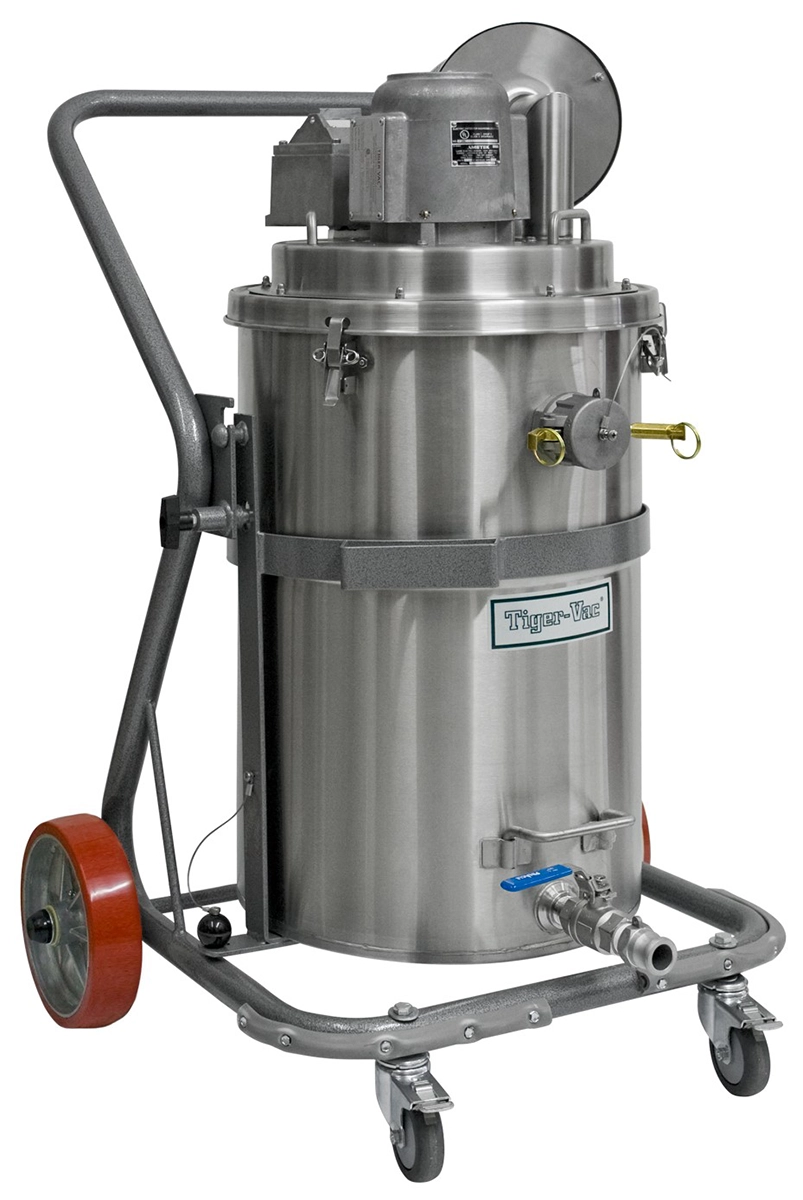
The Tiger-Vac EXP1-15 (TC) RE HEPA is the smaller-sized version of the TC series -- a dual-certified ATEX combined vacuum (II 2GD, EN 17348 DT/LC) for simultaneous dry and wet recovery of combustible dust and non-flammable liquids. The Tilt Cart (TC) construction provides a distinctive base where the entire collection tank can be tilted for disposal, a significant advantage in pharma where the operator should not lift the tank. 38 litre dry capacity / 47.3 litre wet, 1.0 kW TEFC motor delivering 224 m3/h and 1550 mmH2O. HEPA/ULPA filter surface 6,500 cm2 and main cloth filter 3,480 cm2. AISI 304 stainless construction, ISO Class 4 cleanroom compatible.
Applications
- Pharmaceutical cleaning with combined dry dust and water-based detergent
- Laboratories where tilt cart makes emptying fast and ergonomic
- ISO Class 4 cleanrooms with external Zone 21
- Chemical QC and pilot lines with non-flammable liquids
- Biotech production with coating residues and water-based cleaning
Technical specifications
| ATEX marking | II 2GD Ex d IIA T3 Gb / Ex t IIIC T200°C Db IP6X -- LCIE 03 ATEX 6297 -- EN 17348 DT/LC |
|---|---|
| Internal / external zone | -- / 21 |
| Motor type | 1-faset TEFC-motor, eksplosionssikret (Ex d IIA T3 Gb / Ex t IIIC T200°C Db), 1.0 kW / 4.5 A |
| Duty cycle | Continuous |
| Airflow | 224 m³/h |
| Vacuum | 152 mbar (1550 mmH₂O) |
| Container | 38 L |
| Sound pressure | 78 dB(A) |
| Filter class | H class |
| Filter type | HEPA H14 (EN 1822-5, 99,995 % @ 0,3 µm MPPS), 211027B -- ULPA tilvalg |
| Primary filter | Main filter assembly SD (211013) + forfilter (212008) + liquid filter assembly SD (211010). HEPA/ULPA flade 6.500 cm2, main cloth flade 3.480 cm2. |
| Cleaning system | Ingen (manuel) -- filter skiftes eller bankes rent |
| Collection system | Detachable container |
| Material | AISI 304 rustfri stål (undtagen vogn) |
| IP class | IP6X |
| Power | 1.0 kW |
| Current | 4.5 A |
| Voltage | 230 V / 50 Hz / 1~ |
| Inlet | Ø 38 mm |
| Dimensions (L × W × H) | 790 x 690 x 990 mm |
| Weight | 47 kg |
Questions and answers
What is a Tilt Cart and why is it important?
A Tilt Cart (TC) is a base where the entire collection tank is mounted on a tipping mechanism -- the operator releases a latch and the tank tips forward, so dust or liquid can be emptied directly into a waste container without lifting the tank. For a 38 L dust-filled tank or 47.3 L liquid-filled unit, this is a real ergonomic advantage: a full 47 L liquid tank weighs about 50 kg and is not practical to lift alone. In pharma and cleanrooms, TC is also a hygiene advantage because no components need to be opened or removed from the unit during emptying.
Why a 38 mm inlet instead of 50 mm?
The EXP1-15/25 (TC) has a 38 mm (1.5") inlet, while larger TC units such as the EXP1-55 (TC) have 50 mm. 38 mm fits the 1.5" static-dissipative accessory kit that is standard on the EXP1 range (Kanaflex hose 381400A, universal tool 381236 etc.), and it provides sufficient flow for most pharma and laboratory work. 50 mm is typically chosen for high-volume recovery or process extraction where larger volume per unit time matters. For 38 and 56 L tanks, 38 mm is well-dimensioned.
What does EN 17348 DT/LC mean?
EN 17348 DT/LC is the harmonised standard for vacuums in explosive atmospheres, specifically combined dust recovery (DT = Dust Collection) AND non-flammable liquid recovery (LC = Liquid Collection, non-flammable). The test method validates that the unit can handle both media safely within the ATEX framework. Flammable liquids (flash point below 60 °C) are NOT covered -- they require a higher certificate class (typically II 2GD with specifically tested chemical resistance and liquid class). The standard has been harmonised in the EU since March 2023.
Can I use ULPA on this model?
Yes. HEPA/ULPA filter surface is specified at 6,500 cm2, meaning the filter housing is dimensioned to accommodate either a HEPA H14 (standard) or a ULPA upgrade (U15-U17). ULPA filters are more expensive (about 3-5x price) and have shorter service life, but deliver 99.9995+ % efficiency where required -- typically in high-potency API production or cleanroom classes ISO 3/2.
How does the EXP1-15 differ from the EXP1-25 (TC)?
Only the tank size: 38 L dry / 47.3 L wet on the EXP1-15 vs 56.8 L dry / 64.4 L wet on the EXP1-25. Everything else is identical -- motor, flow, vacuum, filter, tilt cart, inlet, sound level. Choice depends on how much you need to collect per emptying. The EXP1-15 is slightly lower (99 cm vs 109 cm) which can matter under lab benches or cleanroom doors. Price difference is about 10-15 %.
What happens if I accidentally vacuum a flammable liquid?
Stop operation immediately. Flammable liquids (flash point below 60 °C -- alcohols, acetone, toluene, benzene, etc.) are not covered by the EN 17348 DT/LC certification and can pose a real explosion risk even in an ATEX-marked machine. Procedure: stop suction, ventilate the area, ground the unit and mark it, and contact Particulair before restarting. Never resume operation before the situation is assessed. For flammable liquid tasks, choose an ATEX unit specifically certified for the liquid class -- e.g. pneumatic models (Delfin 802 WD AIREX) which eliminate electrical ignition risk entirely.