
Depureco BL 45 DEX 1/2D INERT
Reactive metal powder in Zone 20/21 -- BL 45 INERT with N2-flushed container, brushless T140°C motor, Da/Db certification, 45 L, single-phase
- Battery blending station where lithium-bearing electrode powder is continuously in the air
- Aluminium grinding cabinet with process operation and closed work environment
- Pharma pilot powder handling with Zone 20 classified surface
- Titanium powder storage where explosivity-testing research requires inerting
- 3D-print cleaning room with continuous powder exposure (Zone 20) and dust clouds outside
- Magnesium foundry with moisture control and active collection of reactive material
- ATEX Directive 2014/34/EU -- II 1/2D Ex h IIIC T140°C Da/Db
- EN 17348:2022 (harmonized March 2023)
- IEC 60335-2-69 (industrial vacuums)
Depureco BL 45 DEX 1/2D INERT
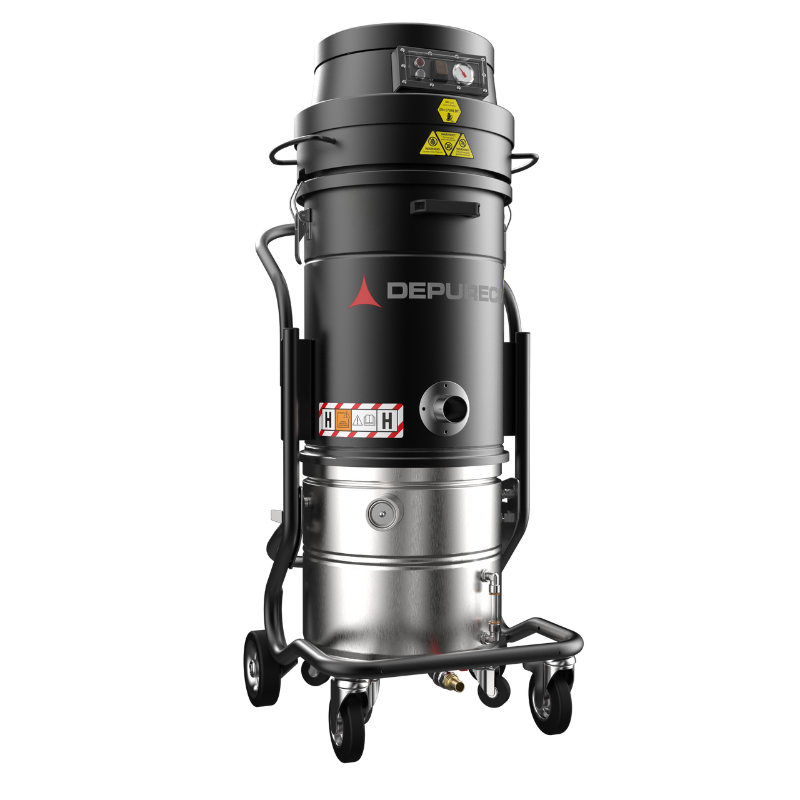
The BL 45 DEX 1/2D INERT is the same physical unit as the BL 45 DEX 1/3D INERT (SKU A1295) -- it simply bears the ATEX marking II 1/2D Ex h IIIC T140°C Da/Db on this slug, which gives it access to stricter zone combinations: internal Zone 20 (continuous reactive dust atmosphere) and external Zone 21 (dust clouds occur occasionally). It is the choice when the collection chamber itself is located in a room where powder is continuously in the air -- e.g. battery material blending stations, aluminium grinding cabinets with constant process operation or lithium powder handling in pharma pilot production. The inerting container, safety hydrogen vent, spark-trap and cartridge HEPA13 filter are identical to the 1/3D slug; the difference lies in the installation's zone classification here requiring EPL Da internal (highest requirement) and EPL Db external. Same price (4,280 €), same documentation, same 1.1 kW brushless motor on 110/230V single-phase.
Applications
- Battery blending station where lithium-bearing electrode powder is continuously in the air
- Aluminium grinding cabinet with process operation and closed work environment
- Pharma pilot powder handling with Zone 20 classified surface
- Titanium powder storage where explosivity-testing research requires inerting
- 3D-print cleaning room with continuous powder exposure (Zone 20) and dust clouds outside
- Magnesium foundry with moisture control and active collection of reactive material
Technical specifications
| ATEX marking | II 1/2D Ex h IIIC T140°C Da/Db |
|---|---|
| Internal / external zone | 20 / 21 |
| Motor type | 1x brushless ATEX motor, single-phase 110/230V 50/60 Hz |
| Duty cycle | Periodic |
| Airflow | 220 m³/h |
| Vacuum | 230 mbar (2345 mmH₂O) |
| Container | 45 L |
| Sound pressure | 72 dB(A) |
| Filter class | H class |
| Filter type | Primary cartridge filter, antistatic polyester HEPA13 (EN 60335-2-69 class H) + E10 cooling air + E10 absolute filter exhaust |
| Primary filter | Antistatic polyester cartridge, class HEPA13 |
| Cleaning system | Manuel filterrens (bagudtryk) |
| Collection system | Detachable container + INERT neutralisation bath |
| Material | Painted steel construction, AISI 304 dust container with N2-fluxed inerting insert |
| Power | 1.1 kW |
| Voltage | 230 V / 50-60 Hz |
| Venturi units | 0 pcs |
| Inlet | Ø 50 mm |
| Dimensions (L × W × H) | 550 x 620 x 1400 mm |
| Weight | 50 kg |
Questions and answers
Why would I need the 1/2D variant rather than 1/3D?
It depends entirely on your installation's zone classification. 1/2D is required when the internal chamber (where powder is collected) is in Zone 20 -- i.e. explosive dust atmosphere is continuously or long-term present. 1/3D is sufficient when both internal and external are Zone 22 (short-lived, infrequent dust cloud). In practical terms, 1/2D is the choice if your work process *produces* the powder (grinding, milling, blending), 1/3D is the choice if it is only *collected* after the process ends. Price and hardware are identical; only the zone documentation differs.
How much N2 does it use per shift?
The consumption estimate for an 8-hour shift under normal operation is 3.8-7.2 Nm³ nitrogen (i.e. 8-15 Nl/min continuously plus initial flushing at start). Expect around 5 Nm³ per shift for reactive aluminium collection at normal factory humidity. A 200 bar N2 bottle (50 L, 9.3 Nm³) lasts two shifts; a 300 bar fibre tank (50 L, 14 Nm³) lasts just under three. If your consumption exceeds 3 shifts daily, it is economical to consider a local N2 generator (PSA or membrane). We can help with sizing.
Can I mix powder types in the same container?
No. Reactive metal powders can react with each other -- e.g. aluminium + rust-bearing iron oxide can form a thermite reaction when rubbed together. Thermite is *self-sustaining* and cannot be extinguished. Similarly, lithium can react with copper carbonate or other transition-metal compounds. Rule of thumb: one powder type per collection cycle, empty and clean the container between shifts if the powder type changes. Our service package includes cross-contamination protocols for multi-production environments.
How do I empty the container safely?
Emptying must happen in an inerted environment -- either a glovebox with N2 atmosphere or a ventilated take-down station with continuous N2 flux. The BL 45's container is constructed so that it can be removed in closed form (sealed clamp-lock top) and transported to an external station for emptying. For manual emptying: (1) close N2 supply, (2) wait 2 minutes for pressure to equalise, (3) remove the container in closed state, (4) open only at the emptying station. Reactive powder must be handled by trained personnel with PPE (IIB-certified suit and full-face mask) per EN 14491 and the relevant SDS.
Can the BL 45 INERT be used in Zone 0 or Zone 1 gas?
No. The BL 45 INERT is classified solely under the ATEX dust directive (dust category 1/3D and 1/2D) -- it is not gas-certified. If your installation has Zone 0 or Zone 1 gas (continuous or frequent flammable gas atmosphere), you need a gas-certified unit. The BL 45 cannot be used in the presence of gas -- even in external Zone 2, it must be documented that the actual gas-tightness level does not exceed model data. Contact us for guidance if your installation has mixed gas and dust zoning.
Is there a maximum powder particle size?
The BL 45 INERT is optimised for powder in the 1-100 micrometre range (typical for grinding and mechanical-machining powder). Larger particles (flakes, chips, fragments > 500 μm) can lodge in the cartridge filter and quickly increase pressure drop. If your process produces coarser material, we recommend a pre-separator (cyclone) ahead of the BL 45. Conversely: very fine powder (nano-scale, < 1 μm) can pass through cartridge HEPA13 -- this requires an upgrade to an H14 absolute filter model. Check the powder's d50 particle distribution in the SDS or technical data sheet before ordering.