
Tiger-Vac C-10 EX (4W) STAINLESS STEEL ULPA BLSD
Single-phase BLSD ATEX II 1/3D ULPA U15 vacuum -- AISI 316 electropolished autoclavable tank, AISI 304 powerhead, ULPA filter (0.12 micron, 99.999 %), 19 L disposable bag, for pharma ISO 4 and high purity
- Pharma manufacturing in ISO 4 and ISO 5 cleanrooms with EU GMP Annex 1 requirements
- Pharmaceutical CMR substances (hormones, cytostatics, beta-lactam antibiotics)
- Sterile area in pharma industry and medical device cleanrooms
- Semiconductor and electronics fabs where 99.999 % particulate filtration is required
- Research and development in pharma pilot plants where cross-contamination must be minimised
- ATEX Directive 2014/34/EU -- II 1/3D Ex h tc IIIC T85 C Dc IP6X (External) -- Ex h IIIC T85 C Da (Internal) -- -5 C <= Ta <= +37 C -- EN 17348 DT -- LCIE 15 ATEX 3061 -- IECEx LCIE 15.0048
- EN 17348:2022 (harmonized March 2023)
- IEC 60335-2-69 (industrial vacuums)
Tiger-Vac C-10 EX (4W) STAINLESS STEEL ULPA BLSD
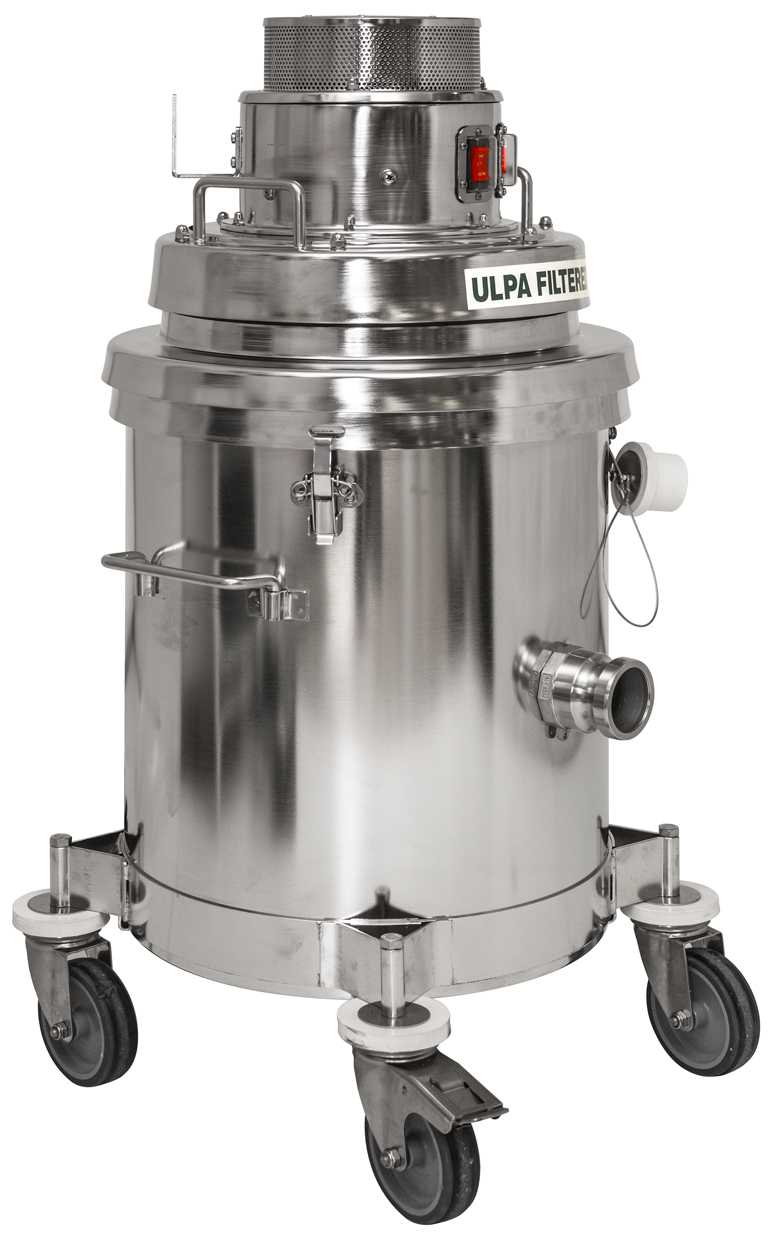
The Tiger-Vac C-10 EX (4W) STAINLESS STEEL ULPA BLSD is the high-purity variant of the C-10 EX platform -- specifically designed for pharma cleanrooms, ISO 4 and pharmaceutical manufacturing. The tank is AISI 316 electropolished and autoclavable, and the powerhead is AISI 304 (not autoclavable). The filter stack includes 2 ULPA U15 filters (one for the air path and one for the cooling air) plus HEPA H14 backup filtration -- combined 99.999 % filtration at 0.12 micron, which is the requirement ISO 14644-1 ISO 4 and pharma EU GMP Annex 1 set for particle control in cleanrooms. Marked II 1/3D BLSD with T85 C surface temperature and 75 dB(A) (slightly higher than the standard C-10 due to the extra ULPA resistance). 19 L disposable filter bag, 50 mm suction port, 4-wheel dolly. Tools include 323412 autoclavable floor tool, 323413 stainless crevice tool and 323564 silicone conical nozzle.
Applications
- Pharma manufacturing in ISO 4 and ISO 5 cleanrooms with EU GMP Annex 1 requirements
- Pharmaceutical CMR substances (hormones, cytostatics, beta-lactam antibiotics)
- Sterile area in pharma industry and medical device cleanrooms
- Semiconductor and electronics fabs where 99.999 % particulate filtration is required
- Research and development in pharma pilot plants where cross-contamination must be minimised
Technical specifications
| ATEX marking | II 1/3D Ex h tc IIIC T85 C Dc IP6X (External) -- Ex h IIIC T85 C Da (Internal) -- -5 C <= Ta <= +37 C -- EN 17348 DT -- LCIE 15 ATEX 3061 -- IECEx LCIE 15.0048 |
|---|---|
| Internal / external zone | 20 / 22 |
| Motor type | 1-faset brushless BLSD-motor (1100 W / 1,1 kW / 8 A) -- forlænget motor-levetid og lavere termisk overflade (T85 C) |
| Duty cycle | Periodic |
| Airflow | 216 m³/h |
| Vacuum | 220 mbar (2250 mmH₂O) |
| Container | 19 L |
| Sound pressure | 75 dB(A) |
| Filter class | H class |
| Filter type | ULPA U15 (EN 1822, 99,999 % 0,12 micron) -- 219372 x 2 (en til luft, en til køling) + HEPA H14 211854 + 212304B-HD som baggrund |
| Primary filter | Hovedfilter PTFE/Epitropic polyester SD* m/stainless steel bands (218627 eller 215393-SD afhængigt af model) |
| Cleaning system | Ingen aktivt rens-system |
| Collection system | Detachable container |
| Material | AISI 316 electropolished autoklaverbar tank + AISI 304 powerhead (ikke autoklaverbar) |
| IP class | IP6X |
| Power | 1.1 kW |
| Current | 8 A |
| Voltage | 220-240 V / 50-60 Hz / 1~ |
| Inlet | Ø 50 mm |
| Dimensions (L × W × H) | 480 x 460 x 880 mm |
| Weight | 30 kg |
Questions and answers
What does II 1/3D mean on this machine?
II 1/3D means category 1 internally and category 3 externally -- the highest protection level (Da) inside the collection tank and the lowest on the outer housing (Dc). In practice: the unit can recover from Zone 20 (dust continuously present) even though the powerhead itself sits in Zone 22 (dust rarely present). That is the typical ATEX housekeeping configuration in process production -- recovery happens at a hazardous point while the operator stays in the less hazardous area.
What is the benefit of the BLSD motor?
BLSD = Brushless. The model delivers 1100 W / 1.1 kW / 8 A and 216 m3/h at 2250 mmH2O. The brushless motor has no carbon brushes, which extends life by about 4-5x (typically 5000 hours versus 1000-1500 hours for a universal motor) and gives a lower surface temperature (T85 C vs T200 C). This also means lower dust-ignition risk and 3rd party certified EN 17348 DT compliance. Plus: no carbon dust from brushes in the internal air path.
What is the HEPA H14 setup on this model?
Every unit is supplied with 4 individually factory-tested HEPA H14 filters in the housing (212304B-HD as primary HEPA, 215372 and 211854 as tertiary). Total filter area is 20,253 cm2 -- about 2 m2. The class is H14 per EN 1822, equivalent to 99.995 % MPPS (Most Penetrating Particle Size). That is the requirement EN 17348 DT places on ATEX vacuums for combustible dust including asbestos, lead and pharma CMR substances.
Can it pick up liquids?
No. The entire C series is certified EN 17348 DT -- dry recovery only. For wet/dry recovery in Zone 20/22, a dedicated WD model must be used, such as the CD-63L EX (W&D) variants. For liquid recovery in ATEX Kombi zones (II 2GD), see the ATEX-12A (4W) or (2+2W).
How is the unit wired up?
The power outlet is not included -- it must be fitted by an electrician per local regulations (typically 16 A schuko or blue CEE in Europe). 220-240 V 50/60 Hz single-phase. The cord is 10.6 m. The ATEX marking covers the vacuum cleaner itself -- the outlet and supply must be ATEX-rated if the unit is supplied from inside Zone 22 (II 3D-rated outlet). Supply from a non-classified area places no requirement on the outlet itself.
What does ULPA U15 mean compared to HEPA H14?
ULPA U15 per EN 1822-5 has 99.999 % filtration at 0.12 micron (MPPS), which is about 10x better than HEPA H14 (99.995 % at 0.3 micron). In practice: ULPA U15 captures 1 in 100,000 particles at the largest slip-through size, while HEPA H14 captures 1 in 20,000. This extra filtration is required in ISO 4 cleanrooms and where MPS (Most Penetrating Substance) is almost as critical as mass concentration. For general ATEX housekeeping, HEPA H14 is fully adequate -- choose ULPA U15 only when the specific environment or contamination class demands it.