
Tiger-Vac C-55L EX DT HD CART (MFS) BLSD
Single-phase BLSD ATEX II 1/3D Detachable Tank with Heavy Duty Cart -- 55 L AISI 430 tank, MFS, 4 HEPA H14, for high collection volume and long shifts
- Process production with high collection volume where frequent tank emptying must be avoided
- Industrial facilities with continuous operation and long shifts
- Combustible dust in larger process rooms where 55 L is a good balance of mobility and capacity
- ATEX housekeeping in refineries and chemical industry where robust wheel construction matters
- Lithium and battery factories where the BLSD motor gives longer service intervals
- ATEX Directive 2014/34/EU -- II 1/3D Ex h tc IIIC T85 C Dc IP6X (External) -- Ex h IIIC T85 C Da (Internal) -- -5 C <= Ta <= +37 C -- EN 17348 DT -- LCIE 15 ATEX 3061 -- IECEx LCIE 15.0048
- EN 17348:2022 (harmonized March 2023)
- IEC 60335-2-69 (industrial vacuums)
Tiger-Vac C-55L EX DT HD CART (MFS) BLSD
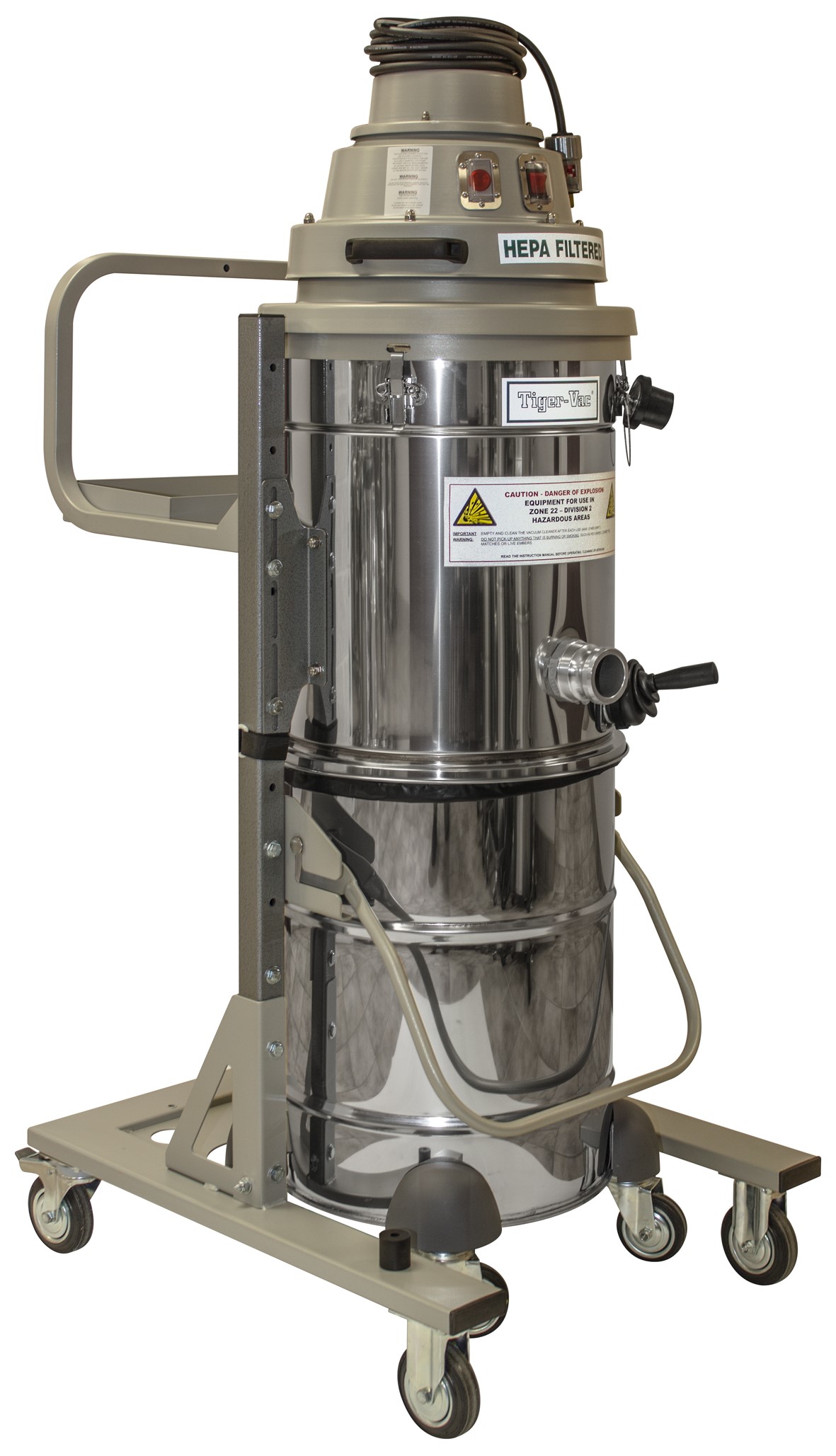
The Tiger-Vac C-55L EX DT HD CART (MFS) BLSD is the largest in the C-DT series -- a 55 L detachable AISI 430 tank mounted on a Heavy Duty Cart that handles the larger collection volume. Marked II 1/3D, EN 17348 DT, IECEx LCIE 15.0048. The single-phase brushless motor (1100 W / 1.1 kW / 8 A) delivers 216 m3/h at 2250 mmH2O and 72 dB(A). The Manual Filter Shaker (MFS) shakes the PTFE main filter clean before tank emptying. 4 HEPA H14 filters individually factory-tested protect the exhaust air (20,253 cm2 total filter area). The Heavy Duty Cart construction includes larger wheels and a rigid frame, making continuous use in industrial environments more stable than the classic C-35L cart.
Applications
- Process production with high collection volume where frequent tank emptying must be avoided
- Industrial facilities with continuous operation and long shifts
- Combustible dust in larger process rooms where 55 L is a good balance of mobility and capacity
- ATEX housekeeping in refineries and chemical industry where robust wheel construction matters
- Lithium and battery factories where the BLSD motor gives longer service intervals
Technical specifications
| ATEX marking | II 1/3D Ex h tc IIIC T85 C Dc IP6X (External) -- Ex h IIIC T85 C Da (Internal) -- -5 C <= Ta <= +37 C -- EN 17348 DT -- LCIE 15 ATEX 3061 -- IECEx LCIE 15.0048 |
|---|---|
| Internal / external zone | 20 / 22 |
| Motor type | Single-phase brushless BLSD motor (1100 W / 1.1 kW / 8 A) -- longer motor life and lower thermal surface (T85 C) |
| Duty cycle | Periodic |
| Airflow | 216 m³/h |
| Vacuum | 220 mbar (2250 mmH₂O) |
| Container | 55 L |
| Sound pressure | 72 dB(A) |
| Filter class | H class |
| Filter type | HEPA H14 (EN 1822, 99.99 % MPPS), individually factory-tested -- 4 x HEPA filters in the cabinet (212304B-HD, 215372, 211854) -- 20,253 cm2 filter area |
| Primary filter | Main filter PTFE/Epitropic polyester SD* with stainless steel bands (218627 or 215393-SD depending on model) |
| Cleaning system | Manual Filter Shaker (MFS) |
| Collection system | Detachable container |
| Material | AISI 430 stainless steel cabinet (AISI 304 tank optional on the 4W EU version) |
| IP class | IP6X |
| Power | 1.1 kW |
| Current | 8 A |
| Voltage | 220-240 V / 50-60 Hz / 1~ |
| Inlet | Ø 50 mm |
| Dimensions (L × W × H) | 700 x 700 x 1300 mm |
Questions and answers
What does II 1/3D mean on this machine?
II 1/3D means category 1 internally and category 3 externally -- the highest protection level (Da) inside the collection tank and the lowest on the outer housing (Dc). In practice: the unit can recover from Zone 20 (dust continuously present) even though the powerhead itself sits in Zone 22 (dust rarely present). That is the typical ATEX housekeeping configuration in process production -- recovery happens at a hazardous point while the operator stays in the less hazardous area.
What is the benefit of the BLSD motor?
BLSD = Brushless. The model delivers 1100 W / 1.1 kW / 8 A and 216 m3/h at 2250 mmH2O. The brushless motor has no carbon brushes, which extends life by about 4-5x (typically 5000 hours versus 1000-1500 hours for a universal motor) and gives a lower surface temperature (T85 C vs T200 C). This also means lower dust-ignition risk and 3rd party certified EN 17348 DT compliance. Plus: no carbon dust from brushes in the internal air path.
What is the HEPA H14 setup on this model?
Every unit is supplied with 4 individually factory-tested HEPA H14 filters in the housing (212304B-HD as primary HEPA, 215372 and 211854 as tertiary). Total filter area is 20,253 cm2 -- about 2 m2. The class is H14 per EN 1822, equivalent to 99.995 % MPPS (Most Penetrating Particle Size). That is the requirement EN 17348 DT places on ATEX vacuums for combustible dust including asbestos, lead and pharma CMR substances.
Can it pick up liquids?
No. The entire C series is certified EN 17348 DT -- dry recovery only. For wet/dry recovery in Zone 20/22, a dedicated WD model must be used, such as the CD-63L EX (W&D) variants. For liquid recovery in ATEX Kombi zones (II 2GD), see the ATEX-12A (4W) or (2+2W).
How is the unit wired up?
The power outlet is not included -- it must be fitted by an electrician per local regulations (typically 16 A schuko or blue CEE in Europe). 220-240 V 50/60 Hz single-phase. The cord is 10.6 m. The ATEX marking covers the vacuum cleaner itself -- the outlet and supply must be ATEX-rated if the unit is supplied from inside Zone 22 (II 3D-rated outlet). Supply from a non-classified area places no requirement on the outlet itself.
What is the difference between MFS and MRP?
MFS (Manual Filter Shaker) is a mechanical shaker that the operator activates manually by pulling a handle. It vibrates the main filter so the filter cake shakes down into the tank. Simple mechanics, no need for compressed air or electrical power. Suitable for dust that falls off the filter on its own under vibration. MRP (Manual Reverse Purge) instead uses a reverse-purge cartridge and a gate valve: the operator closes the gate valve and purges a small amount of air backwards through the filter -- simultaneously -- so the entire filter cake is broken loose. MRP is better for sticky, damp or very fine dust that does not get shaken off by MFS alone. Choose MRP for pharma CMR, sticky powder or where pollution-free disposal is critical; choose MFS for standard housekeeping.