
Tiger-Vac CSSD-30 (TF) HEPA SINGLE VENTURI
ESD-safe pneumatic vacuum for powder coating -- single venturi (7 mm), 204 m3/h, 114 L tank, HEPA H14, 4-wheel dolly, static dissipative and grounded
- Powder coating booth and clean-up of paint dust where ESD protection is essential
- General housekeeping in paint shops and powder handling facilities
- Recovery of combustible fine dust where a pneumatic drive is preferred (no electrics)
- Smaller process handling points where a grounded vacuum is required to prevent ESD ignition
- Sites where a classical II 3D ATEX vacuum would be overspec'd but ESD handling is needed
- ATEX Directive 2014/34/EU -- ESD-safe pneumatisk -- EN 60079-32-1 (statisk afladende og jordet), HEPA H14 EN 1822-5 (99,995 % MPPS), OSHA-compliant. Designet til pulverlakering og braendbare stoev. Ingen separat ATEX type-examination certificate.
- EN 17348:2022 (harmonized March 2023)
- IEC 60335-2-69 (industrial vacuums)
Tiger-Vac CSSD-30 (TF) HEPA SINGLE VENTURI
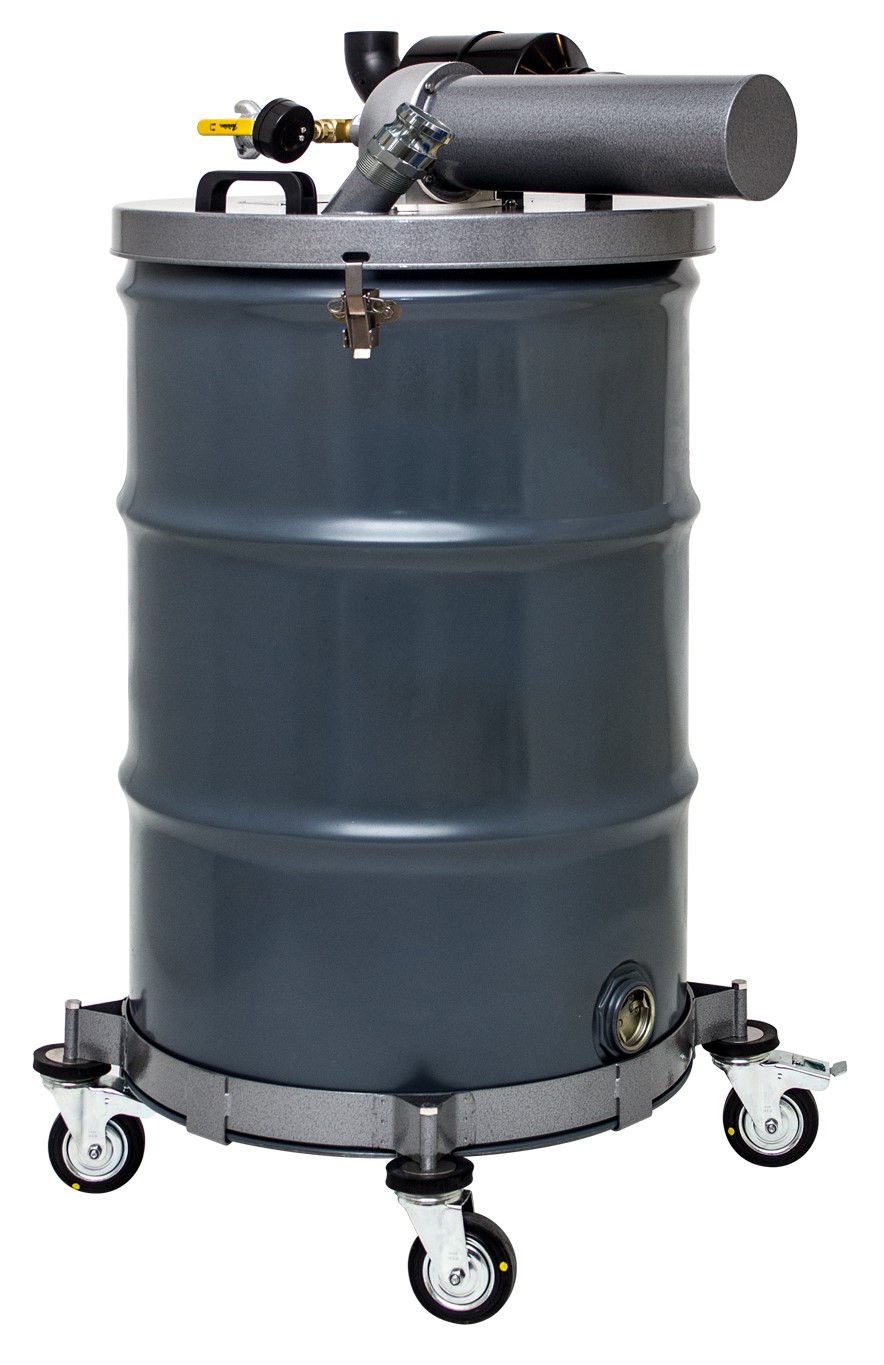
The Tiger-Vac CSSD-30 (TF) HEPA SINGLE VENTURI is an ESD-safe pneumatic industrial vacuum from the CSSD series -- specifically designed for the powder coating industry and other environments where combustible fine dust is combined with static electricity. The entire construction is static dissipative and grounded per EN 60079-32-1, and there are no electrical parts in the suction circuit. Single venturi (diam. 7 mm) delivers 204 m3/h at 5840 mmH2O (573 mbar), driven by a minimum 15 HP compressor at 5,5 bar. 114 L heavy-duty powder coated tank on a 4-wheel dolly. HEPA H14 (211027B, 99.995 % MPPS) is aerosol leak-tested and included as standard. Note: the CSSD series is NOT formally ATEX type-examined -- it is ESD-safe and pneumatic, and use in classified zones requires a Process Hazard Analysis by the user.
Applications
- Powder coating booth and clean-up of paint dust where ESD protection is essential
- General housekeeping in paint shops and powder handling facilities
- Recovery of combustible fine dust where a pneumatic drive is preferred (no electrics)
- Smaller process handling points where a grounded vacuum is required to prevent ESD ignition
- Sites where a classical II 3D ATEX vacuum would be overspec'd but ESD handling is needed
Technical specifications
| ATEX marking | ESD-safe pneumatisk -- EN 60079-32-1 (statisk afladende og jordet), HEPA H14 EN 1822-5 (99,995 % MPPS), OSHA-compliant. Designet til pulverlakering og braendbare stoev. Ingen separat ATEX type-examination certificate. |
|---|---|
| Internal / external zone | -- / 22 |
| Motor type | Single venturi (diam. 7 mm), pneumatisk drift |
| Duty cycle | Continuous |
| Airflow | 204 m³/h |
| Vacuum | 573 mbar (5840 mmH₂O) |
| Container | 114 L |
| Filter class | H class |
| Filter type | HEPA H14 (EN 1822, 99,995 % MPPS), aerosol leak-testet, OSHA-compliant -- Tiger-Vac 211027B (CE-version) |
| Primary filter | Polyester hovedfilter 211480 m/Tridon clamp 211946 og hvid-malet trådbur 214147B (30,5 cm Diam. x 25,4 cm høj) |
| Cleaning system | Ingen aktivt filterrens-system -- HEPA og hovedfilter skiftes ved fuld mætning |
| Collection system | Detachable container |
| Material | Heavy-duty powder coated stålkonstruktion, krop og cart -- statisk afladende og jordet |
| Supply pressure | 5,5 bar |
| Air supply hose | Ø 12.7 mm |
| Venturi units | 1 pcs |
| Inlet | Ø 50 mm |
| Dimensions (L × W × H) | 420 x 420 x 790 mm |
Questions and answers
Is the CSSD ATEX certified?
No -- not as a type-examined product. The CSSD series is an ESD-safe pneumatic vacuum compliant with EN 60079-32-1 (static dissipative and grounded). It is specifically designed for the powder coating industry where combustible fine dust is combined with static electricity, but does not carry separate ATEX type-examination. Use in Zone 21/22 therefore requires the user to perform a Process Hazard Analysis and judge whether ESD-safe pneumatic construction is sufficient for the specific environment. For formally ATEX-certified pneumatic drive, see the Tiger-Vac ATEX-12A series (II 2GD).
What is the difference between Single Venturi and Twin Venturi?
The Single Venturi models (CSSD-30/55 SINGLE) use one venturi nozzle of 7 mm and require a minimum 15 HP compressor at 5.5 bar. They deliver 204 m3/h. The Twin Venturi models (CSSD-30/55 TWIN) use two venturi nozzles of 6 mm and require a minimum 30 HP compressor at 6.9 bar. They deliver 331 m3/h -- about 60 % more flow, but also about 60 % more compressed-air consumption. Choose single if the compressor is limited or the application is single-operator housekeeping; choose twin if you have multiple simultaneous suction points or need to empty booths quickly.
What is the difference between CSSD-30 and CSSD-55?
Drive and filter specs are identical between 30 and 55. The only difference is the tank size and dimensions: the CSSD-30 has a 114 L tank and is 79 cm tall with a 42 cm square footprint. The CSSD-55 has a 208 L tank and is 115 cm tall with a 62 cm square footprint. Choose the 30 for smaller work stations or where space is tight; choose the 55 when collection volume is high and you want to minimise the number of empty cycles per shift.
Can it pick up liquids?
Not as standard -- the CSSD series is certified for Dry Recovery Only. Tiger-Vac does however offer an optional floater system (214960) that fits in the tank and automatically cuts off suction when liquid reaches a given level. With the floater system and a drain valve assembly (214962) the unit becomes wet/dry compatible. For primary wet/dry operation in ATEX-classified zones, the ATEX-12A (4W) or (2+2W) is recommended instead.
How much compressed air does it use?
The single version requires a minimum 15 HP installed compressor at 5,5 bar. Air consumption is 21,2 L/s through a 12.7 mm air line. This is not a small load -- count on 11 kW (single, 15 HP) or 22 kW (twin, 30 HP) installed electrical capacity for the compressor. Refrigerant-dried air (PDP +3 C or better) is recommended to avoid condensation in the venturi nozzles.
Why is the sound level not listed?
Tiger-Vac's brochure for the CSSD series does not state the sound level in its specifications table. Pneumatic venturi systems typically run at 75-82 dB(A) at full load, but the exact value depends on compressor supply, hose length and room size. Contact us for a measured value for a specific installation if it is critical for the occupational health assessment.