
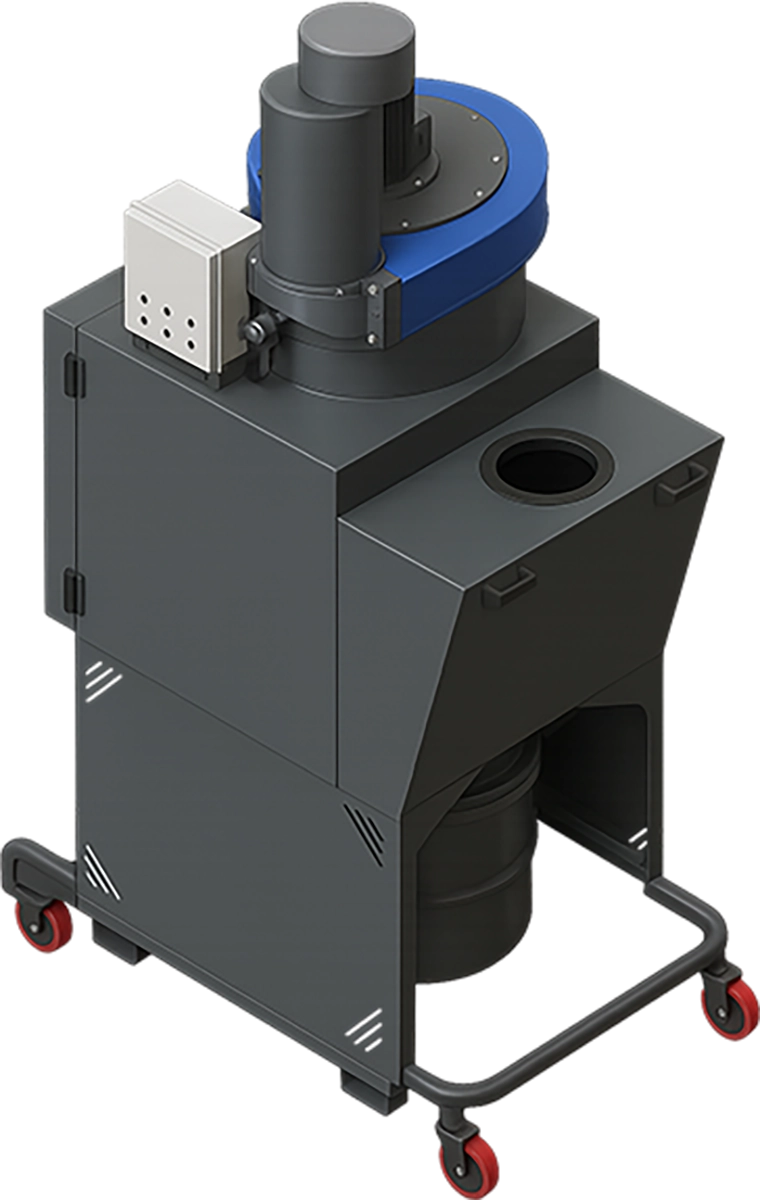
Delfin CUBE 20 K2 PN Z22
Stationary ATEX deduster in the CUBE chassis for Zone 22 -- 2.2 kW centrifugal fan, 2,500 m³/h, 2 cartridge filters with automatic pulse-jet cleaning, forklift-liftable, self-certified per EN 17348:2022
- Larger central suction systems in ATEX Zone 22 with multiple collection points and continuous operation
- Multi-arm welding halls classified Zone 22 with demanding occupational health and ATEX standards
- Pharmaceutical production with dust-classified zones and strict requirements for clean exhaust (HEPA H14)
- Chemical process plants with powder handling in ATEX Zone 22 and need for unmanned operation
- Zone 22-classified MDF and OSB halls where Zone 22 discipline is required due to process environment
- ATEX Directive 2014/34/EU -- II 3D Ex h IIIC T80°C (int) / T135°C (ext) Dc
- EN 17348:2022 (harmonized March 2023)
- IEC 60335-2-69 (industrial vacuums)
Delfin CUBE 20 K2 PN Z22
The Delfin CUBE 20 K2 PN Z22 is the ATEX version of the CUBE 20 K2 PN deduster -- built and certified for ATEX Zone 22 classified areas (marking II 3D Ex h IIIC T80°C (int) / T135°C (ext) Dc). All mechanical and filtration specifications are identical to the ACD version: 2.2 kW centrifugal fan, 2,500 m³/h airflow at 21 mbar vacuum, 2 cartridge filters at 200,000 cm² combined surface with automatic pulse-jet cleaning during suction, 90 L detachable container with plastic liner. The difference lies in the ATEX construction: dust-tight testing of the entire enclosure, Ex-certified motor and control box, stainless steel AISI 304 electrical panel and documentation per the ATEX directive 2014/34/EU. The automatic pulse-jet cleaning here operates 'during suction' -- compressed-air pulses fire in parallel with the airflow without requiring the deduster to stop. Self-certified per the harmonised standard EN 17348:2022. Ideal for continuous operation in ATEX Zone 22 production plants where operator intervention on filter cleaning is not desired.
Applications
- Larger central suction systems in ATEX Zone 22 with multiple collection points and continuous operation
- Multi-arm welding halls classified Zone 22 with demanding occupational health and ATEX standards
- Pharmaceutical production with dust-classified zones and strict requirements for clean exhaust (HEPA H14)
- Chemical process plants with powder handling in ATEX Zone 22 and need for unmanned operation
- Zone 22-classified MDF and OSB halls where Zone 22 discipline is required due to process environment
Technical specifications
| ATEX marking | II 3D Ex h IIIC T80°C (int) / T135°C (ext) Dc |
|---|---|
| Internal / external zone | 22 / 22 |
| Motor type | IE3 centrifugal fan (2.2 kW, three-phase 400 V), Ex h IIIC T135°C external / T80°C internal, Ex tb Dust Tight Certified |
| Duty cycle | Continuous |
| Airflow | 2500 m³/h |
| Vacuum | 21 mbar (210 mmH₂O) |
| Container | 90 L |
| Sound pressure | 72 dB(A) |
| Filter class | H class |
| Filter type | HEPA H14 (EN 1822-5), 99.995 % MPPS, final filter -- included as standard |
| Primary filter | 2 polyester cartridge filters with PTFE-coated surface, class M antistatic (ANT M), 200,000 cm² total filter area |
| Cleaning system | Automatic pulse-jet cleaning (PN -- pneumatic reverse flushing with compressed air during suction), alternating between cartridges |
| Collection system | Plastic bag |
| Material | Painted steel construction with stainless AISI 304 electrical panel and forklift lifting points in the base |
| IP class | IP65 |
| Power | 2.2 kW |
| Voltage | 400 V / 50 Hz / 3~ |
| Inlet | Ø 200 mm |
| Dimensions (L × W × H) | 1350 x 880 x 2550 mm |
| Weight | 250 kg |
EXTRACTION ARM & SOURCE CAPTURE — CENTRAL DUST COLLECTION
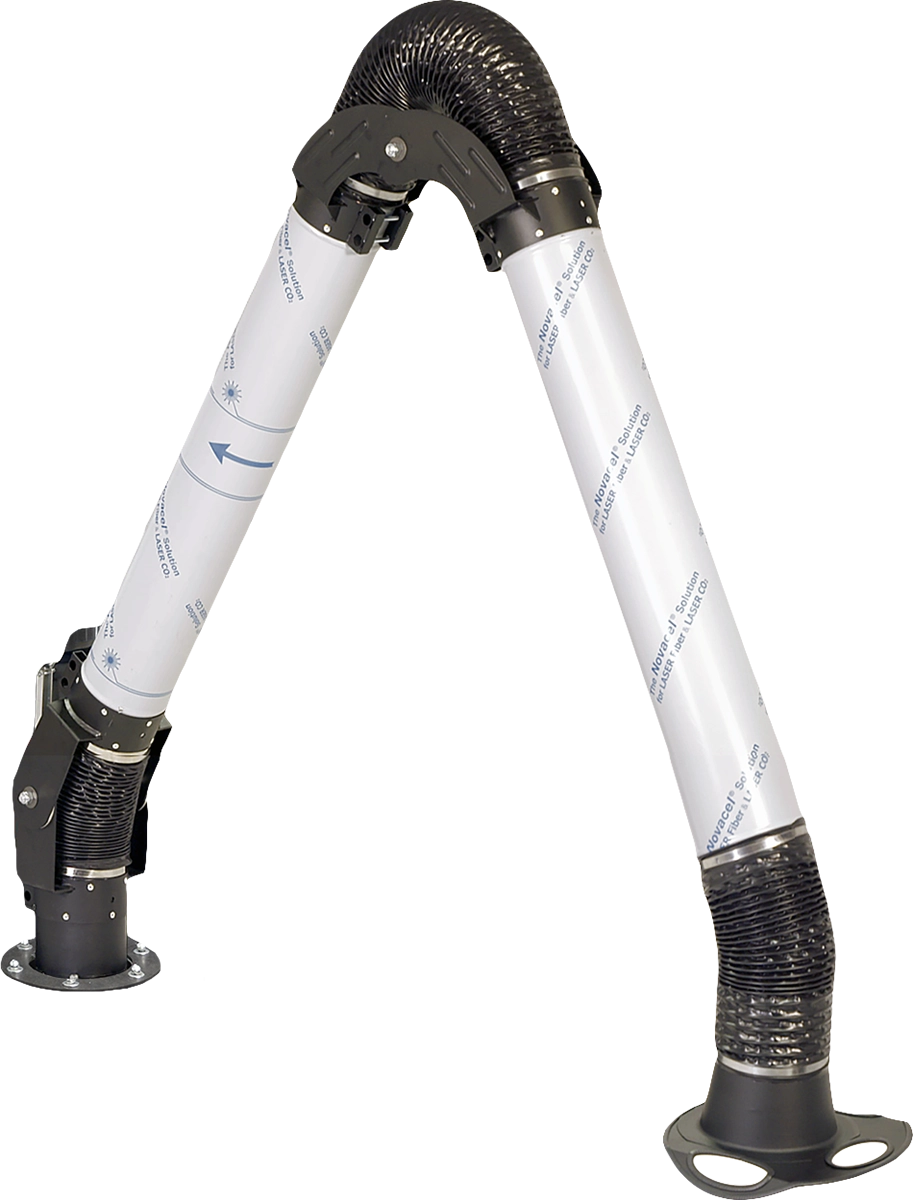
Extraction arm for source capture on central dedusters
An articulated extraction arm is a free-standing, balanced arm that places the deduster's suction point directly at the particle source — welding, grinding, solder fume, bag emptying, mixing stations or quality-control booths. The difference from a fixed hose run is that the operator can adjust the arm's height, reach and angle during operation without tools and without stopping the suction. This delivers far more effective source capture than a general room-extraction system, because the contamination is collected before it reaches the operator's breathing zone.
Why a deduster + extraction arm work so well together
The deduster is a centrifugal-fan based particle collector built for high airflow at low static vacuum — exactly the characteristic an extraction arm needs. The arm's flexible run has low pressure drop per metre, and the wide trumpet-shaped hood at the end loses a small additional amount of vacuum. A centrifugal fan (1,000-3,500 m³/h) supplies the required volume, whereas a side-channel blower (typically 200-400 m³/h at high vacuum) would concentrate the suction on far too small a capture area.
Available dimensions and accessories
Three standard arm configurations are available as accessories, all 3000 mm reach and with earth grounding (MT) included for ESD control: TA.0177.0000 (oe150 arm to oe150 filter chamber inlet), TA.1256.0000 (oe150 arm to oe200 filter chamber inlet — reducing from the deduster's larger inlet to a smaller arm) and TA.0511.0000 (oe200 arm to oe200 filter chamber inlet — maximum airflow). Tubo-flex reductions (SL.2632.0200, SL.6882.0200, SL.3775.0200, SL.6883.0200) allow connection of other hose dimensions, and Y-branches (SL.2775.0200, SL.2692.0200, SL.3022.0200) enable two extraction arms on the same deduster.
Typical industrial scenarios
Arm-equipped dedusters are used for welding fume extraction (MAG, MIG, TIG, arc welding), grinding dust from metal and polymer processing, solder fume and brazing vapours in electronics manufacturing, bag emptying and powder handling in food, pharmaceutical and chemical production, and quality-control booths where particles must be captured but not dispersed. On the ATEX Zone 22 models the arm installation requires ESD earthing throughout the system, and the MT function delivers exactly that. On ACD models (non-ATEX areas with combustible dust) earthing is likewise recommended, because static build-up on the inner wall of the arm can generate ignition sources even without ATEX classification.
Questions and answers
What is the difference between the CUBE 20 K2 PN Z22 and the CUBE 20 K2 PN ACD?
The two models have identical mechanical and filtration specifications -- same motor, same airflow (2,500 m³/h), same vacuum (21 mbar), same cartridge filter surface (200,000 cm²), same container (90 L). The difference is certification and construction for explosion hazard. The Z22 version is ATEX-certified for Zone 22 (II 3D Ex h IIIC) and can be used in officially classified zone areas; the ACD version is for non-classified areas with combustible dust (IEC 60335-2-69 Annex AA). The Z22 model has additional dust-tight testing of the entire enclosure, Ex-certified motor and control box, plus nameplate and documentation per the ATEX directive 2014/34/EU. The price difference reflects this extra certification effort (ca. 2,500-3,500 EUR over the ACD version).
How does the pulse-jet cleaning differ from the ACD version's?
There is a subtle but important difference. The ACD version uses an 'automatic alternating air washing system' -- pulse-jet fires in a rotating pattern while the unit runs normally. The Z22 version is specified with 'automatic filter cleaning with operated air during suction' -- same fundamental principle, but ATEX-compatibly timed so compressed-air pulses are coordinated with suction-point vacuum to avoid momentary counter-flow particles on the cartridge's clean side. For the end-user it makes no difference -- cleaning is still automatic, still continuous and still operationally independent of the operator. But the certificate requires this coordinated design to maintain dust-tight certification during pulses.
What is the stainless steel AISI 304 electrical control box for?
The AISI 304 stainless steel control box is an ATEX construction standard on Z22 models -- required by the aggressive environmental norm for Zone 22, where the atmosphere may contain corrosive substances beyond combustible dust. The stainless box withstands condensation, chemical attack from process dust (e.g. alkaline powders or corrosive organic compounds), and mechanical impact in industrial environments. The box is IP65 enclosed, which combined with the deduster's own IP65 ensures the electrical system is sealed against dust and water jets. Contactors, cables, signal circuits and control cards are all Ex-certified and installed per ATEX guidelines.
Is the deduster EN 17348:2022 tested or only declared?
The CUBE 20 K2 PN Z22 is self-certified by Delfin per the harmonised standard EN 17348:2022 (harmonised March 2023). 'Self-certified' means that Delfin as manufacturer has performed the required performance tests per the standard's annexes and issued the CE conformity declaration; it is NOT certified by a notified third party. For Category 3D products (Zone 22) the ATEX directive 2014/34/EU permits the manufacturer's own conformity assessment under certain conditions -- this applies specifically to this category. Documentation (CE declaration, EC type examination report where relevant, and controlled production procedure) is available on request. If your safety organisation requires notified third-party certification, you should consider asking for documentation or upgrading to a Category 2D model.
What does the ATEX installation require regarding earth grounding on the deduster itself?
ATEX installations in Zone 22 require all conductive parts in contact with dust to be connected to the same earth potential -- maximum resistance 10⁸ ohm. For the CUBE 20 K2 PN Z22 this applies to the deduster chassis, filter housing, container, suction piping, and all extraction arms or Y-branches coupled to it. Delfin supplies the model with a standard earth grounding clamp on the chassis (MT included), but installation must verify continuity between ALL components. At the transition from metal hose to antistatic polymer hose, a metallic end clamp with sufficiently low resistance is required -- typically a stainless steel ring clamp. During installation, measure: (1) from each collection point to earth (≤10⁸ ohm), (2) from container to chassis (continuity), and (3) from chassis to the installation's earth busbar.
Which typical ATEX Zone 22 industries choose the CUBE 20 K2 PN Z22?
Classic ATEX Zone 22 industries for this model are (1) pharmaceutical production with active powder substances classified as combustible (e.g. paracetamol, lactose or protein powders), where strict filter quality and continuous operation is required, (2) food and flour industry with higher risk classification than average -- especially where milling and sieving generate dust in constant presence, (3) chemical industry with pigments and colourants (carbon black, organic pigments), (4) coating and powder coating halls with fully classified zones due to concentration of combustible powder, and (5) light-metal processing with aluminium or magnesium powder in classified production cells -- though here the INERT version of the deduster might be a better choice due to reactive metallic dust. Documented risk analysis is always the precondition.