
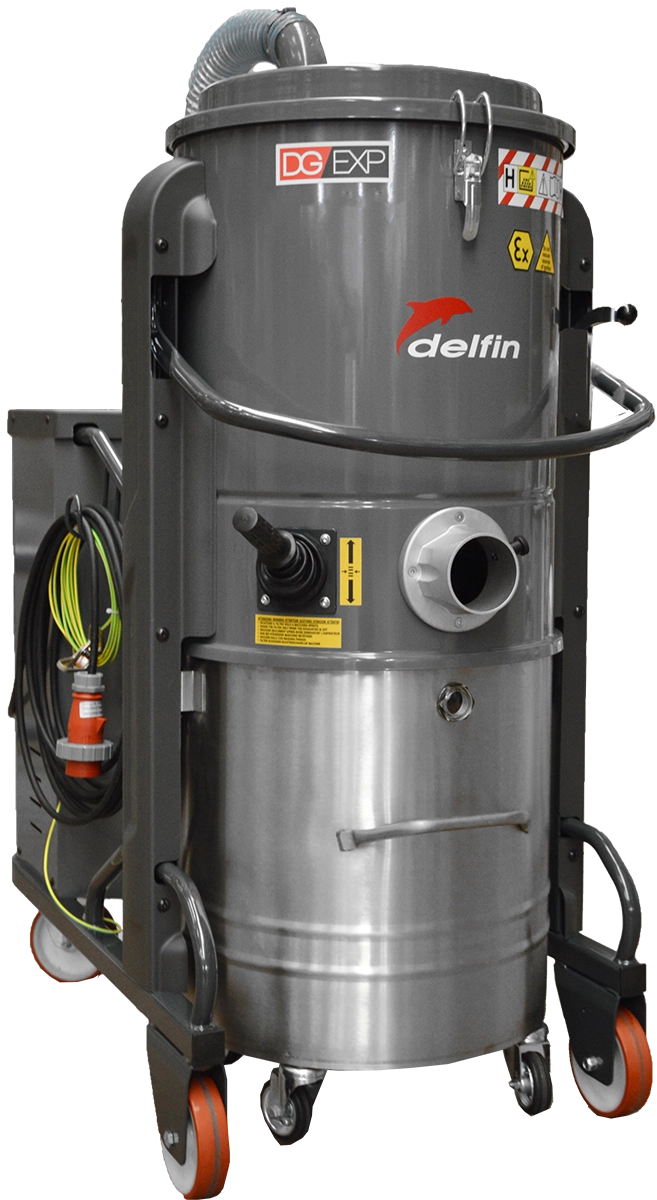
Delfin DG 30 EXP EX1/2D
Three-phase side-channel blower -- third-party certified (notified body) per EN 17348:2022, internal Zone 20 + external Zone 21, 4.0 kW, 100 L tank with manual filter cleaning
- Pharmaceutical process equipment (tablet press, packaging lines, fluid-bed) in Zone 21 where notified-body certification is required
- Chemical production with fine combustible dust -- pigments, polymers, colourants -- and continuous-duty requirement
- Metalworking with conductive dust (aluminium, magnesium, titanium) where IIIC classification is necessary
- Cleaning of cyclones and filter units in Zone 21 areas, where the machine's internal Z20 construction simplifies the ATEX explosion-protection document
- Batch processes in pharma where 100 L collection capacity minimises emptying frequency within a production shift
- Move-between capability between Zone 21 and Zone 22 areas -- the 1/2D class covers both externally
- Process-adjacent dust collection where three-phase 400 V is available and manual filter cleaning is acceptable
- ATEX Directive 2014/34/EU -- II 1/2D Ex h IIIC T160°C Da/Db
- EN 17348:2022 (harmonized March 2023)
- IEC 60335-2-69 (industrial vacuums)
Delfin DG 30 EXP EX1/2D
The Delfin DG 30 EXP EX1/2D is the 4 kW model in Delfin's 100-litre DG EXP range with notified-body third-party certification per EN 17348:2022. With a three-phase side-channel blower it delivers 420 m³/h airflow and 2400 mmH²O vacuum, and the dual ATEX categorisation (internal Zone 20 + external Zone 21, marked II 1/2D Ex h IIIC T160°C Da/Db) makes it suitable for pharmaceutical, chemical and metalworking production where an explosive dust atmosphere is likely during normal operation. HEPA H14 absolute filter at 26,000 cm² and 30,000 cm² antistatic polyester primary filter deliver 99.995 % MPPS separation efficiency, and the 100-litre stainless collection tank is emptied with an antistatic plastic bag for ESD-controlled dust handling.
Applications
- Pharmaceutical process equipment (tablet press, packaging lines, fluid-bed) in Zone 21 where notified-body certification is required
- Chemical production with fine combustible dust -- pigments, polymers, colourants -- and continuous-duty requirement
- Metalworking with conductive dust (aluminium, magnesium, titanium) where IIIC classification is necessary
- Cleaning of cyclones and filter units in Zone 21 areas, where the machine's internal Z20 construction simplifies the ATEX explosion-protection document
- Batch processes in pharma where 100 L collection capacity minimises emptying frequency within a production shift
- Move-between capability between Zone 21 and Zone 22 areas -- the 1/2D class covers both externally
- Process-adjacent dust collection where three-phase 400 V is available and manual filter cleaning is acceptable
Technical specifications
| ATEX marking | II 1/2D Ex h IIIC T160°C Da/Db |
|---|---|
| Internal / external zone | 20 / 21 |
| Motor type | Three-phase side-channel blower |
| Duty cycle | Continuous |
| Airflow | 420 m³/h |
| Vacuum | 235 mbar (2400 mmH₂O) |
| Container | 100 L |
| Sound pressure | 72 dB(A) |
| Filter class | H class |
| Filter type | HEPA H14 (EN 1822-5), 99.995 % MPPS, 26,000 cm² filter area, included as standard |
| Primary filter | Star/bag filter, antistatic polyester M class (ANT M), 30,000 cm², Ø 500 mm |
| Collection system | Plastic bag |
| Material | AISI 304 stainless steel (container as standard; filter housing as option) |
| IP class | IP65 |
| Power | 4.0 kW |
| Current | 7.4 A |
| Voltage | 400 V / 50 Hz / 3~ |
| Inlet | Ø 80 mm |
| Dimensions (L × W × H) | 600 x 1030 x 1700 mm |
| Weight | 145 kg |
Questions and answers
Why choose the DG 30 EXP EX1/2D over the larger DG 70 EXP EX1/2D?
The difference is motor power and airflow. The DG 30 EXP delivers 420 m³/h at 4.0 kW, while the DG 70 EXP delivers 560 m³/h at 5.5 kW. Cabinet, tank and primary filter are identical (60 x 103 x 170 cm, 100 L, 30,000 cm² primary). Choose the DG 30 EXP for moderate airflow in continuous dust collection at installations with current limits or where running cost matters. Choose the DG 70 EXP where you need larger suction openings, longer hose runs or higher dust loads -- it also has twice the HEPA filter area (52,000 cm² vs 26,000 cm²), giving longer filter life under heavy load.
What is a "notified body" in ATEX context, and which notified bodies does Delfin use?
A notified body is a technical test house designated by EU member states to perform conformity assessment under the ATEX Directive 2014/34/EU. Notified bodies have a 4-digit identification number and are listed in the European Commission's NANDO database. For ATEX vacuum cleaners, European manufacturers typically use Eurofins (NB 0477 or similar), CESI (NB 0722), DEKRA (NB 0158) or InterTek (NB 0359). Delfin states the specific notified-body number on the EU type-examination certificate supplied with each machine in the technical file. The certificate number is central to compliance audit and should be archived with the ATEX explosion-protection document.
Why is the noise level 72 dB(A) higher than the smaller MTL 3533 EX1/2D at 69 dB(A)?
The side-channel blower in the DG 30 EXP is larger and runs at higher speed to deliver 420 m³/h versus the MTL 3533's 320 m³/h. Noise level in industrial vacuums is practically always correlated with airflow and motor power, because turbulent airflow from the blower wheel dominates the acoustic signature under continuous duty. The 72 dB(A) figure is measured per EN ISO 3744 at 1 m distance without suction accessories; with hose and tool the level typically falls 2-4 dB(A). Even under 8 hours of continuous duty the DG 30 EXP is well below the Danish Working Environment Act action limit of 85 dB(A) LEX,8h, so hearing protection is not mandatory at the machine alone. Ambient noise in the production, however, can raise the total level -- a noise survey must always be performed as part of the workplace risk assessment.
What does EN 17348:2022 mean in practice -- and why is it the standard used here?
EN 17348:2022 is the European harmonised standard for "Industrial vacuum cleaners and dust collectors for use in explosive atmospheres". It was harmonised in March 2023 under the ATEX Directive and in August 2024 under the Machinery Regulation 2023/1230. The standard consolidates requirements for construction, testing, documentation and marking of vacuum cleaners for explosive dust atmospheres (Zone 20/21/22) and replaces the older EN 60335-2-69 requirements for ATEX applications. The practical effect is that a machine like the DG 30 EXP EX1/2D with direct compliance to EN 17348 provides a "presumption of conformity" with the essential health and safety requirements of ATEX 2014/34/EU -- which significantly simplifies commissioning and documentation. Third-party certification by a notified body is a requirement in EN 17348's normative part for internal Zone 20 equipment.
Can I connect the DG 30 EXP EX1/2D to an existing central-vacuum piping system?
Yes, but three technical conditions must be considered. (1) The pressure drop in the existing piping must not exceed what the DG 30 EXP can compensate (approx. 2400 mmH²O upper limit). For long pipe or bend runs, a calculation with Delfin Denmark or the distributor's application department is recommended. (2) The pipe inner diameter must match the machine's suction opening (Ø 80 mm) to maintain transport air velocity above 20 m/s -- below that, dust will settle in the pipe. (3) The entire piping system including bends, dampers and endpoints must be ATEX-certified to at least the same level (1/2D for Zone 21) and have documented third-party certification for components in the explosive zone. An unassessed pipe section is a frequent ATEX compliance challenge and must be addressed in an installation-level explosion-protection document.
How often should the HEPA H14 filter be replaced -- and how is it measured?
There is no fixed replacement interval -- HEPA H14 filter life depends on dust load, particle size distribution and whether the primary filter (star/pocket) is cleaned on time. In practice the filter condition is monitored via differential pressure: a new HEPA filter typically gives 50-80 mbar pressure drop at 420 m³/h, and replacement is required at 200-250 mbar. Measurement requires a U-tube manometer or electronic pressure gauge fitted across the filter. Delfin offers differential-pressure monitoring as an option. Under continuous operation in pharmaceutical production with fine API powders it is typically 12-18 months; with lighter dust load in e.g. packaging lines 24-36 months. Life is extended by regular cleaning of the primary filter -- unfiltered dust is the variable you control yourself.
What documentation is supplied with the DG 30 EXP EX1/2D at delivery?
Delfin supplies a complete ATEX technical file: (1) EU Declaration of Conformity (DoC) per ATEX 2014/34/EU and the Machinery Regulation 2023/1230, (2) EU type-examination certificate from the notified body that issued the certification (with 4-digit NB number), (3) ATEX rating plate on the machine with complete marking II 1/2D Ex h IIIC T160°C Da/Db + serial number + year of manufacture, (4) operating and maintenance manual in at least English and Danish, (5) quality assurance documentation for the production process (ISO 9001 and module D/E per ATEX), and (6) test report for earth-bonding verification. Documents should be archived with your ATEX explosion-protection document and be available for inspection by the Danish Working Environment Authority. In case of loss, Delfin Italy or the distributor can issue a copy based on serial number.