
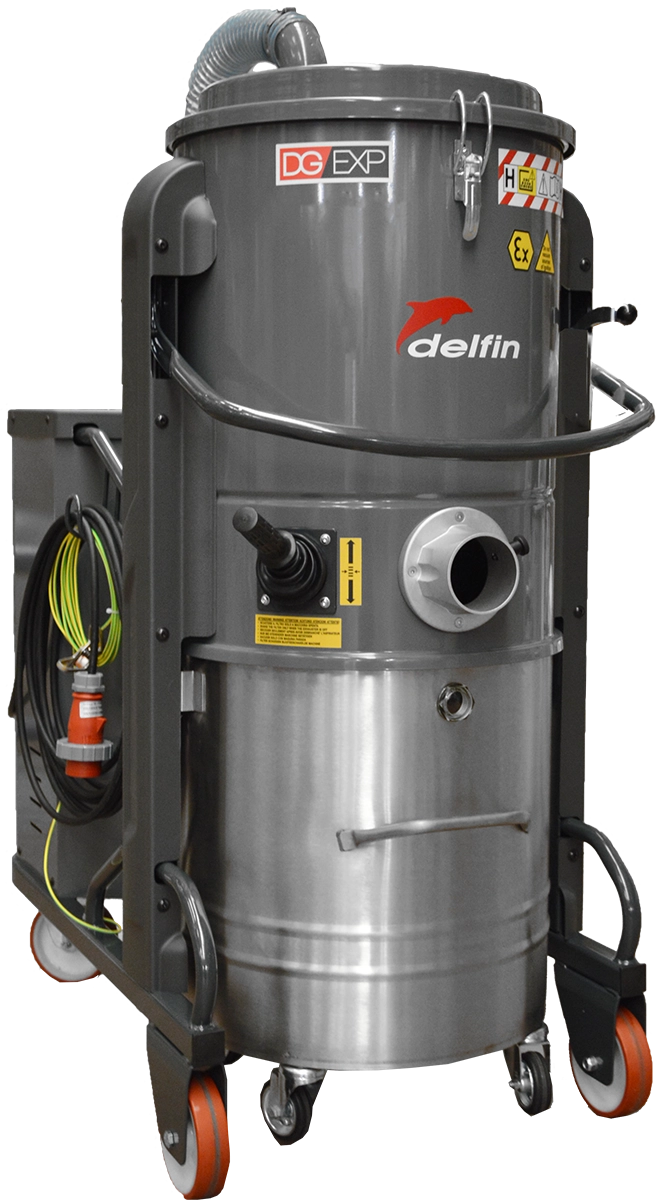
Delfin DG 70 EXP EX1/2D
Three-phase side-channel blower -- third-party certified (notified body) per EN 17348:2022, internal Zone 20 + external Zone 21, 5.5 kW, 100 L tank, doubled HEPA filter area
- Primary vacuum in pharmaceutical GMP production in Zone 21 where notified-body certification is a contract requirement
- Continuous collection of conductive metal dust (aluminium, titanium, stainless grinding swarf) in IIIC class
- Central vacuum for installation with long hose runs and multi-operator use, where 560 m³/h ensures adequate reserve
- Chemical process plants with heavy dust loads where 52,000 cm² HEPA area gives 18-36 month filter life
- Mobile unit for relocation between multiple Zone 21/22 areas at the same plant -- the 1/2D class covers both zones
- Documentation-heavy industries (pharma, chemical, oil & gas) where the EU type-examination certificate eases the compliance process
- Heavy process-adjacent work where airflow and ATEX robustness are prioritised over purchase price and compact footprint
- ATEX Directive 2014/34/EU -- II 1/2D Ex h IIIC T160°C Da/Db
- EN 17348:2022 (harmonized March 2023)
- IEC 60335-2-69 (industrial vacuums)
Delfin DG 70 EXP EX1/2D
The Delfin DG 70 EXP EX1/2D is the flagship of the 100-litre DG EXP family with notified-body third-party certification per EN 17348:2022. The 5.5 kW three-phase side-channel blower delivers 560 m³/h airflow -- the highest in its class -- and the HEPA H14 filter area is doubled to 52,000 cm² compared to the DG 30 EXP, significantly reducing pressure drop and extending filter life under continuous operation with fine dust. The ATEX marking II 1/2D Ex h IIIC T160°C Da/Db covers internal Zone 20 + external Zone 21 and makes the model suitable for flagship installations in pharmaceutical production, chemical process plants and heavy metalworking where ATEX compliance is highly valued and where investment in notified-body certification is justified by insurance or audit requirements.
Applications
- Primary vacuum in pharmaceutical GMP production in Zone 21 where notified-body certification is a contract requirement
- Continuous collection of conductive metal dust (aluminium, titanium, stainless grinding swarf) in IIIC class
- Central vacuum for installation with long hose runs and multi-operator use, where 560 m³/h ensures adequate reserve
- Chemical process plants with heavy dust loads where 52,000 cm² HEPA area gives 18-36 month filter life
- Mobile unit for relocation between multiple Zone 21/22 areas at the same plant -- the 1/2D class covers both zones
- Documentation-heavy industries (pharma, chemical, oil & gas) where the EU type-examination certificate eases the compliance process
- Heavy process-adjacent work where airflow and ATEX robustness are prioritised over purchase price and compact footprint
Technical specifications
| ATEX marking | II 1/2D Ex h IIIC T160°C Da/Db |
|---|---|
| Internal / external zone | 20 / 21 |
| Motor type | Three-phase side-channel blower |
| Duty cycle | Continuous |
| Airflow | 560 m³/h |
| Vacuum | 196 mbar (2000 mmH₂O) |
| Container | 100 L |
| Sound pressure | 72 dB(A) |
| Filter class | H class |
| Filter type | HEPA H14 (EN 1822-5), 99.995 % MPPS, 52,000 cm² filter area, included as standard |
| Primary filter | Star/bag filter, antistatic polyester M class (ANT M), 30,000 cm², Ø 500 mm |
| Collection system | Plastic bag |
| Material | AISI 304 stainless steel (container as standard; filter housing as option) |
| IP class | IP65 |
| Power | 5.5 kW |
| Current | 11.1 A |
| Voltage | 400 V / 50 Hz / 3~ |
| Inlet | Ø 80 mm |
| Dimensions (L × W × H) | 600 x 1030 x 1700 mm |
| Weight | 145 kg |
Questions and answers
Why does the DG 70 EXP EX1/2D have twice the HEPA area as the DG 30 EXP in the same cabinet?
The cabinet is identical (60 x 103 x 170 cm), but the HEPA filter element is dimensioned differently. The DG 30 EXP has 26,000 cm² HEPA area; the DG 70 EXP has 52,000 cm² -- a doubling achieved by using a deeper filter element with more filter folds. At the same flow this gives half the air velocity through the filter face and thus significantly longer filter life. When airflow is scaled to 560 m³/h (DG 70 EXP) vs 420 m³/h (DG 30 EXP), the actual load on the HEPA face is: DG 30 EXP = 420 / 2.6 = 162 m³/m²/h, DG 70 EXP = 560 / 5.2 = 108 m³/m²/h. The DG 70 EXP is therefore gentler on the filter per cubic metre of air, explaining the longer life under heavy dust loads.
Why is the vacuum lower on the DG 70 EXP (2000 mmH²O) than the DG 30 EXP (2400 mmH²O)?
This is a side-channel blower characteristic: there is a trade-off between flow and vacuum within the same motor family. The DG 70 EXP blower is dimensioned to deliver higher volume flow (560 m³/h) realised via a wider impeller and lower static pressure. The DG 30 EXP blower is dimensioned for lower flow (420 m³/h) but higher static pressure (2400 mmH²O). Practically: choose the DG 30 EXP when the application is pressure-driven (long hoses, bends, small suction openings such as filter cartridges or narrow channels) and choose the DG 70 EXP when the application is flow-driven (wide nozzle, short hoses, large surface). Both models can handle dust pickup up to Ø 80 mm suction opening, but the DG 70 EXP covers a larger area per unit time.
How does the DG 70 EXP EX1/2D compare to the self-certified DG 70 EXP (non-1/2D) on the same site?
The self-certified DG 70 EXP (marked II 3D Ex h tc IIIC T80°C/T165°C Dc) is categorised for external Zone 22 ONLY. Its ATEX conformity rests on the manufacturer's internal quality control without notified-body testing. The DG 70 EXP EX1/2D, by contrast, is third-party certified by a notified body and covers internal Zone 20 + external Zone 21 -- a substantial extension. The practical difference: the EX1/2D variant may be used in areas where an explosive dust atmosphere is likely during normal operation (Zone 21), and has documentation accepted by all European compliance regimes without further questions. Motor, cabinet and primary/HEPA filter are technically identical, but the third-party certified version also undergoes individual ATEX end-of-line testing before delivery.
Can the DG 70 EXP EX1/2D operate in sub-zero outdoor conditions?
The DG 70 EXP EX1/2D is dimensioned for operation at -10°C to +40°C ambient temperature in accordance with the standard. Below -10°C the side-channel blower lubricating oil and rubber seals are not specified and would most likely cause operational disturbances. For outdoor installation at the coldest winter temperatures (offshore, arctic climate, unheated storage), the model must be placed in a heated shed or cabinet. Alternatively, Delfin can supply an arctic version with synthetic cold-rated lubricating oil and EPDM seals upon request -- this is not the standard version and requires additional ATEX determination. At operating temperatures above +40°C motor derating must be considered: up to +60°C is possible with reduced continuous power and with manufacturer approval.
How much does it weigh in freight, and what shipping method is recommended?
The DG 70 EXP EX1/2D weighs 145 kg net without packaging and approximately 175-185 kg in a transport crate on a wooden pallet. The cabinet dimensions (60 x 103 x 170 cm) make it unsuitable for pallet friction -- the model typically arrives in a sturdy wooden or cardboard crate strapped to a pallet. For delivery to Denmark, we recommend a logistics carrier (DHL Freight, Schenker, DSV Road) with pallet delivery service and kerbside access using a tail-lift. For users without a floor pallet jack, Delfin can arrange door-to-door service with hand jack upon request. For installation on upper floors the lift must be dimensioned for 145 kg plus the operator; all external dimensions from the cabinet are under 110 cm on one axis and fit through standard doorways (80 cm) if the height can be handled.
Is the DG 70 EXP EX1/2D compatible with Delfin Longopac containerless collection instead of plastic bag?
The standard configuration of the DG 70 EXP EX1/2D is antistatic plastic bag in the container. Longopac (a continuous polyethylene sleeve collection with clips) is available as an option on other Delfin models but is not standard on the EX1/2D series. The Longopac option requires a specific Longopac-fitted container (typically 100 L stainless with Longopac ring and independent ATEX certificate), which can be supplied on request for the DG 70 EXP EX1/2D with longer lead time (4-8 weeks) and separate notified-body addendum to the technical file. Plastic bag collection is generally cheaper in operation and more flexible with varying dust types, while Longopac gives an advantage in 24/7 shift work where bag change is highly time-critical and operator exposure to dust must be minimised. Contact Particulair for Longopac variant specification.
What is the expected life of a three-phase side-channel blower under continuous duty?
Side-channel blowers are known for their long life under S1 (continuous) duty -- typically 20,000-40,000 operating hours before major service is required. This is due to oil-free construction, no wear-prone brush parts and simple mechanical design. At 16 hours' operation per day over 250 days per year, that is 4,000 operating hours per year, corresponding to 5-10 years of uninterrupted life before major service. Service includes bearing replacement and seals and is typically possible without sending the blower back to the factory. Under continuous 24/7 duty (8,000 hours/year) life falls to 2-4 years before major service -- still substantially better than bypass or brushless motors. Preventive service (oil change and bearing greasing) is recommended every 2,000-4,000 hours or at least annually.