
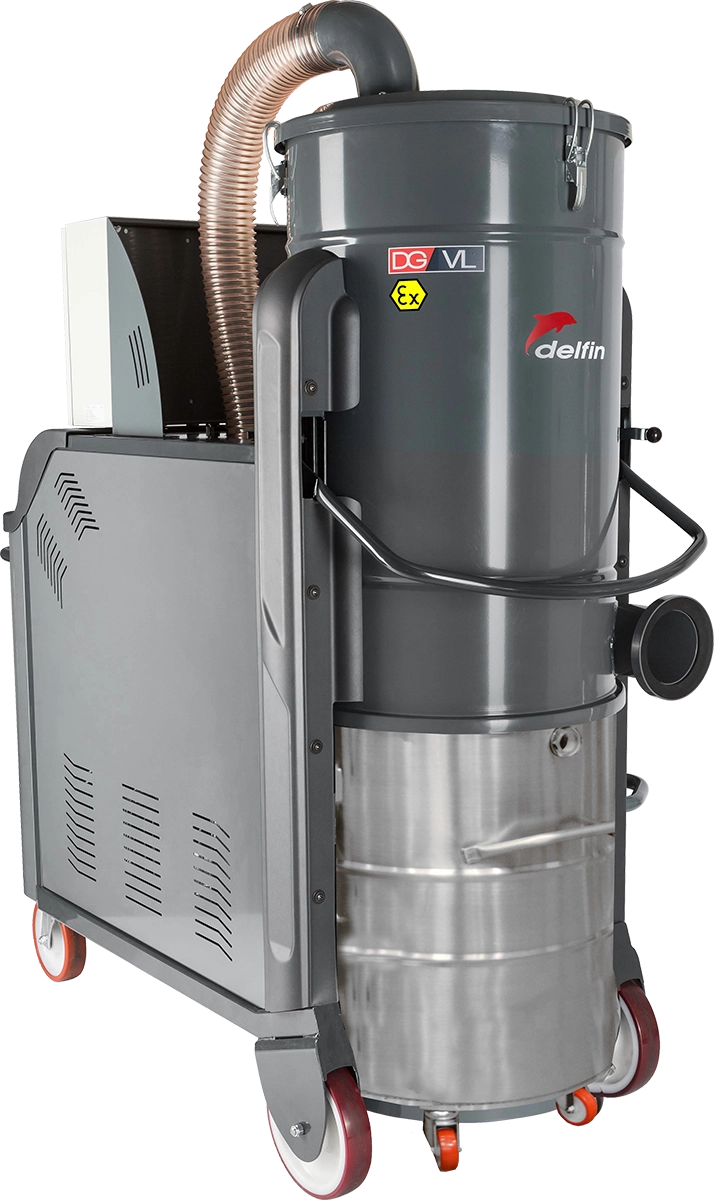
Delfin DG VL 185 EX1/3D
Three-phase side-channel blower -- third-party certified (notified body) per EN 17348:2022, internal Zone 20 + external Zone 22, 18.5 kW, 160 L stainless tank, self-cleaning filter and PTC motor heat sensor standard
- 24/7 continuous dust collection in pharmaceutical GMP process plants with internal Zone 20 requirements
- Central ATEX vacuum for multi-operator facilities with 1350 m³/h reserve airflow and long hose/pipe installation
- Chemical production with heavy continuous dust loads where self-cleaning filter reduces maintenance visits
- Metalworking with IIIC-class conductive dust (aluminium, magnesium, titanium) and Zone 22 coverage requirement
- Process plants where HEPA filter area of 103.500 cm² gives 24-48 month service intervals under moderate dust load
- Central vacuum system with fixture installation -- 200 kg weight and 1.80 m footprint allow permanent placement without wheel requirement
- Audit-heavy industries' (pharma, chemical, offshore) compliance requirements for notified-body EU type-examination and ISO 9001 quality management in production
- ATEX Directive 2014/34/EU -- II 1/3D Ex h IIIC T160°C Da/Dc
- EN 17348:2022 (harmonized March 2023)
- IEC 60335-2-69 (industrial vacuums)
Delfin DG VL 185 EX1/3D
The Delfin DG VL 185 EX1/3D is the flagship model in the DG VL range's dual-certified flagship family -- an industrial three-phase side-channel blower at 18.5 kW with notified-body third-party certification per EN 17348:2022. The model delivers 1350 m³/h airflow and 2600 mmH²O vacuum and is equipped with a self-cleaning filter system (SELF CLEAN) that automatically shakes or pulse-jets the primary filter during operation -- a marked step up from the DG EXP family's manual filter cleaning. The HEPA H14 absolute filter at 103.500 cm² and the 70,000 cm² antistatic polyester primary filter deliver 99.995 % MPPS separation efficiency and extended service intervals. The ATEX marking II 1/3D Ex h IIIC T160°C Da/Dc covers internal Zone 20 + external Zone 22, and the model is built for 24/7 operation in pharmaceutical process plants, chemical production lines, metalworking with conductive dust and heavy ATEX installations where notified-body documentation is a contract requirement. A PTC motor heat sensor is standard on this size and protects against thermal overload during extended high-load operation.
Applications
- 24/7 continuous dust collection in pharmaceutical GMP process plants with internal Zone 20 requirements
- Central ATEX vacuum for multi-operator facilities with 1350 m³/h reserve airflow and long hose/pipe installation
- Chemical production with heavy continuous dust loads where self-cleaning filter reduces maintenance visits
- Metalworking with IIIC-class conductive dust (aluminium, magnesium, titanium) and Zone 22 coverage requirement
- Process plants where HEPA filter area of 103.500 cm² gives 24-48 month service intervals under moderate dust load
- Central vacuum system with fixture installation -- 200 kg weight and 1.80 m footprint allow permanent placement without wheel requirement
- Audit-heavy industries' (pharma, chemical, offshore) compliance requirements for notified-body EU type-examination and ISO 9001 quality management in production
Technical specifications
| ATEX marking | II 1/3D Ex h IIIC T160°C Da/Dc |
|---|---|
| Internal / external zone | 20 / 22 |
| Motor type | Sidekanalblæser, 3-faset (trifase), industriel udførelse |
| Duty cycle | Continuous |
| Airflow | 1350 m³/h |
| Vacuum | 255 mbar (2600 mmH₂O) |
| Container | 160 L |
| Sound pressure | 78 dB(A) |
| Filter class | H class |
| Filter type | HEPA H14 (EN 1822-5), 99,995 % MPPS, 103.500 cm² filterflade, standard inkluderet |
| Primary filter | Stjerne/taske antistatisk polyester M-klasse (ANT M), 70.000 cm², Ø 560 mm |
| Collection system | Plastic bag |
| Material | AISI 304 rustfrit stål (beholder standard; filterhus som option) |
| IP class | IP65 |
| Power | 18.5 kW |
| Current | 38.25 A |
| Voltage | 400 V / 50 Hz / 3~ |
| Inlet | Ø 120 mm |
| Dimensions (L × W × H) | 1800 x 770 x 2000 mm |
| Weight | 200 kg |
Questions and answers
How does the self-cleaning filter system on the DG VL range work, and what is the difference from manual filter cleaning?
The DG VL series self-cleaning filter system (SELF CLEAN) combines two mechanisms: cyclic pulse-jet cleaning of the primary filter (star/pocket) and automatic vibration shaking via an eccentric motor mounted on top of the filter chamber. During operation the pulse is typically activated every 30-60 seconds or on detected pressure drop, loosening accumulated dust and sending it down into the collection tank. Practically this means the primary filter retains its nominal flow capacity over the entire working day without manual cleaning. On the DG EXP range (DG 30/70 EXP EX1/2D) the operator must stop the machine and shake the filter manually after approximately 2-4 hours of operation under heavy dust load -- a productivity loss of 15-30 minutes per interval, completely eliminated by SELF CLEAN.
What is the difference between the DG VL 185 EX1/3D and EX1/2D?
Motor, cabinet, filter and performance are identical between the EX1/3D and EX1/2D variants of the DG VL 185 -- only the ATEX marking and covered zone area differ. The EX1/3D (marked II 1/3D Ex h IIIC T160°C Da/Dc) may be used in areas classified as external Zone 22, where an explosive dust atmosphere occurs only rarely or briefly during normal operation. The EX1/2D covers the stricter external Zone 21 (explosive dust atmosphere likely during normal operation). Both variants cover internal Zone 20 through the third-party certification -- the difference is only where the model may be used in the environment. Choose the EX1/3D for most industrial production environments (typically Zone 22 around process equipment); choose the EX1/2D when zone classification is Zone 21 or when future-proofing against zone reclassification in facility changes is valued.
What is the function of the PTC motor heat sensor on the DG VL 185, and is it a legal requirement?
The PTC motor heat sensor (Positive Temperature Coefficient thermistor) is fitted directly in the motor windings and measures winding temperature continuously. When temperature exceeds the motor's thermal limit (typically 130-150°C depending on insulation class), sensor resistance rises sharply and triggers the motor relay to disconnect. This protects the motor against thermal overload during long continuous operation, at high ambient temperature or on phase loss. On the DG VL 185 with 18.5 kW motor and 38.25 A current draw, the PTC sensor is standard -- the manufacturer's assessment is that it is necessary on this motor size to provide 10+ years of reliable operating life. PTC protection is not a direct legal requirement but is indirectly required by the Machinery Directive for motor protection (Annex I, 1.5.6) in case of thermal failure risk.
Sound pressure 78 dB(A) -- where is it measured, and how does it compare to the DG EXP family?
The noise level of 78 dB(A) is measured per EN ISO 3744 at 1 m distance in free air without suction accessories. Compared to the DG 30/70 EXP (72 dB(A) both), the DG VL 185 sits 6 dB(A) higher -- which is expected given the higher airflow (1350 m³/h versus 420-560 m³/h). In practical production environments the noise source is often dominated by surrounding process equipment and not the vacuum cleaner itself. The Danish Working Environment Act action limit for hearing protection is 85 dB(A) LEX,8h -- the DG VL 185 at 78 dB(A) is substantially below the limit even under 8 hours of continuous operation. More important for the user: when the self-cleaning filter is activated short pressure pulses can occur 5-10 dB(A) higher -- these are typically under 1 second and included in the average measurement.
Can the DG VL 185 be moved around the production, or does it need a fixed installation?
The DG VL 185 weighs 200 kg and has a footprint of 1.80 x 0.77 m -- the machine is wheel-mounted (mobility: mobile-wheels) and can in theory be moved, but in practice it is too heavy for a single operator to move long distances. Typically there are two usage scenarios: (1) Permanent stationary placement in production with connection to a fixed pipe system and 3-phase 400 V group connection -- the preferred installation form. (2) Mobile use within a confined area with short moves on stable flooring (e.g. production hall with level concrete floor, indoors). For moves across door thresholds or up/down level differences, a forklift or pallet truck is recommended. The wheels are dimensioned for rolling on level floors -- not for long distance or outdoor terrain. For permanent installation the wheels can be removed and replaced with adjustable feet for stability.
What hose diameter should I use with the DG VL 185, and how long can the hose be?
The suction opening on the DG VL 185 is Ø 120 mm. To maintain at least 20 m/s transport air velocity -- the threshold below which coarse dust begins to settle in the hose -- the hose diameter must match, and 1350 m³/h flow must be distributed over the cross-section. Calculation: v = Q / A. At Ø 120 mm (A = 113 cm²), v = 1350 / (3600 * 0.0113) = 33 m/s -- ample. For usage situations with longer hose and bends the ANSI standard is to accept pressure drop up to 50 % of the machine's maximum vacuum. At 2600 mmH²O maximum vacuum this means the hose must be dimensioned so the pressure drop does not exceed 1300 mmH²O. In practice: up to 10 m hose at Ø 120 mm without bends, or up to 15 m with one 90° bend -- longer installations ahead require calculation of specific pipe pressure loss. Delfin can provide sizing calculation based on your installation.
What are the operating costs for the DG VL 185 -- electricity, filter, service?
Operating costs for the DG VL 185 typically split into three categories. (1) Electricity: at 18.5 kW and 400 V/3-phase, continuous operation consumes approximately 18.5 kWh per hour. At Danish commercial rate (approx. 1.20-1.80 DKK/kWh including taxes), this corresponds to 27.75 DKK/hour or approximately 111000.0 DKK/year at 16 hours' operation over 250 days. (2) Filters: primary filter (star/pocket, 70,000 cm²) costs approximately 2,500-4,000 DKK and is typically replaced every 12-24 months. HEPA H14 filter (103.500 cm²) costs approximately 4,500-7,500 DKK and is typically replaced every 24-48 months thanks to the SELF CLEAN system. (3) Service: annual preventive maintenance (oil change, bearing greasing, tightness check) costs approximately 3,500-5,500 DKK. Total cost of ownership approximately 15,000-30,000 DKK/year for the DG VL 185 under moderate load. Third-party certification (EU type-examination) must be renewed on major changes but is otherwise continuously valid with maintained serial-number register.