
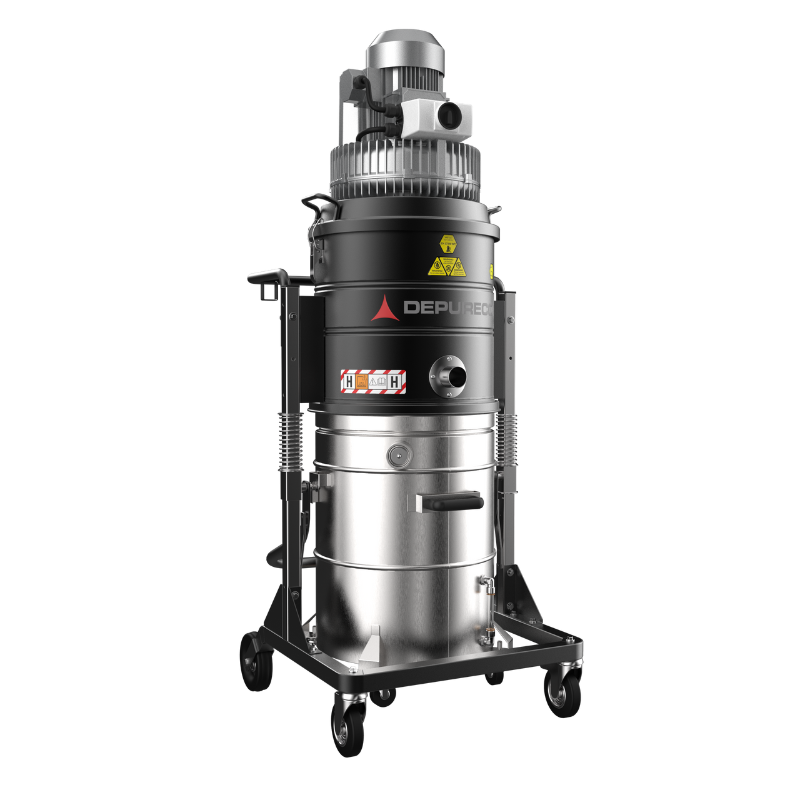
Depureco ECOBULL T DEX 1/2D INERT
Heavy-duty three-phase INERT for Zone 20/21 -- ECOBULL T with 3 kW side-channel blower, 340 m³/h, 230 mbar, cartridge HEPA13, N2 flush
- Industrial battery plants with Zone 21-classified lithium electrode lines
- Stationary aluminium grinding at larger factories with three-phase 400V
- Titanium grinding in aerospace and defense, continuous production runs
- Pharmaceutical production plants with reactive powders and strict Zone 20/21 zoning
- Zirconium and magnesium handling in process industries with higher airflow demand
- 3D-printing metal powder (Al/Ti) in continuous production lines
- ATEX Directive 2014/34/EU -- II 1/2D Ex h IIIC T160°C Da/Db
- EN 17348:2022 (harmonized March 2023)
- IEC 60335-2-69 (industrial vacuums)
Depureco ECOBULL T DEX 1/2D INERT
The ECOBULL T DEX 1/2D INERT is the three-phase big brother of the M 1/2D INERT and the safest, most robust combination Depureco delivers on the dust side of ATEX vacuums: 3 kW 400V side-channel blower with 340 m³/h and 230 mbar, N2-flushed inerting container, safety hydrogen vent, cartridge HEPA13 and the entire chassis built to EPL Da/Db (Zone 20 internal + Zone 21 external). It is the model for industrial production classified Zone 20 as a dust-exposed core area -- lithium battery blending stations, aluminium grinding cells with continuous production, titanium powder handling. The key difference from the M 1/2D (A1090) is not safety -- the protection level is identical -- but raw air performance: 40% more flow and 28% more vacuum means that several suction points can pull simultaneously, or that a single demanding process (continuous mechanical grinding cell or central vacuum over several metres of pipe) receives sufficient capacity. The ATEX class is II 1/2D Ex h IIIC T160°C Da/Db -- identical to the M 1/2D -- and the motor is a 3D-certified 3 kW 400V industrial side-channel blower from FPZ or Elektror, built to EN ISO 80079-36 (constructional safety).
Applications
- Industrial battery plants with Zone 21-classified lithium electrode lines
- Stationary aluminium grinding at larger factories with three-phase 400V
- Titanium grinding in aerospace and defense, continuous production runs
- Pharmaceutical production plants with reactive powders and strict Zone 20/21 zoning
- Zirconium and magnesium handling in process industries with higher airflow demand
- 3D-printing metal powder (Al/Ti) in continuous production lines
Technical specifications
| ATEX marking | II 1/2D Ex h IIIC T160°C Da/Db |
|---|---|
| Internal / external zone | 20 / 21 |
| Motor type | 2D ATEX-certificeret sidekanalblæser, 3 kW 3-faset 400V 50/60 Hz |
| Duty cycle | Continuous |
| Airflow | 340 m³/h |
| Vacuum | 230 mbar (2345 mmH₂O) |
| Container | 100 L |
| Sound pressure | 72 dB(A) |
| Filter class | H class |
| Filter type | Cartridge-primærfilter antistatisk polyester HEPA13 (EN 60335-2-69 klasse H) |
| Primary filter | Cartridge antistatisk polyester klasse HEPA13 |
| Cleaning system | Manuel filterrens (bagudtryk) |
| Collection system | Detachable container + INERT neutralisation bath |
| Material | Lakeret stålkonstruktion, AISI 304 støvbeholder med N2-fluxet inerting-indsats |
| IP class | IP55 |
| Power | 3.0 kW |
| Voltage | 400 V / 50-60 Hz |
| Venturi units | 0 pcs |
| Inlet | Ø 50 mm |
| Dimensions (L × W × H) | 660 x 800 x 1630 mm |
| Weight | 95 kg |
Questions and answers
Why is the T 1/2D not uprated in kW like the M 1/2D was?
Because it does not need to be. The 3 kW motor in the T series is *already* oversized relative to the 340 m³/h output. In the 1/3D variant, the same motor runs at around 75% of nominal load under normal operation, which provides plenty of thermal margin to maintain the T160°C limit even under the Da class two-fault scenarios. For the M series (only 1.8 kW in 1/3D), there was not the same reserve -- hence the uprate to 2.2 kW in 1/2D. The T series has enough design factor from the start. This is also why the price difference between T 1/3D and T 1/2D is smaller than between M 1/3D and M 1/2D: only the ATEX certification cost, not a motor uprate.
Can the T 1/2D handle central vacuum from multiple points simultaneously?
Yes, this is actually the classic application area. With 340 m³/h at 230 mbar, the T 1/2D can drive typically 3-4 simultaneous d50 suction points via a central pipe network (d80 main pipe, d50 outlets). Concrete calculation: each d50 suction wand on 25 m of pipe and 3 m of hose requires about 70-80 m³/h and 60 mbar for effective metal-powder collection. 340 / 80 = 4 simultaneous points with reserve for individual pressure drops. Important: the pipe network must be antistatic (Depureco supplies electrically conductive PVC/metal pipe for central installation, typically 80-150 €/metre installed), and there must be an earth connection at each endpoint. Contact us for sizing the central network -- we typically make a flow model for customers building installations with more than 2 suction points.
Can the T 1/2D INERT be used for collecting lithium battery powder during production?
Yes -- this is actually the primary application Depureco designed the model for. In modern lithium battery factories (cell manufacturing, electrode coating, active material handling), the blending cells and electrode coater rooms are classified Zone 20 (continuous presence of active-material dust), and the T 1/2D INERT is one of the few commercially available mobile collectors that may be used in these zones. Important to know: (1) N2 inerting must be active *before* collection begins, not after -- O2 must be below 8% before the motor starts; (2) the lockable lid remains closed between cycles, and collected material is handed off in a sealed container for further processing; (3) the collected powder must continue to be handled as reactive material after tipping, typically via cabinet with N2 atmosphere. The model is currently installed at several European battery cell producers -- contact us for references.
What is the power consumption in practice, and are there any start-up surge problems?
Nominally, 3 kW three-phase 400V draws about 5.4 A per phase at full load (calculated as P / (√3 · V · cosφ) with cosφ = 0.8), and under normal operation 3.8-4.5 A. Start-up surge for a side-channel blower is around 5 times nominal current in the first 0.5 second = about 27 A per phase, which the 16 A breaker handles for short periods (magnetic release at 5-10 times rated current). Important for installation: connect via a motor starter with *adjustable* d-curve (consumer-grade b- or c-curve breakers may trip unexpectedly). The earth connection is PE + local equipotential bonding -- never connected as a separate neutral. Power consumption over an 8-hour workday: about 12-18 kWh depending on duty cycle, i.e. 2-3 € at an industrial power price of 0.15 €/kWh.
Can the ECOBULL T 1/2D INERT also pick up liquids together with reactive powder?
It is built with a *liquid drain* and a *150 micron liquid filter* on the intake, so it can handle contaminated mixtures (e.g. cutting fluid with metal swarf), but it *is not primarily designed as a liquid collector*. In INERT mode, the chamber is filled with N2, and larger quantities of liquid dilute the N2 atmosphere and raise the O2 level -- which compromises the safety level. In practice: use it for collection of *dry* reactive powder; for mixed liquid-and-powder, consider the FOX 25 LP DEX series (ATEX wet/dry vacuums with separate container insert). If you absolutely must do liquid collection in Zone 20/21 -- talk to us first. It is not a recommendation we give lightly.
Is there certification documentation I need to present on receipt?
Yes. Each T 1/2D INERT is delivered with: (1) EU declaration of conformity per directive 2014/34/EU (ATEX product directive), (2) ATEX type examination certificate from a notified body (typically IMQ CESI or TUV NORD), (3) factory test report with O2 level measurement and N2 flow calibration, (4) EN ISO 80079-36/37 constructional report for the Ex h enclosure, (5) EN 60335-2-69 test report for HEPA13 filter performance, (6) service manual in DA and EN. These documents form your ATEX 'as-delivered' package and must be included in your Explosion Protection Document (directive 1999/92/EC art. 8). If anything in the archive folder is wrong -- for instance a defective type approval -- the machine must be taken out of operation. We keep the originals and can reissue copies within 24 hours.