
Delfin EXP 50 INERT
Three-phase ATEX vacuum for Zone 22 with INERT neutralisation bath -- 4 kW side-channel blower, 44 L tank in AISI 304 and pressure relief valve
- Stationary process plants with large quantities of reactive metal powder
- Central 3D-print vacuuming with aluminium or titanium powder
- Defense ammunition facilities with continuous production
- Light-metal machining with high dust volume in Zone 22
- Powder metallurgy with round-the-clock operation and larger particle fractions
- ATEX Directive 2014/34/EU -- II 3D Ex h tc IIIC T80°C (int) /T165°C (ext) Dc
- EN 17348:2022 (harmonized March 2023)
- IEC 60335-2-69 (industrial vacuums)
Delfin EXP 50 INERT
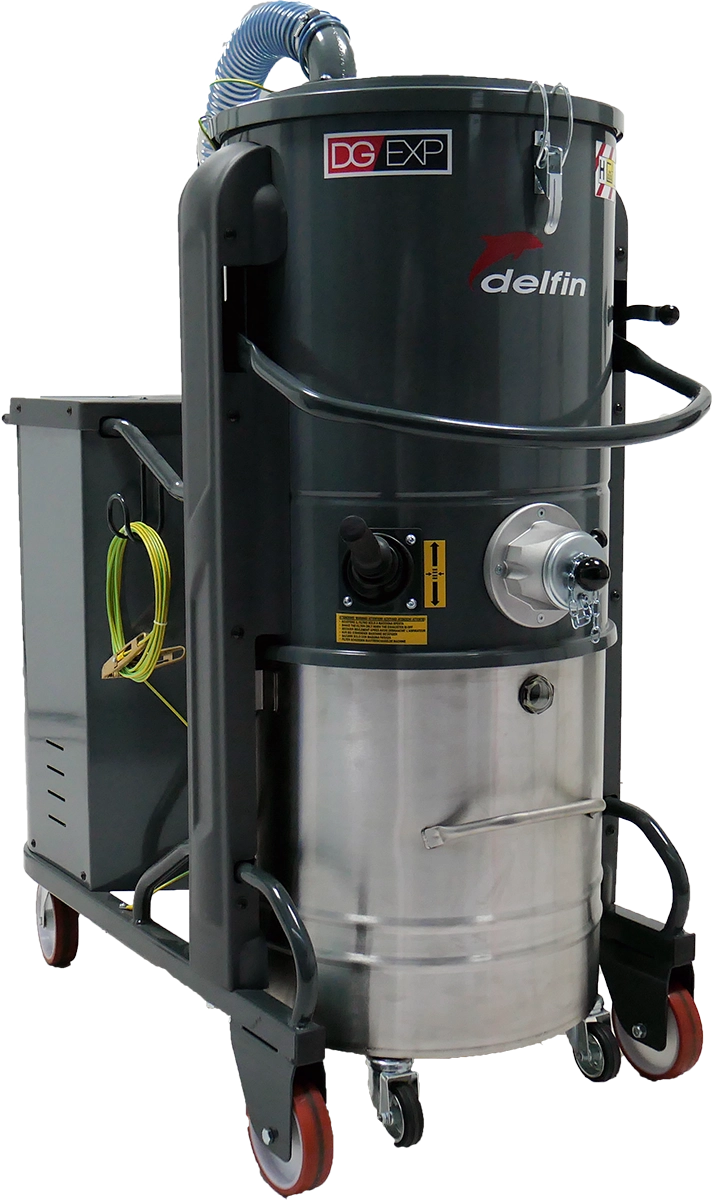
The Delfin EXP 50 INERT is the 4 kW variant of the DG EXP INERT series -- a stationary industrial vacuum with three-phase side-channel blower, 420 m³/h airflow and 44-litre neutralisation tank (37 L liquid + 7 L material) in AISI 304. Same pressure relief valve and H-HEPA final filtration as the ZFR 75 INERT, but with higher airflow and larger dimensions (66 x 118 x 145 cm). ATEX-certified for Zone 22 (II 3D Ex h tc IIIC) and performance-tested to EN 17348:2022. Used at process plants where airflow and continuous operation require a step up from the ZFR series.
Applications
- Stationary process plants with large quantities of reactive metal powder
- Central 3D-print vacuuming with aluminium or titanium powder
- Defense ammunition facilities with continuous production
- Light-metal machining with high dust volume in Zone 22
- Powder metallurgy with round-the-clock operation and larger particle fractions
Technical specifications
| ATEX marking | II 3D Ex h tc IIIC T80°C (int) /T165°C (ext) Dc |
|---|---|
| Internal / external zone | 22 / 22 |
| Motor type | Sidekanalblæser, 3-faset (4 kW, 8,4 A) |
| Duty cycle | Continuous |
| Airflow | 420 m³/h |
| Vacuum | 314 mbar (3200 mmH₂O) |
| Container | 44 L |
| Sound pressure | 72 dB(A) |
| Filter class | H class |
| Filter type | Klasse H HEPA H14 (EN 1822-5), 99,995 % MPPS, 26.000 cm² filterflade |
| Primary filter | Stjerne/taske polyester ANT M-klasse antistatisk, 30.000 cm², diameter 500 mm |
| Cleaning system | Manuel filterrensning + trykudligningsventil inkluderet |
| Collection system | INERT neutralisation bath |
| Material | Lakeret stålkonstruktion (krop), AISI 304 INERT-beholder, ABS tilbehørsholder |
| IP class | IP65 |
| Power | 4.0 kW |
| Current | 8.4 A |
| Voltage | 400 V / 50 Hz / 3~ |
| Inlet | Ø 50 mm |
| Dimensions (L × W × H) | 660 x 1180 x 1450 mm |
| Weight | 137 kg |
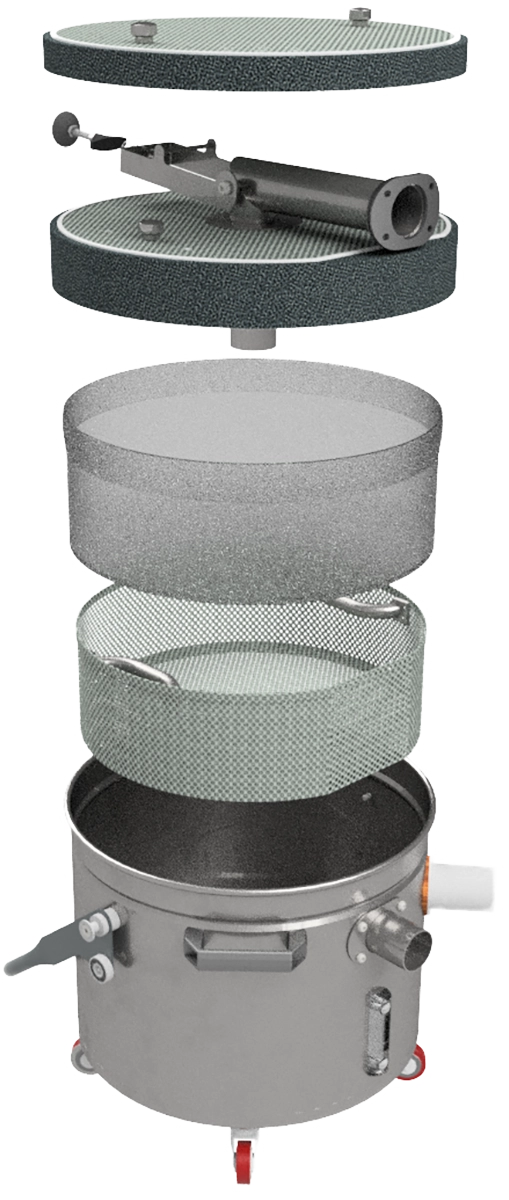
INERT TECHNOLOGY — EN 17348:2022
What is an INERT vacuum cleaner?
Delfin's INERT vacuum cleaners are built to collect reactive metallic dust — the kind of dust that can self-ignite or react violently with oxygen, heat or water. Instead of collecting dust dry in a bag or container, the vacuum channels it directly into a neutralising liquid bath (typically water with a passivating agent added), where the reactive metal particle is inactivated on the spot. That is the difference between a controlled process and a vacuum that can itself become the ignition source.
Tested to EN 17348:2022
The INERT range is certified and performance-tested to EN 17348:2022, the harmonized European standard for industrial vacuum cleaners in ATEX zones. The test confirms that the neutralisation system actually inactivates reactive dust under real operating conditions — not merely in a lab setup. Combined with HEPA H14 final filtration (99.995 % efficiency at MPPS per EN 1822-5), the exhaust is clean down to the finest health-hazardous particles.
Typical applications
INERT vacuums are used at shooting ranges (lead dust and primer residue from cartridges), in ammunition manufacturing, for 3D printing with metal powders (aluminium and titanium are highly reactive when finely divided), in light-metal machining in aerospace and defense, and at process plants where pyrophoric powders such as zirconium and magnesium are handled. Some models are ACD-certified (IEC 60335-2-69 Annex AA) for non-ATEX-classified areas, others are ATEX-certified for Zone 20, 21 or 22 — but they all share the same neutralising liquid bath and the same uncompromising filtration.
INERT versus conventional HEPA filtration
A conventional HEPA vacuum retains particles in a filter but leaves them dry and potentially reactive. With reactive metallic dust that is not enough — the particle may react with oxygen (exothermic oxidation) or moisture (hydrolysis of certain metal hydrides) and disrupt the collection process itself. INERT technology solves this by inactivating the particle at the moment of collection: dust is immersed in the liquid before it can react, and the HEPA H14 filter then captures any residual aerosol before exhaust.
Questions and answers
What does INERT mean in this context?
INERT denotes a vacuum cleaner with a neutralising liquid bath in the collection tank. Dust is channelled directly into the liquid and inactivated immediately, so it cannot react with oxygen, heat or sparks. The technology is developed for reactive metallic dust (aluminium, titanium, magnesium, zirconium, lead dust from shooting ranges), where conventional dry collection would itself be an ignition source.
Is the INERT system tested to EN 17348:2022?
Yes. The entire Delfin INERT range is performance-tested to EN 17348:2022 -- the harmonized European standard for industrial vacuum cleaners in ATEX zones. The test confirms that the neutralisation bath actually inactivates reactive dust under real operating conditions, not just in a lab setup. Documentation available on request.
What types of dust is INERT technology intended for?
Reactive metallic dust: aluminium and aluminium alloys, titanium, magnesium, zirconium, fine iron powder, lead dust and primer residue from shooting ranges, and pyrophoric powders from aerospace and defense. For non-reactive dust (organic process dust, plastics, etc.) the INERT technology adds no further safety -- a standard ATEX or ACD model without liquid bath is selected instead.
How does the HEPA H14 final filter work together with the liquid bath?
The neutralisation bath inactivates dust at the moment of collection, but there will always be a fine aerosol fraction that passes the liquid surface. The HEPA H14 filter captures 99.995 % of particles down to 0.3 micrometres per EN 1822-5 (MPPS method) before exhaust. The combination secures both safe collection (no reactive dry particle) and clean exhaust (no health-hazardous aerosol). The filter is Included/Incluso as standard on all INERT models.
When is the EXP 50 INERT better than the ZFR 75 INERT?
The EXP 50 INERT has 32 % higher airflow (420 vs 318 m³/h) and higher vacuum (3200 vs 3000 mmH₂O max), and is built for larger process plants with stationary installation. However, it is significantly larger (66 x 118 x 145 cm vs 79 x 66 x 170 cm) and heavier (137 vs 95 kg). Choose the EXP 50 where airflow is the bottleneck and stationary installation is feasible; choose the ZFR 75 where a more compact footprint matters.
Is the EXP 50 INERT suited to continuous 24/7 operation?
Yes. The side-channel blower is maintenance-free (no brushes, no bearings requiring periodic lubrication) and built for continuous industrial operation. Combined with the pressure relief valve and HEPA final filtration, the machine can run round-the-clock under typical process conditions. The liquid in the neutralisation tank must however be checked and refilled after each collection cycle.