
Delfin MTL 3533 EX1/2D
Three-phase side-channel blower -- third-party certified (notified body) per EN 17348:2022, internal Zone 20 + external Zone 21, 4.0 kW, 45 L stainless container
- Pharmaceutical production in Zone 21 where both continuous duty and HEPA H14 fine filtration are requirements
- Collection of fine combustible dust (e.g. lactose, cellulose, API powders) during packaging or tableting operations
- Chemical process plants with likely explosive dust in Zone 21 where notified-body documentation is requested by compliance audits
- Servicing and cleaning of filter units and cyclones in active Zone 21 areas
- Metalworking with fine aluminium, magnesium or titanium dust requiring external Zone 21 approval
- Process-adjacent dust collection where three-phase power is available and a compact footprint (0.93 x 0.58 m) is required
- Post-production cleaning of production cells in batch pharmaceutical manufacture, where internal Zone 20 construction simplifies ATEX risk assessment
- ATEX Directive 2014/34/EU -- II 1/2D Ex h IIIC T160°C Da/Db
- EN 17348:2022 (harmonized March 2023)
- IEC 60335-2-69 (industrial vacuums)
Delfin MTL 3533 EX1/2D
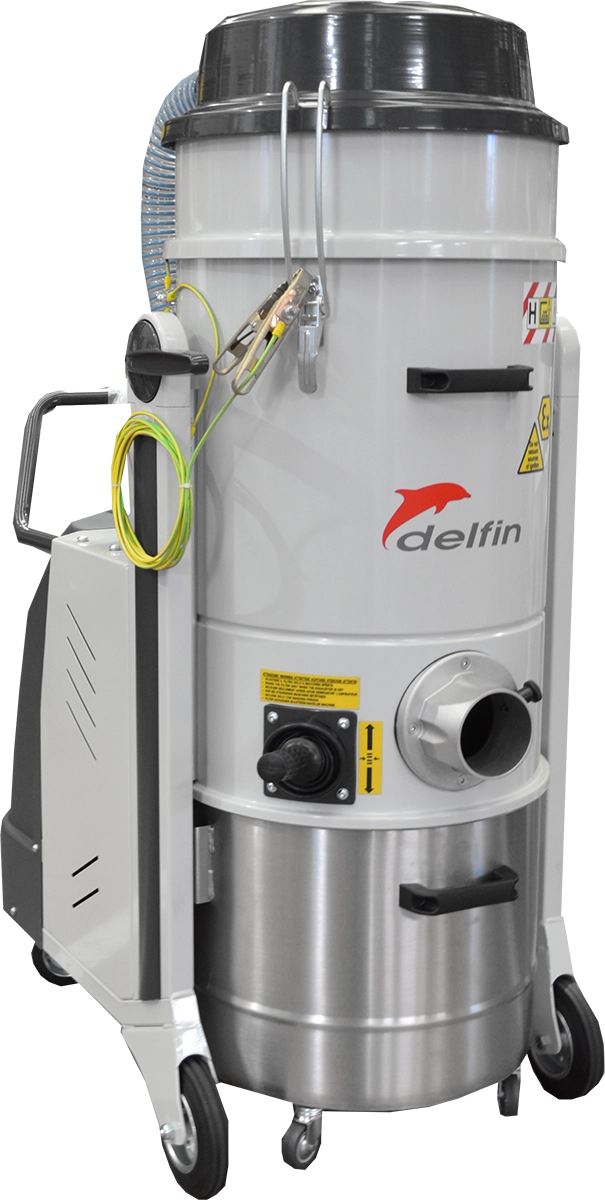
The Delfin MTL 3533 EX1/2D is the compact mid-range model in Delfin's dual-certified ATEX range: a 4 kW side-channel blower in AISI 304 stainless construction, third-party certified by a notified body in compliance with EN 17348:2022 for internal Zone 20 and external Zone 21 (ATEX marking II 1/2D Ex h IIIC T160°C Da/Db). Built for continuous duty with HEPA H14 absolute filter as standard, it delivers 320 m³/h airflow and 2600 mmH²O vacuum at 69 dB(A) -- a quiet profile that suits pharmaceutical production areas, process plants with fine combustible dust, and service work in Zone 21-classified rooms. The 45-litre stainless collection tank is emptied using an antistatic plastic bag, keeping dust handling both contained and ESD-controlled.
Applications
- Pharmaceutical production in Zone 21 where both continuous duty and HEPA H14 fine filtration are requirements
- Collection of fine combustible dust (e.g. lactose, cellulose, API powders) during packaging or tableting operations
- Chemical process plants with likely explosive dust in Zone 21 where notified-body documentation is requested by compliance audits
- Servicing and cleaning of filter units and cyclones in active Zone 21 areas
- Metalworking with fine aluminium, magnesium or titanium dust requiring external Zone 21 approval
- Process-adjacent dust collection where three-phase power is available and a compact footprint (0.93 x 0.58 m) is required
- Post-production cleaning of production cells in batch pharmaceutical manufacture, where internal Zone 20 construction simplifies ATEX risk assessment
Technical specifications
| ATEX marking | II 1/2D Ex h IIIC T160°C Da/Db |
|---|---|
| Internal / external zone | 20 / 21 |
| Motor type | Three-phase side-channel blower |
| Duty cycle | Continuous |
| Airflow | 320 m³/h |
| Vacuum | 255 mbar (2600 mmH₂O) |
| Container | 45 L |
| Sound pressure | 69 dB(A) |
| Filter class | H class |
| Filter type | HEPA H14 (EN 1822-5), 99.995 % MPPS, 27,100 cm² filter area, included as standard |
| Primary filter | Star/bag filter, antistatic polyester M class (ANT M), 20,000 cm², Ø 420 mm |
| Collection system | Plastic bag |
| Material | AISI 304 stainless steel (container as standard; filter housing as option) |
| IP class | IP65 |
| Power | 4.0 kW |
| Current | 7.4 A |
| Voltage | 400 V / 50 Hz / 3~ |
| Inlet | Ø 80 mm |
| Dimensions (L × W × H) | 930 x 580 x 1160 mm |
| Weight | 85 kg |
Questions and answers
What does it mean that the MTL 3533 EX1/2D is third-party certified, and why does it matter?
Third-party certification means that a notified body (an independent, EU-accredited technical test house) has conducted the technical evaluation and issued an EU type-examination certificate under the ATEX Directive 2014/34/EU. For category 1 equipment (such as internal Zone 20 components) it is a legal requirement, while for category 2 it is chosen voluntarily to document a higher level of safety. The model is covered by the harmonised standard EN 17348:2022 for industrial vacuum cleaners for use in explosive atmospheres, giving a direct presumption of conformity. In practice the notified-body certificate is often requested by insurers, safety engineers and compliance audits in pharmaceutical and chemical production.
What does the marking II 1/2D Ex h IIIC T160°C Da/Db mean in practical terms?
"II" is equipment group II -- surface installations (not mining). "1/2" indicates internal/external category: 1 means internal category 1 (Zone 20, continuous explosive dust atmosphere inside the machine) and 2 means external category 2 (Zone 21, explosive dust atmosphere likely during normal operation in the room around the machine). "D" is Dust. "Ex h" is constructional safety per EN ISO 80079-36/37. "IIIC" is the strictest dust group -- covering combustible non-conductive and conductive (metal) dust. "T160°C" is the maximum surface temperature of components in contact with dust. "Da/Db" is the Equipment Protection Level (EPL): Da = "very high protection" internally, Db = "high protection" externally. The digits 1 and 2 in this marking NEVER refer to gas zones.
What is the difference between the MTL 3533 EX1/2D and the older MTL 3533 ATEX (self-certified)?
Motor, cabinet and basic air performance are comparable, but the MTL 3533 EX1/2D is a separate notified-body certified product with its own EU type-examination. The practical difference is threefold: (1) It covers external Zone 21 -- the older version is not certified for Zone 21. (2) The ATEX marking uses the new EN 17348:2022 notation with a single T160°C instead of split internal/external T-classes. (3) The documentation package includes the notified-body certificate, which is a requirement in certain insurance policies and internal compliance standards. Technically the MTL 3533 EX1/2D is the correct choice if there is doubt about zone classification or if future-proofing against coming EN 17348 harmonisation is desired.
Can the MTL 3533 EX1/2D be used in Zone 22 instead of a 1/3D model?
Yes. The ATEX hierarchy allows a category 2-certified machine (covering Zone 21) to also be used in Zone 22, which is the less strict external zone. The 1/2D class therefore covers both Zone 21 and Zone 22 externally. If the work area is unambiguously Zone 22, a 1/3D variant is typically more economical, but 1/2D gives flexibility to move the machine between areas with varying zone classification. Conversely -- a 1/3D model must NOT be used in Zone 21. The decision follows the zone plan in the employer's ATEX explosion-protection document (Article 8, Directive 1999/92/EC).
How does the collection work in practice, and why an antistatic plastic bag?
Dust is collected in an open antistatic plastic bag placed inside the 45-litre stainless collection tank. At commissioning the bag is attached to the upper edge of the tank, and the tank vacuum presses the bag against the wall so that the bag sides are stabilised during operation. The antistatic construction (surface resistance below 10⁹ Ω) ensures that electrostatic charges from dust transport are conducted to ground through the tank and the vacuum's earth-bonding clamp -- a critical defence against spark ignition in Zone 20/21. At emptying the bag is closed, removed, and the dust is disposed of in closed packaging according to the site's combustible-dust procedure. The method is both continuity-break-minimising and ESD-controlled.
Is the 69 dB(A) sound pressure realistic in daily operation, and does it require hearing protection?
The 69 dB(A) figure is measured per EN ISO 3744 at 1 m distance in free air without suction accessories. In daily operation with hose and suction tool the level often falls further, because accessories act as silencers. The Danish Working Environment Act action limit for hearing-protection use is 85 dB(A) daily noise exposure (LEX,8h), so the MTL 3533 EX1/2D is well below the limit even with 8 hours' continuous operation at 1 m. In practical production environments with ambient noise the total level may be higher -- a noise survey should be performed as part of the workplace risk assessment. The level is, however, among the lowest in its class for three-phase side-channel technology, making the model popular in pharmaceutical production where quiet operation is highly valued.
Which EN standard is decisive for the IIIC classification, and why choose IIIC over IIIA/IIIB?
IIIC is the dust-group classification in EN 60079-0 and covers the broadest application range: conductive dust -- e.g. metal dust from aluminium, magnesium, iron or carbon-based dust -- which is stricter than IIIA (combustible flyings such as fibres) and IIIB (non-conductive dust such as flour or sugar). By classifying the MTL 3533 EX1/2D as IIIC, Delfin covers all three sub-classes in one product. This simplifies material selection, because companies often have mixed dust types on the same production line (e.g. metal powder and polymer), and avoids situations where a dust-group-specific machine no longer fits after a process change. For customers handling IIIB dust only, the IIIC model is therefore not more expensive to run -- only to procure -- but provides future-proofing.