
Depureco PUMA 25 DEX 1/3D
- Heavy industry and three-shift operation in Zone 22
- Powder metallurgy and metal grinding chips
- Steelworks and foundries
- Multiple simultaneous collection points via central system
- Larger production plants with internal Zone 20 requirement
- ATEX Directive 2014/34/EU -- II 1/3D Ex htc IIIC T140°C Da/Dc
- EN 17348:2022 (harmonized March 2023)
- IEC 60335-2-69 (industrial vacuums)
Depureco PUMA 25 DEX 1/3D
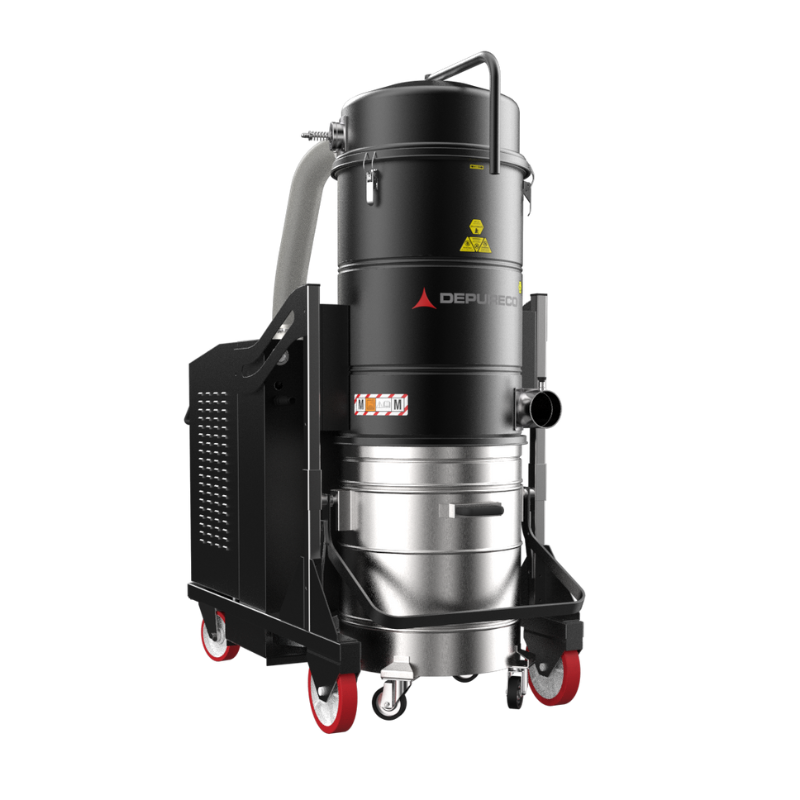
The Depureco PUMA 25 DEX 1/3D is the PUMA chassis with TUEV-certified electrical panel and 1/3D certification -- built for heavy industrial duty in Zone 22. Three-phase 18.5 kW side-channel blower, 175 L container, 100 mm tangential inlet and 1350 m3/h airflow at 270 mbar vacuum. Manual filter cleaning. ATEX II 1/3D Ex htc IIIC T140°C Da/Dc. Remote control included. Suited to three-shift operation, powder metallurgy, steelworks and larger production plants with internal Zone 20 requirement.
Applications
- Heavy industry and three-shift operation in Zone 22
- Powder metallurgy and metal grinding chips
- Steelworks and foundries
- Multiple simultaneous collection points via central system
- Larger production plants with internal Zone 20 requirement
Technical specifications
| ATEX marking | II 1/3D Ex htc IIIC T140°C Da/Dc |
|---|---|
| Internal / external zone | 20 / 22 |
| Motor type | Sidekanalblæser 3-fase (18.5 kW), TUEV-certificeret el-panel + remote control |
| Duty cycle | Continuous |
| Airflow | 1350 m³/h |
| Vacuum | 270 mbar (2753 mmH₂O) |
| Container | 175 L |
| Sound pressure | 74 dB(A) |
| Filter class | M class |
| Filter type | Stjernefilter antistatisk polyester klasse M, 45.000 cm2, manuel rens |
| Primary filter | Stjernefilter antistatisk polyester klasse M, 45.000 cm2 |
| Cleaning system | Manuel filterrens |
| Collection system | Detachable container |
| Material | Lakeret stålkonstruktion, AISI 304 støvbeholder |
| IP class | IP65 |
| Power | 18.5 kW |
| Voltage | 400 V / 50-60 Hz |
| Inlet | Ø 100 mm |
| Dimensions (L × W × H) | 850 x 1550 x 1980 mm |
| Weight | 370 kg |
Questions and answers
How is the PUMA range positioned compared to FOX?
PUMA is heavy-industrial class: 100 mm inlet (vs FOX 80 mm), 175 L container (vs FOX 100 L), larger chassis (850 x 1550 mm), TUEV-certified electrical panel and remote control. No internal cyclone -- PUMA is intended for clean fine-dust collection without large fractions. FOX has a cyclone and is better for mixed dust sizes.
What is the difference between PUMA DEX and PUMA SP DEX?
The DEX variant (PUMA 25 DEX 1/3D) has a star filter 45,000 cm2 with manual cleaning. The SP variant (PUMA 25 SP DEX 1/3D) has a larger star filter 120,000 cm2 with automatic reverse jet cleaning. SP is for continuous operation without operator intervention and longer interval between container emptying; DEX is cheaper and suited to periodic operation with regular filter-cleaning cycles.
How much airflow does the PUMA 25 DEX 1/3D deliver (18.5 kW)?
1350 m3/h at 270 mbar vacuum. Can drive 1-3 simultaneous 100 mm collection points depending on hose length and dust load. The largest variant (PUMA 25 DEX) delivers 1350 m3/h and can drive 4-6 collection points.
What is the TUEV-certified electrical panel and why is it important?
A TUEV-certified electrical panel is a control-panel design that has passed safety review at TUEV (technical inspection). In ATEX environments it ensures electrical components have the correct IP class, proper termination and proper overcurrent protection. Important in insurance and regulatory contexts -- many steelworks and pharma plants require a TUEV panel as a condition for installation.
How heavy is the PUMA 25 DEX 1/3D and can it be moved?
370 kg. The PUMA range is heavy-industrial stationary -- installed fixed. Relocation between service areas requires pallet truck or crane. For mobility between workstations choose the FOX range (142-242 kg) or ECOBULL (95 kg).
Can PUMA run with multiple simultaneous collection points?
Yes. The remote control allows central start/stop and operation-status monitoring. A Y-manifold can be connected to distribute the 100 mm suction among multiple collection points -- note that total airflow is divided over points, so single-point airflow drops proportionally. Larger models (PUMA 20/25) have enough airflow for 4-6 simultaneous points.