
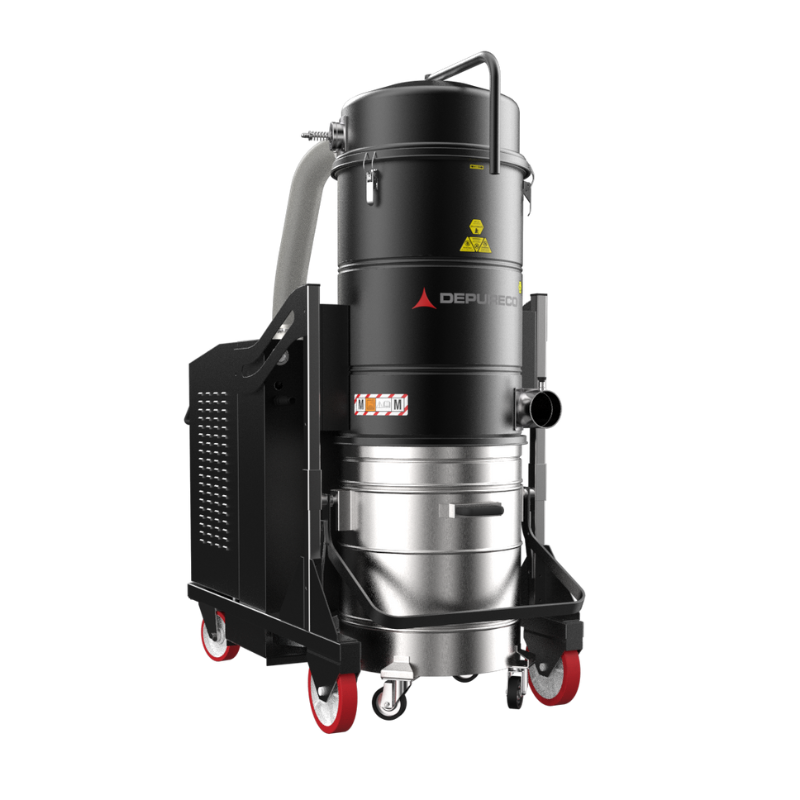
Depureco PUMA 25 SP DEX 1/2D
- Large-scale continuous production (bakery, cement, metallurgy) 24/7
- Central suction station for whole departments with 6-8 simultaneous points
- Automated conveyor lines with high bulk dust loading
- Dust collection at large-scale palletising or container filling
- Replacement of multiple smaller units in a central consolidation
- ATEX Directive 2014/34/EU -- II 1/2D Ex htc IIIC T140°C Da/Dc
- EN 17348:2022 (harmonized March 2023)
- IEC 60335-2-69 (industrial vacuums)
Depureco PUMA 25 SP DEX 1/2D
The PUMA 25 SP DEX 1/2D is the 24/7 top of the standard PUMA range: 18.5 kW motor + a 120,000 cm2 star filter with automatic reverse jet + TUEV panel with remote control. 1350 m3/h at 270 mbar for handling a whole department's continuous dust collection without operator intervention. ATEX II 1/2D Ex htc IIIC T140°C Da/Dc, H14 HEPA (110,000 cm2) included. 370 kg chassis for the highest flows in the PUMA family. The right installation for large-scale Zone 21 production that cannot stop for any kind of filter handling.
Applications
- Large-scale continuous production (bakery, cement, metallurgy) 24/7
- Central suction station for whole departments with 6-8 simultaneous points
- Automated conveyor lines with high bulk dust loading
- Dust collection at large-scale palletising or container filling
- Replacement of multiple smaller units in a central consolidation
Technical specifications
| ATEX marking | II 1/2D Ex htc IIIC T140°C Da/Dc |
|---|---|
| Internal / external zone | 20 / 21 |
| Motor type | Three-phase side-channel blower (18.5 kW), TÜV-certified electrical panel + remote control |
| Duty cycle | Continuous |
| Airflow | 1350 m³/h |
| Vacuum | 270 mbar (2753 mmH₂O) |
| Container | 175 L |
| Sound pressure | 74 dB(A) |
| Filter class | M class |
| Filter type | Antistatic polyester star filter, class M, 120,000 cm2, reverse jet cleaning (automatic) + H14 absolute filter 110,000 cm2 (included) |
| Primary filter | Antistatic polyester star filter, class M, 120,000 cm2 |
| Cleaning system | Automatisk reverse jet cleaning |
| Collection system | Detachable container |
| Material | Painted steel construction, AISI 304 dust container |
| IP class | IP65 |
| Power | 18.5 kW |
| Voltage | 400 V / 50-60 Hz |
| Inlet | Ø 100 mm |
| Dimensions (L × W × H) | 850 x 1550 x 1980 mm |
| Weight | 370 kg |
Questions and answers
How many kilowatt-hours does the PUMA 25 SP consume per year?
At 5-day-week 16-hour operation: about 15 kWh/hour x 16 hours x 260 days = about 62,400 kWh/year. At 24/7 continuous: about 131,000 kWh/year. Electricity cost at EUR 0.20/kWh industrial rate: about EUR 12,500 to 26,300/year. Compressed-air consumption on top = an additional ~EUR 200. Compare against OPEX and operator-time savings to verify the business case.
Is there a point where the PUMA 25 SP is undersized and I should look at PUMA HD?
Yes. PUMA HD DEX 1/2D (A273/A278) has a 130 mm inlet and motors of 22 kW (30P) or 18.5 kW (30S). Switch to PUMA HD if: (1) the inlet must be 130 mm to handle coarse dust or long horizontal runs; (2) you need over 1,500 m3/h flow (PUMA 30P = 1940); (3) or you need 380+ mbar vacuum (PUMA 30S = 380). The PUMA 25 SP hits about 85-90% of PUMA 30-class performance at 60% of the price -- so jump only if you actually cross those limits.
How is heat dissipation from the 18.5 kW motor handled?
Under full load the motor dissipates about 3-4 kW of heat to the surroundings (the rest goes into suction work). In a 200 m3 room with ventilation turnover once per hour, that raises temperature about 0.5-1°C above outdoor ambient. If the room is small (under 50 m3), consider supplementary ventilation or relocation to a larger room. In a large well-ventilated room: no intervention needed.
Can the PUMA 25 SP be used as a pre-separator for a PUMA HD or a central plant?
Not in the traditional sense -- the PUMA 25 SP is a standalone vacuum unit, not a stationary pre-separator. For pre-separation ahead of a PUMA HD, the DM range is designed for that. But two PUMA units can run in parallel with a manifold for load sharing or redundancy (see also the PUMA 10 SP FAQ on parallelisation). Note that a dual-SP configuration requires double the compressed-air supply.