
Tiger-Vac EXP1-55 (DMB) TE
Single-phase TEFC ATEX vacuum with Dead Man Brake for Zone 1 gas + Zone 21 dust -- 151 L dry / 170 L liquid, self-engaging safety brake, EN 17348 LC -- flagship for defense use
- Defueling and depuddling of military aircraft (F-35, legacy fighters) in hangars
- Recovery of JP-8, Jet A-1 and diesel spills around refueling stations
- Depot work with fuel residues in defense logistics (NSN/NATO)
- Civilian aviation MRO -- wing-tank emptying during service checks
- Chemical industry with flammable solvents (toluene, acetone, alcohols) in Zone 1/21
- ATEX Directive 2014/34/EU -- II 2GD Ex d IIA T3 Gb / Ex t IIIC T200°C Db IP6X -- LCIE 03 ATEX 6297 -- EN 17348 LC
- EN 17348:2022 (harmonized March 2023)
- IEC 60335-2-69 (industrial vacuums)
Tiger-Vac EXP1-55 (DMB) TE
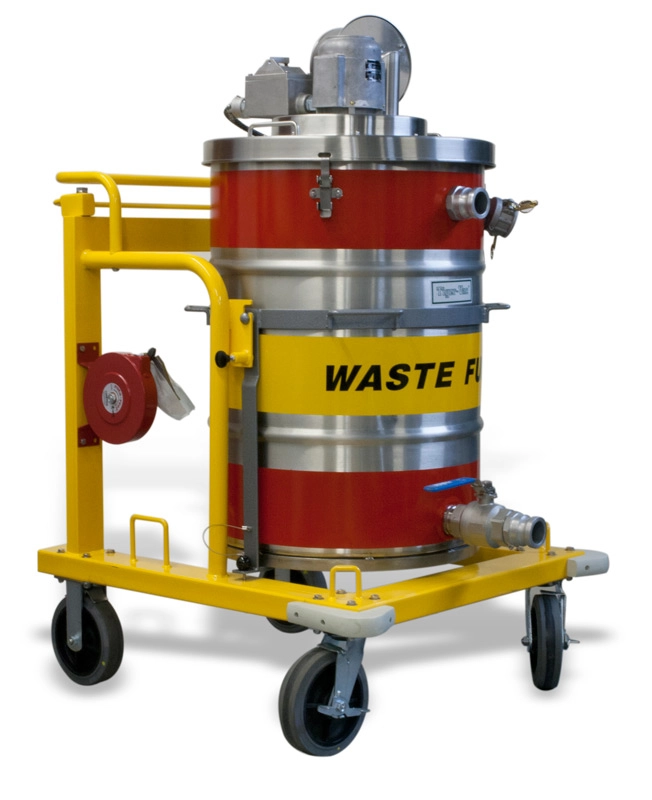
The Tiger-Vac EXP1-55 (DMB) TE is the flagship of the TE series for hangar and field operations where operator safety is critical. The Dead Man Brake (DMB) cart requires active pressure on the brake handle to roll -- release the handle and the rear brakes engage automatically, stopping the unit. This eliminates the risk of a 98 kg machine rolling away on a sloped hangar floor with 170 L of fuel inside. Same motor and flow as EXP1-55 (TC) TE (single-phase TEFC, 224 m3/h, 1550 mmH2O, 50 mm inlet), but larger footprint (104 x 86 cm) to accommodate the DMB mechanism. ATEX II 2GD certified -- LCIE 03 ATEX 6297 with EN 17348 LC for flammable and non-flammable liquids.
Applications
- Defueling and depuddling of military aircraft (F-35, legacy fighters) in hangars
- Recovery of JP-8, Jet A-1 and diesel spills around refueling stations
- Depot work with fuel residues in defense logistics (NSN/NATO)
- Civilian aviation MRO -- wing-tank emptying during service checks
- Chemical industry with flammable solvents (toluene, acetone, alcohols) in Zone 1/21
Technical specifications
| ATEX marking | II 2GD Ex d IIA T3 Gb / Ex t IIIC T200°C Db IP6X -- LCIE 03 ATEX 6297 -- EN 17348 LC |
|---|---|
| Internal / external zone | -- / 21 |
| Motor type | Single-phase TEFC motor, explosion-proof (Ex d IIA T3 Gb / Ex t IIIC T200°C Db), 1.0 kW / 4.5 A |
| Duty cycle | Continuous |
| Airflow | 224 m³/h |
| Vacuum | 152 mbar (1550 mmH₂O) |
| Container | 151 L |
| Sound pressure | 78 dB(A) |
| Filter class | Stainless steel mesh filter (not HEPA-classified, for liquid recovery) |
| Filter type | Stainless steel mesh filter with clamp (part 213433) -- activated carbon filter (211045) optional |
| Primary filter | Stainless steel mesh filter (213433) + strainer basket 211796. Static conductive construction (< 10 ohm). |
| Cleaning system | None (manual) -- mesh filter is removed and rinsed clean |
| Collection system | Detachable container |
| Material | AISI 304 stainless steel (except cart) |
| IP class | IP6X |
| Power | 1.0 kW |
| Current | 4.5 A |
| Voltage | 230 V / 50 Hz / 1~ |
| Inlet | Ø 50 mm |
| Dimensions (L × W × H) | 1040 x 860 x 1370 mm |
| Weight | 98 kg |
Questions and answers
What is Dead Man Brake and why is it important?
Dead Man Brake (DMB) is a mechanical safety system that engages the rear brakes when the operator releases the brake handle. It means the unit CANNOT roll away without active supervision -- an important risk reduction when a 98 kg machine with 170 L of flammable contents stands on a sloped hangar floor or at an open fuel tank. The principle is the same as on industrial forklifts and locomotives: if the operator collapses, falls ill, or leaves the unit, it stops itself. DMB is required in many defense procurements following MEEP program specifications.
What's the difference between EXP1-55 (DMB) TE and EXP1-55 (TC) TE?
Both share the same motor, flow, vacuum, tank capacity and filtration. The difference is the cart: TC = Tilt Cart with tipping for emptying, DMB = Dead Man Brake with self-engaging brake. TC is optimised for easy emptying (tipping), DMB for operator safety (anti-runaway). DMB is 30 kg heavier (98 kg vs 68 kg) and has a larger footprint (104 x 86 cm vs 102 x 76 cm). Choose TC when frequent emptying is daily. Choose DMB when the unit works unattended or on sloped surfaces.