
Tiger-Vac EXP1-55 (TC) TE
Single-phase TEFC ATEX vacuum for Zone 1 gas + Zone 21 dust -- 151 L dry / 170 L liquid, Tilt Cart (TC) for fuel recovery, EN 17348 LC for flammable liquids -- 151 L dry / 170 L liquid, 50 mm inlet for high-volume recovery
- Defueling and depuddling of military aircraft (F-35, legacy fighters) in hangars
- Recovery of JP-8, Jet A-1 and diesel spills around refueling stations
- Depot work with fuel residues in defense logistics (NSN/NATO)
- Civilian aviation MRO -- wing-tank emptying during service checks
- Chemical industry with flammable solvents (toluene, acetone, alcohols) in Zone 1/21
- ATEX Directive 2014/34/EU -- II 2GD Ex d IIA T3 Gb / Ex t IIIC T200°C Db IP6X -- LCIE 03 ATEX 6297 -- EN 17348 LC
- EN 17348:2022 (harmonized March 2023)
- IEC 60335-2-69 (industrial vacuums)
Tiger-Vac EXP1-55 (TC) TE
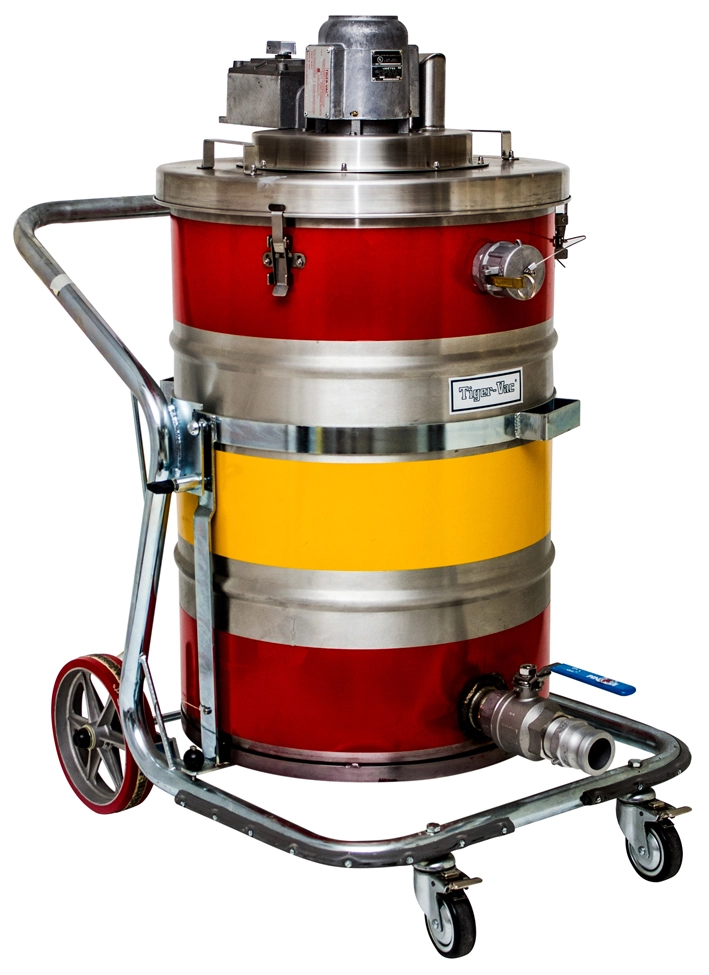
The Tiger-Vac EXP1-55 (TC) TE is the largest single-phase explosion-proof vacuum in the TE series for the recovery of fuel and flammable liquids in ATEX Zone 1 (gas) and Zone 21 (dust). Certified to EN 17348 LC class, covering both flammable and non-flammable liquids. The Tilt Cart (TC) construction allows the operator to tip the entire tank for emptying without lifting, a real ergonomic and safety advantage for a 170 litre full liquid tank. 1.0 kW TEFC motor delivering 224 m3/h and 1550 mmH2O. AISI 304 stainless construction, optional activated carbon filter for VOC vapours, designed for defueling and hangar clean-up.
Applications
- Defueling and depuddling of military aircraft (F-35, legacy fighters) in hangars
- Recovery of JP-8, Jet A-1 and diesel spills around refueling stations
- Depot work with fuel residues in defense logistics (NSN/NATO)
- Civilian aviation MRO -- wing-tank emptying during service checks
- Chemical industry with flammable solvents (toluene, acetone, alcohols) in Zone 1/21
Technical specifications
| ATEX marking | II 2GD Ex d IIA T3 Gb / Ex t IIIC T200°C Db IP6X -- LCIE 03 ATEX 6297 -- EN 17348 LC |
|---|---|
| Internal / external zone | -- / 21 |
| Motor type | Single-phase TEFC motor, explosion-proof (Ex d IIA T3 Gb / Ex t IIIC T200°C Db), 1.0 kW / 4.5 A |
| Duty cycle | Continuous |
| Airflow | 224 m³/h |
| Vacuum | 152 mbar (1550 mmH₂O) |
| Container | 151 L |
| Sound pressure | 79 dB(A) |
| Filter class | Stainless steel mesh filter (not HEPA-classified, for liquid recovery) |
| Filter type | Stainless steel mesh filter with clamp (part 213433) -- activated carbon filter (211045) optional for VOC/vapours |
| Primary filter | Stainless steel mesh filter (213433). Strainer basket included. Static conductive construction (< 10 ohm resistivity). |
| Cleaning system | None (manual) -- mesh filter is removed and rinsed clean |
| Collection system | Detachable container |
| Material | AISI 304 stainless steel (except cart) |
| IP class | IP6X |
| Power | 1.0 kW |
| Current | 4.5 A |
| Voltage | 230 V / 50 Hz / 1~ |
| Inlet | Ø 50 mm |
| Dimensions (L × W × H) | 1020 x 760 x 1270 mm |
| Weight | 68 kg |
Questions and answers
What's the difference between EXP1-(TC) TE and EXP1-(TC) RE HEPA?
The TE series is specifically built for fuel and flammable liquid recovery (EN 17348 LC class), while the RE HEPA series is an ATEX-combi unit for combustible dust or flammable and non-flammable liquids, never a mixture of the two (EN 17348 DT/LC). They share the same chassis, motor, airflow and vacuum -- but filtration is fundamentally different: TE has a stainless steel mesh filter that can be washed and reused, RE HEPA has an HEPA H14 filter for fine particles. Choose TE for JP-8, Jet A-1, solvents or other flammable liquids. Choose RE HEPA for pharma dust, water-based cleaning or other non-flammable media where HEPA efficiency is required.
Why a stainless steel mesh filter instead of HEPA on the TE variant?
HEPA media is typically glass fibre or synthetic polyester -- materials that can swell, degrade or chemically react when exposed to flammable hydrocarbons such as JP-8 or organic solvents. A stainless steel mesh has no chemical reaction with these substances, can be washed between jobs and reused for years, and is compatible with the EN 17348 LC class liquid test protocols. The mesh captures the particles and sludge typically found in fuel residues (rust particles, sand, combustion residue) -- not micro-particles a HEPA filter is designed for. For tasks where VOC vapours also need filtration, an activated carbon filter can be added as an option.
Which liquids does EN 17348 LC cover?
LC (Liquid Collection) is the EN 17348 class for flammable liquid recovery. It covers JP-8 and Jet A-1 (typical flash point 38-66 °C), diesel, MEK, acetone, toluene, alcohols and other organic solvents with flash point below 60 °C. Non-flammable liquids are ALSO covered -- LC is the highest liquid class in the standard. For comparison, DT/LC (available on the EXP1 RE HEPA series) also covers flammable liquids, but for dust or liquid, never a mixture. EN 17348 was harmonised in the EU standard in March 2023 and is today the normal requirement in defense procurement and the chemical industry.
Can I retrofit with an activated carbon filter?
Yes. The activated carbon filter is supplied as an option in a stainless steel filter housing (part 211046B for 25 gal, 211046C for 55 gal) mounted on the exhaust, with a replaceable activated carbon cartridge (211045). The carbon filter adsorbs VOC vapours (toluene, acetone, benzene, alcohols, aerosolised hydrocarbons) before exhausting into room air. Service life depends on exposure -- typically 50-200 operating hours before replacement. Strongly recommended for work in enclosed spaces such as hangars or depot warehouses, where vapours can otherwise accumulate at working height.
Why 50 mm inlet on EXP1-55 but 38 mm on EXP1-15/25?
Higher throughput. At the same motor power, a 50 mm inlet delivers about 70 % more volume flow than a 38 mm. For a 170 litre liquid tank, this means a real time saving -- about 18-22 min to full fill under continuous suction vs 30-35 min with 38 mm. 50 mm also requires 2" accessories (Camlock coupling, suction hose 500126, double-bend wand in larger dimension). The standard accessory kit for EXP1-55 is 1.5" with adapter -- so you can use existing 38 mm accessories when the task does not require maximum throughput.