
Tiger-Vac SS-25 HRS TE (HY-C)
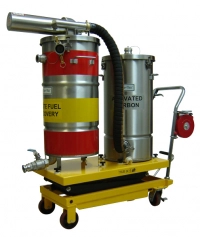
Pneumatic ATEX T6 with High Recovery System and hydraulic cart -- coalescing filter for improved liquid/vapour separation, 56.8 L dry / 64.4 L liquid, EN 17348 LC
- Defueling and depuddling of military aircraft (F-35, legacy fighters) in hangars
- Recovery of JP-8, Jet A-1 and diesel spills around refueling stations
- Depot work with fuel residues in defense logistics (NSN/NATO)
- Civilian aviation MRO -- wing-tank emptying during service checks
- Chemical industry with flammable solvents (toluene, acetone, alcohols) in Zone 1/21
- ATEX Directive 2014/34/EU -- II 2GD Ex h IIC T6 Gb / Ex h IIIC T85°C Db -- LCIE 03 ATEX 6310 X -- IECEx LCIE 17.0076 X -- EN 17348 LC
- EN 17348:2022 (harmonized March 2023)
- IEC 60335-2-69 (industrial vacuums)
Tiger-Vac SS-25 HRS TE (HY-C)
The Tiger-Vac SS-25 HRS TE (HY-C) is the HRS variant of SS-25 TE -- High Recovery System with a coalescing filter element that improves separation between recovered liquid and exhausted air. The result: lower vapour level in the exhaust, better liquid recovery efficiency on fine-crystallised spills (aerosolised fuel, spray water, oil mist). Main Cloth Filter (static dissipative) included -- the unit is dual-filtered. Hydro Cart (HY-C) for ergonomic emptying of the 56.8 L tank. Vacuum 4570 mmH2O (slightly lower than SS-25 TC's 5080 due to additional filter resistance) but higher effective recovery on fine liquids. ATEX II 2GD T6 + IECEx + EN 17348 LC -- 'GUARANTEED for the Safe Recovery of Flammable Liquids' (Tiger-Vac's own phrasing).
Applications
- Defueling and depuddling of military aircraft (F-35, legacy fighters) in hangars
- Recovery of JP-8, Jet A-1 and diesel spills around refueling stations
- Depot work with fuel residues in defense logistics (NSN/NATO)
- Civilian aviation MRO -- wing-tank emptying during service checks
- Chemical industry with flammable solvents (toluene, acetone, alcohols) in Zone 1/21
Technical specifications
| ATEX marking | II 2GD Ex h IIC T6 Gb / Ex h IIIC T85°C Db -- LCIE 03 ATEX 6310 X -- IECEx LCIE 17.0076 X -- EN 17348 LC |
|---|---|
| Internal / external zone | -- / 21 |
| Motor type | Pneumatisk venturi-aggregat (single, 6 mm), ingen elektriske komponenter -- ATEX T6 (Tmax 85 °C) |
| Duty cycle | Continuous |
| Airflow | 204 m³/h |
| Vacuum | 448 mbar (4570 mmH₂O) |
| Container | 56.8 L |
| Sound pressure | 75 dB(A) |
| Filter class | Stainless steel mesh filter (not HEPA-classified, for liquid recovery) |
| Filter type | Main Cloth Filter (211013, static dissipative) + rustfri mesh (213433) + coalescerende filter-element |
| Primary filter | Two-stage: Main Cloth Filter 211013 (static dissipative) + mesh 213433 + coalescing element for liquid/vapour separation. |
| Cleaning system | None (manual) -- filter is removed and rinsed; coalescing element is a consumable |
| Collection system | Detachable container |
| Material | AISI 304 stainless steel |
| Air consumption | 1272 nl/min |
| Supply pressure | 5.5 bar |
| Air supply hose | Ø 12.7 mm |
| Venturi units | 1 pcs |
| Inlet | Ø 38 mm |
| Dimensions (L × W × H) | 1240 x 510 x 1300 mm |
| Weight | 117 kg |
Questions and answers
What is HRS (High Recovery System) and why better than standard SS-25 TE?
HRS adds a coalescing filter element and a dual-filter configuration (Main Cloth Filter + mesh + coalescing). Coalescence = the phenomenon where small liquid droplets combine into larger ones -- this improves capture of aerosolised liquids and reduces VOC vapour in the exhaust. Standard SS-25 TC TE has only a mesh filter and gets more vapour in the exhaust with fine liquids. Choose HRS when working with aerosolised fuel, spray water from drainage procedures, or in hangars where vapour emission is an active concern. The downside: slightly lower vacuum (4570 mmH2O vs 5080) due to additional filter resistance, and higher operating cost due to coalescing element replacement.