
Tiger-Vac SS-55 (TC) TE TWIN VENTURI
Pneumatic twin-venturi ATEX T6 vacuum for Zone 1 gas + Zone 21 dust -- high-volume fuel recovery at 331 m3/h airflow, 151 L dry / 170 L liquid, Tilt Cart (TC), EN 17348 LC for flammable liquids, 50 mm inlet
- High-volume defueling of larger aircraft (C-130, transport aircraft) and tanker trucks where 204 m3/h is not enough
- Simultaneous extraction from several suction points or long hose runs where extra airflow is required
- Recovery of larger fuel spills (JP-8, Jet A-1) in areas with high vapour concentration
- Continuous process extraction without motor overheating (24/7 operation possible)
- Chemical industry with flammable solvents in Zone 1/21 where both T6 rating and high capacity are required
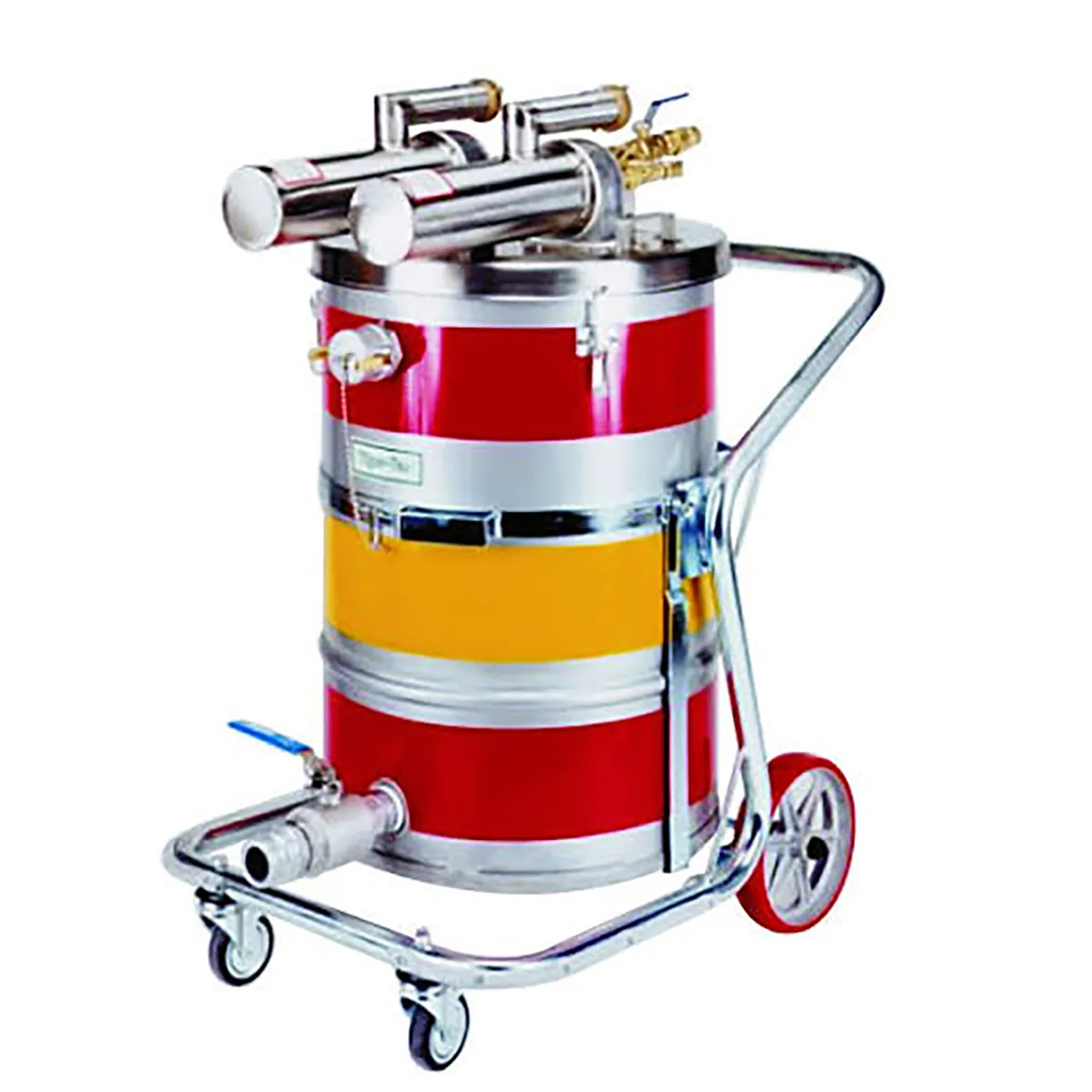
- ATEX Directive 2014/34/EU -- II 2GD Ex h IIC T6 Gb / Ex h IIIC T85°C Db -- LCIE 03 ATEX 6310 X -- IECEx LCIE 17.0076 X -- EN 17348 LC
- EN 17348:2022 (harmonized March 2023)
- IEC 60335-2-69 (industrial vacuums)
Tiger-Vac SS-55 (TC) TE TWIN VENTURI
The Tiger-Vac SS-55 (TC) TE TWIN VENTURI is the most powerful pneumatic explosion-proof vacuum in the SS-TE series for the recovery of fuel and flammable liquids in ATEX Zone 1 (gas) and Zone 21 (dust). Two parallel venturi nozzles (2x 6 mm) deliver 331 m3/h airflow -- about 60 % more than the single-venturi version's 204 m3/h -- and 5840 mmH2O vacuum at 6.9 bar supply pressure. Driven exclusively by compressed air, with no electrical components and no ignition risk, in ATEX T6 class (max 85 °C surface temperature). Certified to EN 17348 LC (flammable + non-flammable liquids) and dual-certified under ATEX (LCIE 03 ATEX 6310 X) and IECEx (LCIE 17.0076 X) for international defense procurement. The Tilt Cart (TC) construction tips the entire tank for emptying without lifting -- a real ergonomic advantage for a 170 litre full liquid tank. AISI 304 stainless construction, activated carbon filter optional for VOC vapours, 75 dB(A) sound level. The higher performance requires a larger compressor: minimum 30 HP with 33 L/s (1980 NL/min) capacity and a 1" (25 mm) air hose. Choose TWIN VENTURI where high-volume recovery is needed -- larger aircraft (C-130, tanker trucks) or simultaneous extraction from multiple jobs.
Applications
- High-volume defueling of larger aircraft (C-130, transport aircraft) and tanker trucks where 204 m3/h is not enough
- Simultaneous extraction from several suction points or long hose runs where extra airflow is required
- Recovery of larger fuel spills (JP-8, Jet A-1) in areas with high vapour concentration
- Continuous process extraction without motor overheating (24/7 operation possible)
- Chemical industry with flammable solvents in Zone 1/21 where both T6 rating and high capacity are required
Technical specifications
| ATEX marking | II 2GD Ex h IIC T6 Gb / Ex h IIIC T85°C Db -- LCIE 03 ATEX 6310 X -- IECEx LCIE 17.0076 X -- EN 17348 LC |
|---|---|
| Internal / external zone | -- / 21 |
| Motor type | Pneumatic venturi unit (twin venturi, 2x 6 mm), no electrical components -- ATEX T6 class (Tmax 85 °C) |
| Duty cycle | Continuous |
| Airflow | 331 m³/h |
| Vacuum | 573 mbar (5840 mmH₂O) |
| Container | 151 L |
| Sound pressure | 75 dB(A) |
| Filter class | Stainless steel mesh filter (not HEPA-classified, for liquid recovery) |
| Filter type | Stainless steel mesh filter with clamp (part 213433) -- activated carbon filter (211045) optional for VOC/vapours |
| Primary filter | Stainless steel mesh filter (213433). Strainer basket included. Static conductive construction (< 10 ohm resistivity). |
| Cleaning system | None (manual) -- mesh filter is removed and rinsed clean |
| Collection system | Detachable container |
| Material | AISI 304 stainless steel (except cart) |
| Air consumption | 1980 nl/min |
| Supply pressure | 6.9 bar |
| Air supply hose | Ø 25.4 mm |
| Venturi units | 2 pcs |
| Inlet | Ø 50 mm |
| Dimensions (L × W × H) | 1020 x 710 x 1270 mm |
| Weight | 70 kg |
Options
Tiger-Vac
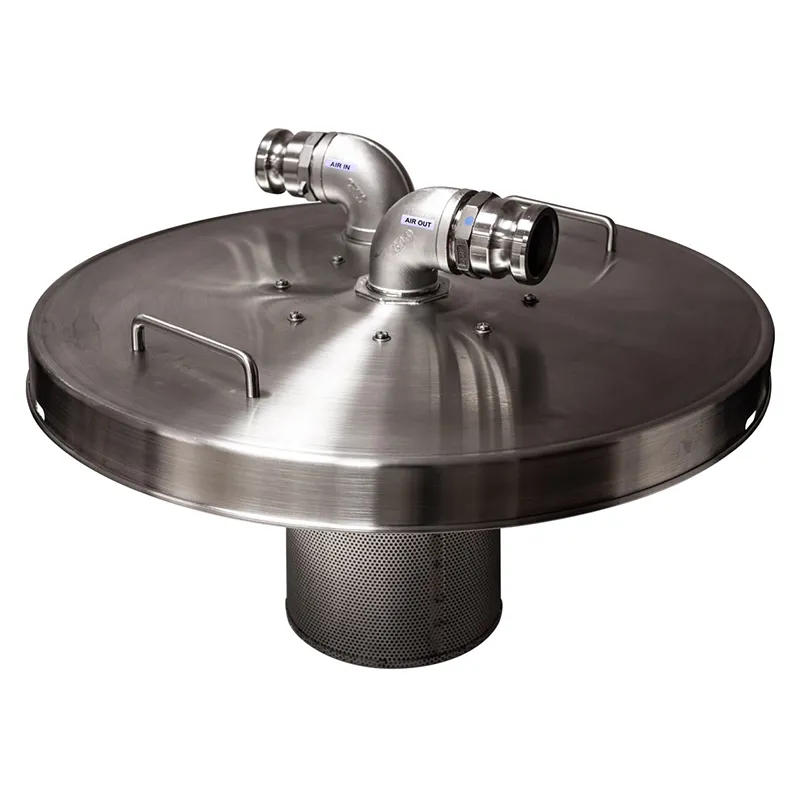
Transfer Lid Assembly
Lid for open-top drum filling in Type 304 stainless steel. Mounts on a standard 209 L (55 gal.) recovery drum. Explosion-proof/dust-ignition-proof and grounded, for liquid recovery.
Tiger-Vac
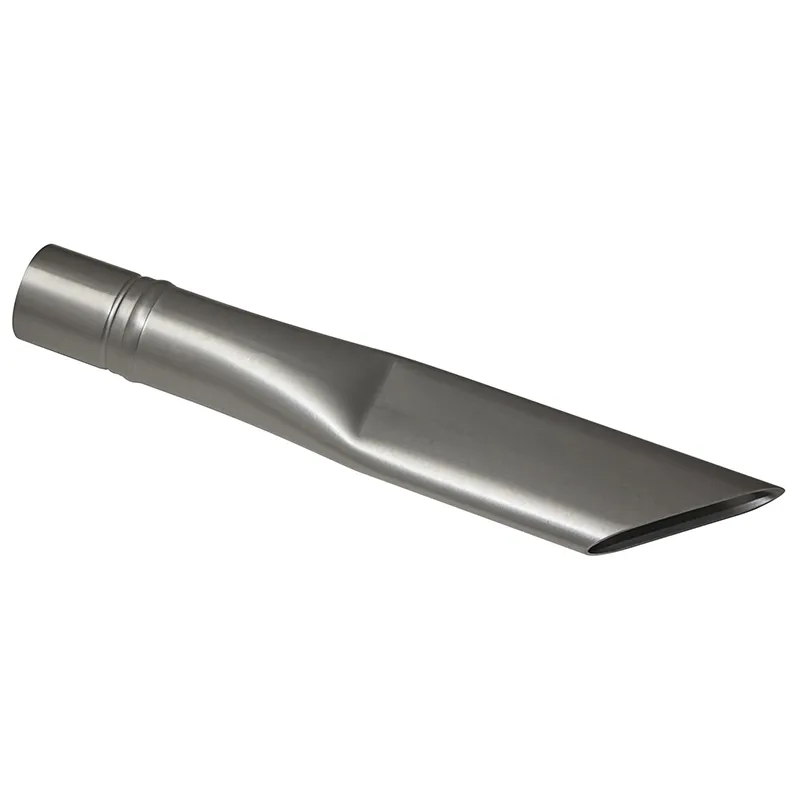
381188 -- Crevice Nozzle
Crevice nozzle in aluminium, static conductive, 38 mm x 28 cm. ATEX category 2/3. Requires a 50->38 mm reduction for the twin's 50 mm inlet.
Tiger-Vac
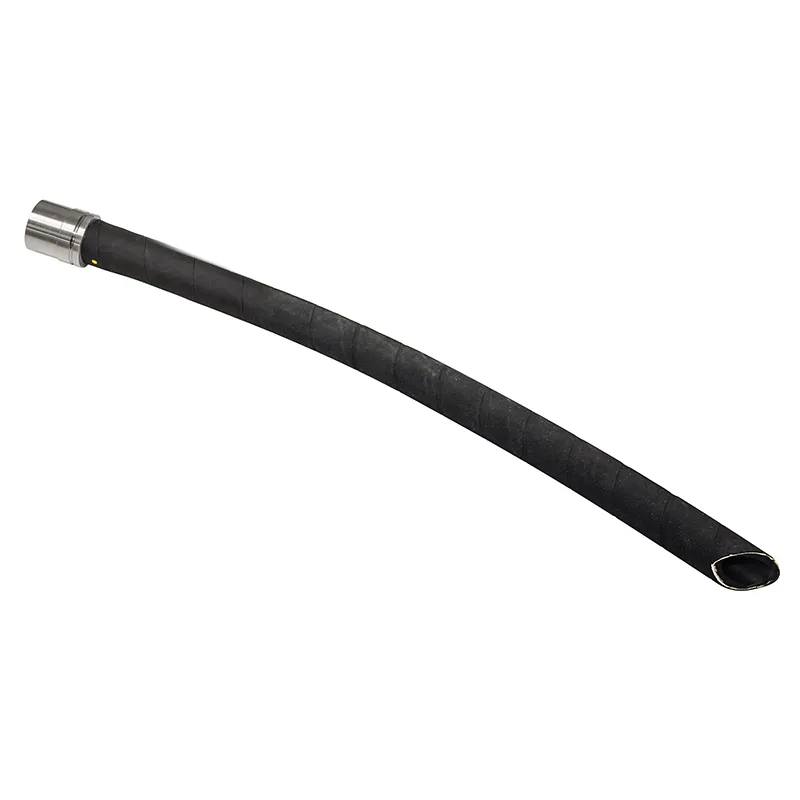
381219 -- Conical Nozzle
Conical nozzle in conductive nitrile rubber, 38 mm x 53 cm, pressure-fit + screw connection. ATEX category 2/3.
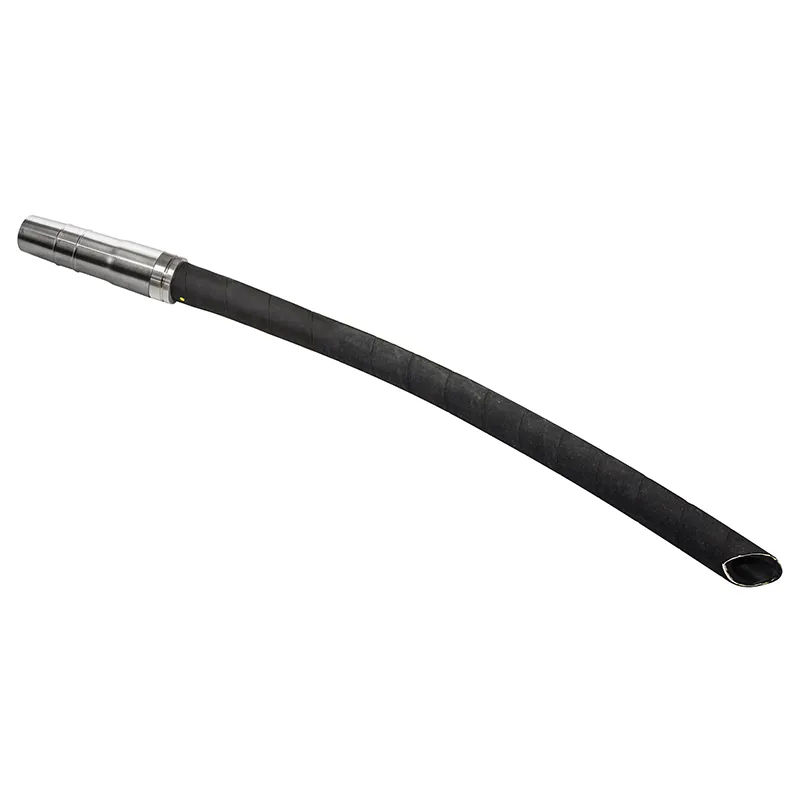
Tiger-Vac
381219D -- Conical Nozzle
Conical nozzle in nitrile, 38 mm x 53 cm, for use with Kanaflex hose cuff with ring. ATEX category 2/3.
Questions and answers
What is the difference between SINGLE and TWIN VENTURI on the SS-55 (TC) TE?
Both share the same chassis, the same Tilt Cart, the same filtration and the same EN 17348 LC certification -- the difference is in the venturi section. SINGLE VENTURI (part number 110278) has one 6 mm venturi nozzle, delivers 204 m3/h and requires a minimum 15 HP compressor at 5.5 bar with a 1/2" (12.7 mm) air hose. TWIN VENTURI (part number 110282) has two parallel 6 mm venturi nozzles, delivers 331 m3/h -- about 60 % more airflow -- and 5840 mmH2O vacuum, but in turn requires a minimum 30 HP compressor at 6.9 bar and a 1" (25 mm) air hose. Choose single if the compressor is limited or the task is single-operator; choose twin for high-volume recovery or several simultaneous suction points.
What compressor does TWIN VENTURI require?
A minimum 30 HP (22 kW) compressor delivering 33 L/s (1980 NL/min) at 6.9 bar continuously -- roughly twice that of the single-venturi version (15 HP / 21.2 L/s). You also need a 1" (25 mm) air hose from the compressor, not 1/2" as on the single. The unit can be operated continuously as long as the compressor maintains pressure. For field work the compressor must be placed outside the ATEX zone -- a diesel or petrol compressor is itself an ignition source -- with the air hose run into the zone.
Why T6 instead of T3 -- what does it mean in practice?
T6 is ATEX's strictest temperature class: maximum surface temperature 85 °C. T3 is 200 °C. For most fuels such as diesel or Jet A-1, T3 is sufficient because auto-ignition temperature is 210-230 °C. But for hydrogen, acetylene, and certain aerosolised aromatics (such as benzene vapours at high concentration), even 90-120 °C surface temperature can trigger ignition. T6 is also required in many newer defense specifications (NATO STANAG, US Air Force TO-0 series) where a single worst-case class is chosen for all tasks. SS-TE models are built to T6 because the pneumatic construction makes it physically impossible to exceed 85 °C.
What's the difference between the SS (pneumatic) and EXP1 (electric) TE series?
Same chassis family, same Tilt Cart, same filtration (stainless mesh + activated carbon optional), same EN 17348 LC certification. But the motor is fundamentally different: EXP1 is single-phase TEFC electric (230V), SS is pneumatic venturi (compressed air). Choice depends on available energy and risk level: When you have 230V and T3 is sufficient -- choose EXP1 (lighter, no compressor requirement, longer hose reach via cable). When you have compressed air and T6 is required, or you work in ultra-high-risk areas (hydrogen, F-35, rocket fuel) -- choose SS. In practice, many defense units choose SS models because NATO/US Air Force specifications typically require T6.
Do the optional nozzles fit the twin's 50 mm inlet directly?
Not directly. The SS-55 (TC) TE has a 50 mm inlet, while the optional nozzles -- crevice nozzle (381188) and the two conical nozzles (381219 and 381219D) -- have a 1.5" (38 mm) connection. To use them on the twin a 50->38 mm reduction or a reducer hose is required. Contact us and we will find the right reduction for your setup. The Transfer Lid Assembly, by contrast, is a drum solution and is independent of the inlet diameter.
What is the advantage of pneumatic twin-venturi over an electric motor?
Zero electrical ignition risk combined with high capacity. A pneumatic vacuum is driven exclusively by compressed air passing through venturi nozzles, creating negative pressure by aerodynamic effect -- no motor, no sparks, no hot electrical component. This qualifies the unit for T6 class (max 85 °C surface temperature), while an electric TEFC motor can only achieve T3 (200 °C). Twin-venturi adds high performance (331 m3/h) without compromising T6 safety. The downside is the compressor requirement -- minimum 30 HP and 33 L/s at 6.9 bar -- so the compressed-air supply can be the limiting factor in the field.