OLI OR · roller vibrators

Roller vibrators for damp and sticky material

A steel roller running round a hardened track while turning about itself. Four sizes, 2 to 6 bar, up to 783 kilos of centrifugal force, 200 °C and ATEX category 2 as standard.

Cement, concrete, sand and foundry sand draw moisture, and damp material sticks to the steel instead of sliding. The OR is OLI's roller vibrator for exactly that. Compressed air at 2 to 6 bar drives a steel roller round a hardened and ground track, and the mass running round gives a high frequency with a large force behind it. The unit bolts on the outside, and no hole is drilled in the wall. Four sizes from 370 grams to 2.6 kilos, all with ATEX category 2 for both gas and dust.

OR2–6 bar<90 dB(A)−20 to 200 °C0.37–2.60 kg
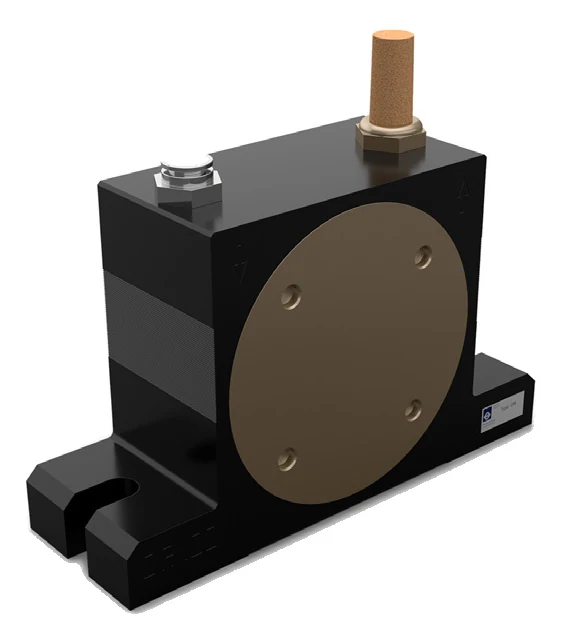
A roller vibrator seen from the front at an angle: a black anodised aluminium body, clearly wider than it is tall, with a large round brass cover in the middle of the side. Four countersunk holes sit near the rim of the cover. On top are two connections: on the left a push-in fitting, on the right a brass nut carrying a sintered bronze silencer. A mark is cast into the front face under each connection: on the left a downward triangle, on the right an upward arrow. A small nameplate sits on the right-hand side of the body. At the bottom the body meets a wide foot with an open slot in the end.
The problem

Two everybody knows, and two that belong to the rotary range

Bridging and rat-holing are familiar to anyone who has stood at a silo. What sets the rotary range apart from the rest of the programme is the next two: reducing the friction between the material and the steel, and separating material that has lumped together. On damp material that is exactly where the problem sits.

Bridge over the outlet

Bridge over the outlet

The material spans an arch across the opening and carries its own weight. The silo is full, the screw underneath runs in empty space, and nothing moves on.

Rathole through the middle

Rathole through the middle

A narrow shaft runs down through the centre while the rest stands still along the walls. It looks like it is running, but most of it stays put and gets older by the hour.

Friction and separation

Friction and separation

Damp material does not slide, because it sticks to the steel, and it lumps together instead of falling apart. A high frequency with a large force behind it works exactly there, in the boundary between the material and the surface.

Walkthrough

Four steps through the product

Click through: from the silo the material will not leave, to the choice between 2, 4 and 6 bar.

01 The problem

The same silo with and without roller vibratorsA silo seen from the side, divided by a vertical line. To the left of the line the material has formed a bridge across the outlet, and under the bridge it is empty; along the two cone walls a layer of material has stayed behind, and nothing comes out at the bottom. To the right roller vibrators sit on the outside of the cone walls at three heights, bolted on with the foot against the wall. None of them goes through the wall. At each unit a circular arrow shows that the force rotates, and two arcs spread into the material. The layer is gone, and a stream falls out at the bottom. The line can be dragged from side to side.Without vibratorsWith the OR

Without vibrators the material carries its own weight: the bridge stands across the outlet, and a layer stays behind along the cone walls that never comes along. With vibrators the vibration travels through the steel and keeps the material moving all the way down. It is the same silo on both sides of the line.

02 The technology

Section through a roller vibrator, and the foot seen from belowAbove, the vibrator seen from the front in section. The body is clearly wider than it is tall and stands on a wider foot. Inside the body is a circular track, and in the track a roller running round it; a radial line on the roller is a mark showing that the roller also turns about its own axis. Behind the roller is the inside of the round brass cover. Two ports sit in the top face of the body: the air comes in through the left one and leaves through the right. The width of the body and the overall height of the unit are both dimensioned as A, and the thickness of the foot as D. Below is the foot seen from underneath: an elongated plate with an open slot at each end and two round holes inboard. The length of the foot is dimensioned as B, the distance between the slots as C, the depth of the foot as E and the width of the slot as F.AADCompressed air inAir outHardened trackThe steel rollerThe foot from belowBCEFOR65

The compressed air comes in through the left port and out through the right. Between the two a steel roller runs round a hardened track, and a mark on the roller shows that it turns about its own axis at the same time. Behind it is the inside of the brass cover. Below is the foot seen from underneath: two open slots on the outside and two round holes inboard. The drawing shows that the roller runs and turns, not how fast: a real OR65 reaches 317 to 433 revolutions per second.

03 The installation

Roller vibrators on a silo with the complete air supplyA silo seen from the side with roller vibrators bolted to the outside of the two cone walls at three heights. On the left stands the compressor, and from it an air line runs through four components in a row: a filter, a flow control valve, a lubricator and a 3/2 way valve. From there the line goes up over the silo and down both sides to each vibrator. At each vibrator a circular arrow shows that the force rotates, and two arcs spread into the material. At the bottom a stream of material falls out of the outlet.12345

The units bolt to the outside of the silo, and no hole is drilled in the wall. That is also why they can go onto a plant that is already running. In the supply sit a filter, a flow control valve, a lubricator and a 3/2 way valve. The lubricator is not optional here: the OR wants lubricated air.

  1. The compressed air The OR runs on compressed air at 2 to 6 bar. The pressure is what sets the frequency, the force and the air consumption alike.
  2. The filter The air has to be clean. The filter is the first stage between the compressor and the vibrator, and it is there on all four sizes.
  3. The lubricator The OR wants lubricated air in class 5.4.4, so the lubricator is not optional. Where oil mist is not allowed at the position, the OT turbine vibrator is the right one: it runs without lubrication.
  4. The 3/2 way valve The valve is normally closed and opens the air when the vibrator is to run. It is the last stage before the connection, and it is also what controls how long it runs at a time.
  5. The units on the silo The foot bolts to the outside, and no hole is drilled in the wall of the vessel. The force is rotary and not linear, which is why the symbol is a circular arrow and not a double arrow.

04 The choice

The working pressure
The OR65 at 2 bar with the three figuresA roller vibrator seen from the front in section with the roller in the hardened track, and below it three horizontal bars drawn to the same fixed scale: vibrations per minute, centrifugal force and air consumption at 2 bar.OR65 at 2 barPressure, frequency, force and air belong together.OR65Vibrations per minute19,000Centrifugal force235 kgAir consumption100 l/min
The OR65 at 4 bar with the three figuresA roller vibrator seen from the front in section with the roller in the hardened track, and below it three horizontal bars drawn to the same fixed scale: vibrations per minute, centrifugal force and air consumption at 4 bar.OR65 at 4 barPressure, frequency, force and air belong together.OR65Vibrations per minute22,000Centrifugal force439 kgAir consumption198 l/min
The OR65 at 6 bar with the three figuresA roller vibrator seen from the front in section with the roller in the hardened track, and below it three horizontal bars drawn to the same fixed scale: vibrations per minute, centrifugal force and air consumption at 6 bar.OR65 at 6 barPressure, frequency, force and air belong together.OR65Vibrations per minute26,000Centrifugal force552 kgAir consumption296 l/min

The figures are the OR65's. The bars are drawn to the same fixed scale on all three sheets, so the difference can be seen as a length. The direction holds across the range, but the figures do not: look your own size up in the table above.

Not which size, that is in the table above. Nor are there two versions or an option: there is one version of each size. What you actually set is the pressure, and it moves three things at once. The bars are drawn to the same fixed scale, so the difference can be seen and not just read: the air rises most, and it does so on all four sizes.

The technology

A roller that both runs round and turns about itself

Inside the body is a circular track of hardened and ground steel, and in the track lies a steel roller. Compressed air at 2 to 6 bar drives the roller round the track. This is where the OR differs from the ball vibrator: a ball runs round, while a roller both runs round the track and turns about its own axis. The force is not a movement back and forth along one axis, as on a piston vibrator: it is a vector that rotates.

The frequency is high and the force behind it is large. An OR50 reaches 29,500 vibrations per minute at 6 bar and weighs 370 grams, and the largest, the OR100, gives 783 kilos of centrifugal force at the same pressure. The temperature limit is 200 °C. That is the highest among the pneumatic vibrators, and the OR shares it with the adjustable F and with the P piston vibrators.

The body is anodised aluminium and the covers are brass. The unit comes in four sizes from 370 grams to 2.6 kilos, and all four carry ATEX category 2 for both gas and dust as standard. The air has to be lubricated, class 5.4.4, and the duty is discontinuous. If the unit has to run without stopping, tell us for how long at a time and we will find the right answer.
Data

Technical specifications

TechnologyRoller vibration, high frequency and centrifugal force
Duty cycleDiscontinuous
Working pressure2 to 6 bar
Centrifugal force188 to 783 kg, depending on size and pressure
Frequency6,750 to 29,500 vibrations per minute
Air consumption78 to 412 l/min
Pneumatic circuitFilter, flow control valve, lubricator and 3/2 way valve N.C.
Air supply qualityClass 5.4.4, lubricated
Working temperature−20 to 200 °C
Noise levelBelow 90 dB(A)
ATEXII2G Ex h IIB Tx Gb and II2D Ex h IIIC Tx Db, as standard
MaterialAnodised aluminium body, brass covers, hardened and ground steel track
MountingFoot with four fixing points, bolted on the outside
Connection1/8″ or 1/4″ BSPP, the OR100 1/4″–3/8″ BSPP
Weight0.37 to 2.60 kg
The dimensions

Four sizes

The frequency is given as the span from 2 to 6 bar, because the pressure moves it. The force is given at both ends. A is the width of the body and its overall height including the foot, B is the length of the foot, and both are dimensioned on the drawing in step 02.

Frequency in vibrations per minute at 2 to 6 bar, centrifugal force in kilograms, air consumption in litres per minute, dimensions in millimetres
ModelFrequencyForce 2 barForce 6 barAir 2 barAir 6 barABConnectionWeight
OR5021,000–29,500188 kg355 kg78 l/min204 l/min50 mm86 mm1/8″ BSPP0.37 kg
OR6519,000–26,000235 kg552 kg100 l/min296 l/min65 mm113 mm1/4″ BSPP0.76 kg
OR8014,000–21,500342 kg624 kg122 l/min378 l/min80 mm128 mm1/4″ BSPP1.27 kg
OR1006,750–11,000289 kg783 kg132 l/min412 l/min100 mm160 mm1/4–3/8″ BSPP2.60 kg

The number in the model name is the width of the body in millimetres: the OR50 is the smallest and the OR100 the largest. A is both the width of the body and the overall height of the unit including the foot, and B is the length of the foot. The four remaining letters are dimensioned on the drawing in step 02 and given as figures on the component card: C is the distance between the two slots, D the thickness of the foot, E its depth and F the width of the slot. The connection is a BSPP thread, and in and out share the same size on the three smaller ones. The OR100 is the one exception: it is listed with two thread sizes, and if you need it in order to order fittings, say so and we will confirm which is in and which is out. The force is the maximum centrifugal force, given in kilograms.

Components

Four things worth looking at before ordering

It is the same mechanism in all four: a steel roller in a hardened track. What changes with the size is the dimensions and the thread. What they all share is that no hole is drilled in the wall.

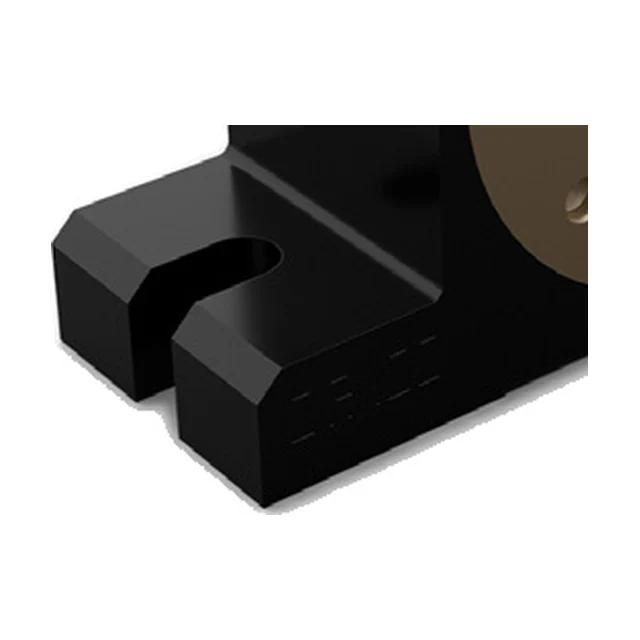
Close-up of one end of the foot on a black roller vibrator: an open slot running right out to the end of the foot, and behind it the edge of the round brass cover. Two rows of small cast marks are visible on the side of the foot.

The foot A · B · C · D · E · F

The foot has four fixing points, not two. The outer two are open slots running out to the end, and the inner two are round holes. The foot sits against whatever it is bolted to, and the body stands perpendicular to that face.

Foot length, B86 to 160 mm
Slot spacing, C68 to 130 mm
Foot thickness, D12, 16 and 20 mm
Foot depth, E30 to 52 mm
Slot width, F7, 9 and 11 mm
  1. An open slot means the unit can be dropped over two bolts that are already in place, rather than having to be threaded onto them.
  2. We do not have the spacing between the two round holes. If you need it in order to pre-drill, say so and we will measure a unit.
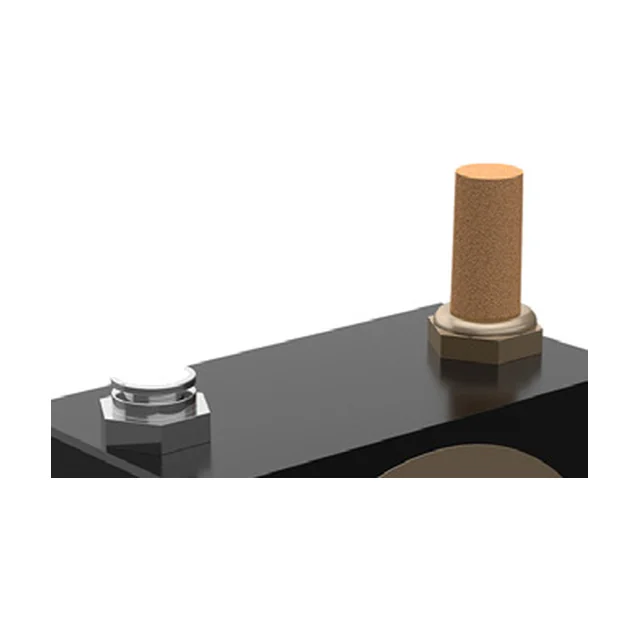
The top face of a black roller vibrator with two connections, one at each end. On the left a bright metal push-in fitting, on the right a brass nut with a sintered bronze silencer screwed into it. At the bottom the edge of the round brass cover is visible.

The two ports IN · OUT

There are two ports in the top face, an inlet and an outlet. The air comes in through one, drives the roller round and leaves the body through the other.

Thread, OR501/8″ BSPP
Thread, OR65 and OR801/4″ BSPP
Thread, OR1001/4″–3/8″ BSPP
In and out, OR50 to OR80Same size
  1. The outlet has the same thread as the inlet on the three smaller ones, so a silencer or an exhaust hose can be screwed into it.
  2. If the air has to be taken away from the area around the unit, tell us where it should go and we will find the right arrangement.
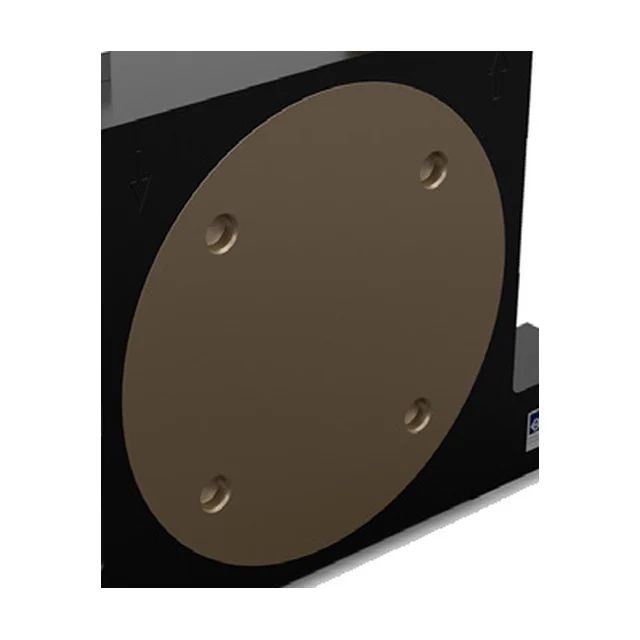
Close-up of the large round brass cover on the side of a black roller vibrator. Four countersunk holes sit near the rim of the cover. To the left and to the right of the cover two marks are cast into the front face of the body: a downward triangle and an upward arrow.

The brass cover Messing

The track is closed by a round cover on each side, and the covers are brass. That is one of the two materials on the unit: the body around them is anodised aluminium.

CoverBrass
BodyAnodised aluminium
TrackHardened and ground steel
Outdoor useYes
  1. The aluminium body and the anodised surface are what make the range resistant to oxidation and suitable for sitting outside.
  2. We do not have a replacement interval for the cover from OLI. If the unit has to go into a preventive maintenance plan, say so and we will ask.
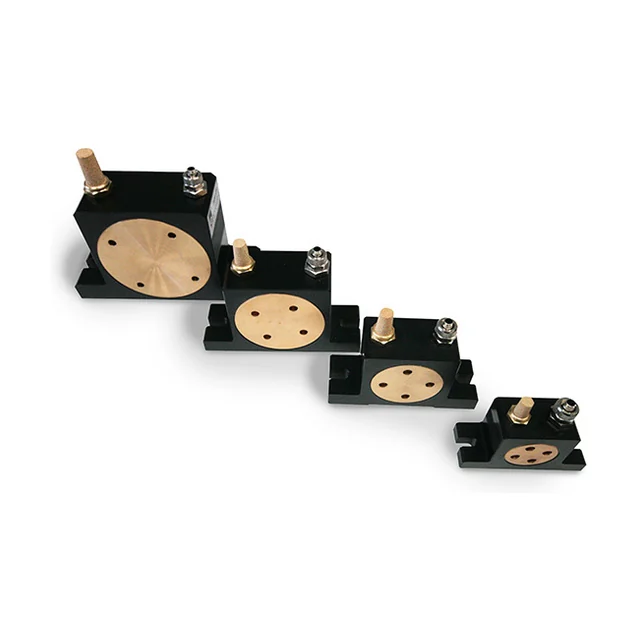
All four sizes lined up, seen from above at an angle and falling in size from left to right. Each unit has a black body, a round brass cover with four holes, a sintered bronze silencer on one connection and a foot with an open slot at each end.

The marking covers all four ATEX

ATEX is standard on the whole range, not an option. The marking covers both gas and dust in category 2, that is zone 1 and 21, and it is the same on all four sizes.

GasII2G Ex h IIB Tx Gb
DustII2D Ex h IIIC Tx Db
Category2, as standard
Zone1 and 21
  1. The temperature class is given as Tx, that is without a figure. If the unit has to sit in a zone with a requirement for a particular class, tell us which and we will come back with the answer.
  2. Zone 20, that is the inside of a vessel containing dust, is not covered by category 2.

There are no options for the OR: no timer, no solenoid, no ATEX kit and no mounting plate. There is one version of each size, and ATEX comes as standard.

Application

Where the OR belongs

Damp materialThe range is meant for hygroscopic materials, that is the ones that draw moisture: cement, concrete, sand and foundry sand. That is what sets the OR apart from the S ball vibrator, which is for dry powders and granules.
Silo, hopper, chute and pipeThe units bolt on the outside, and the vibration runs through the steel and on into the material. No hole is drilled in the wall, so the range can also go onto a plant that is already running.
Concrete compactionIt is the large centrifugal force that makes the range usable there.
Hot steelThe temperature limit is 200 degrees, and that is the highest among the pneumatic vibrators. The OR shares it with the adjustable F and with the P piston vibrators.
Not for continuous runningThe duty is discontinuous. Where running has to be continuous, the pneumatic piston vibrators K and F are built for it, and they sit at 80 dB(A) at the same time.

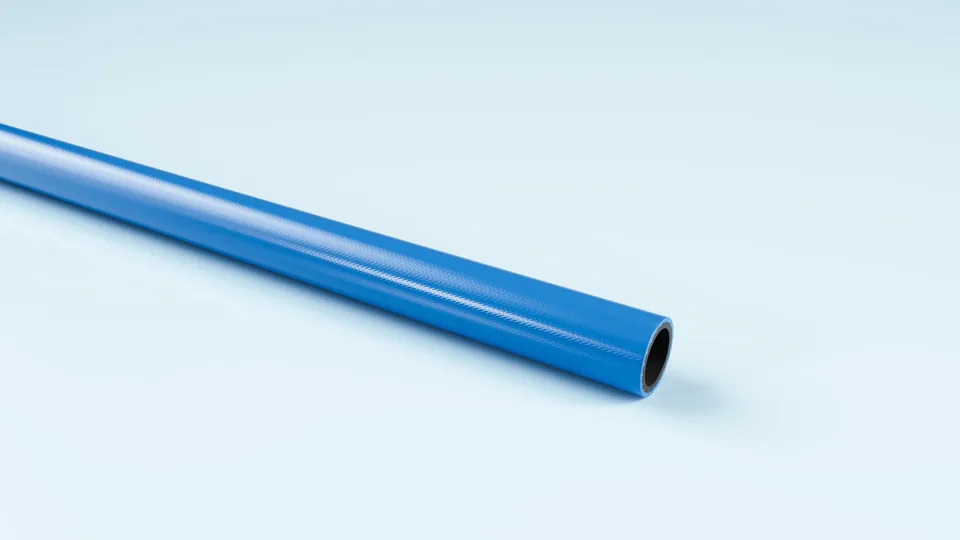
Blue polyurethane hose, coiled.

FlexCore

ARIAFORM/TPU

Light polyurethane hose for tools and reel systems. The softest of the three, and the one that suits the smallest 1/8″ connection.

Material
TPU
Inner diameter
6–13 mm
Working pressure
20 bar
Temperature
-30 to +80 °C

See the full product page on FlexCore →

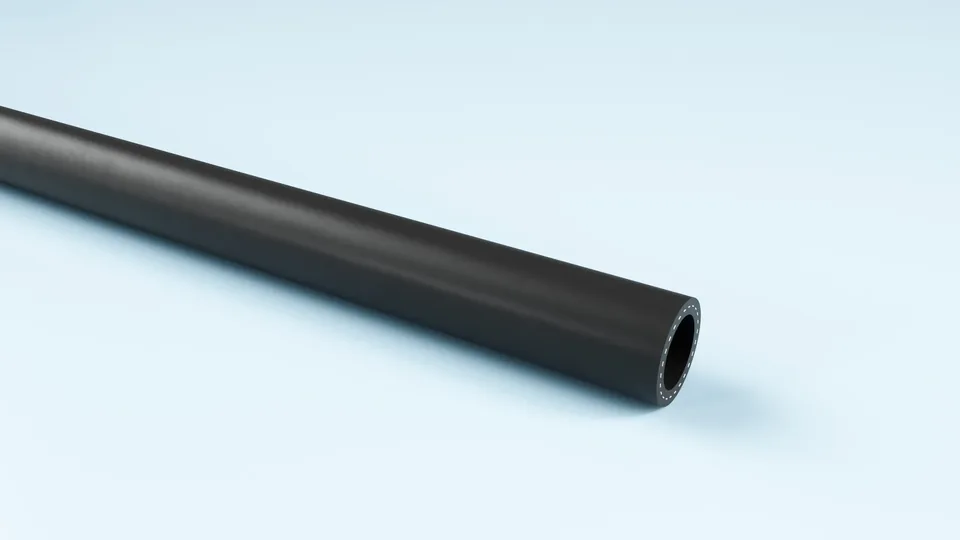
Black TPE air hose, coiled.

FlexCore

ARIAFORM/15

TPE air hose for industry and workshop. Handles water, air and oil-laden compressed air, which is exactly what the OR needs.

Material
TPE
Inner diameter
16–25 mm
Working pressure
15 bar
Temperature
-30 to +80 °C

See the full product page on FlexCore →

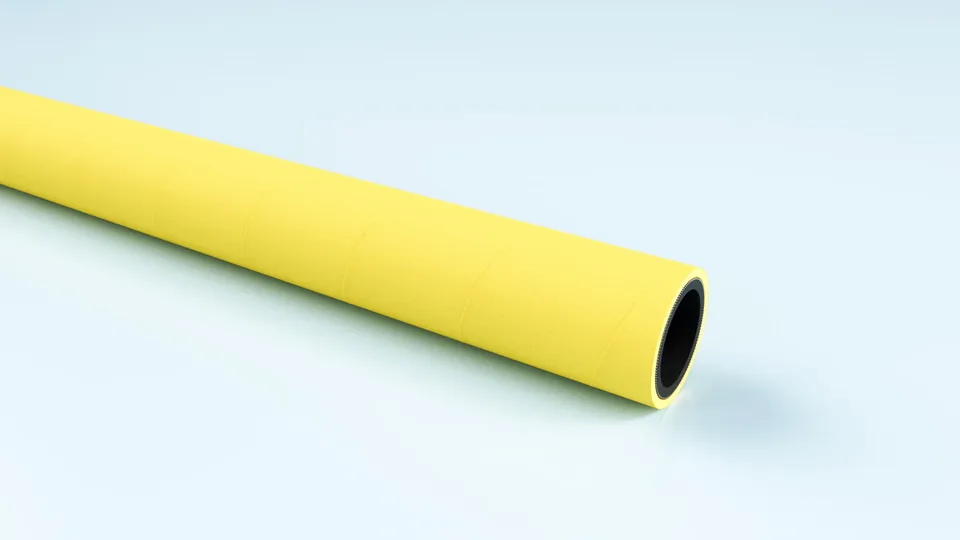
Yellow EPDM compressed air hose, coiled.

FlexCore

ARIACORD/YELLOW

Rugged EPDM hose for compressed air and water, 25 bar. Weather and UV resistant, so it can live outdoors alongside a range that is itself built for outdoor use.

Material
EPDM
Inner diameter
32–76 mm
Working pressure
25 bar
Temperature
-30 to +80 °C

See the full product page on FlexCore →

Portrait of a technical adviser at Particulair.

Technical advice

Which size, and how many?

Tell us what the silo, hopper or chute is made of, how thick the steel is, what you handle, how damp it is, and how long it has to run at a time. We come back with a size, a number and a price, not with a catalogue.

Contact us Try the product selector