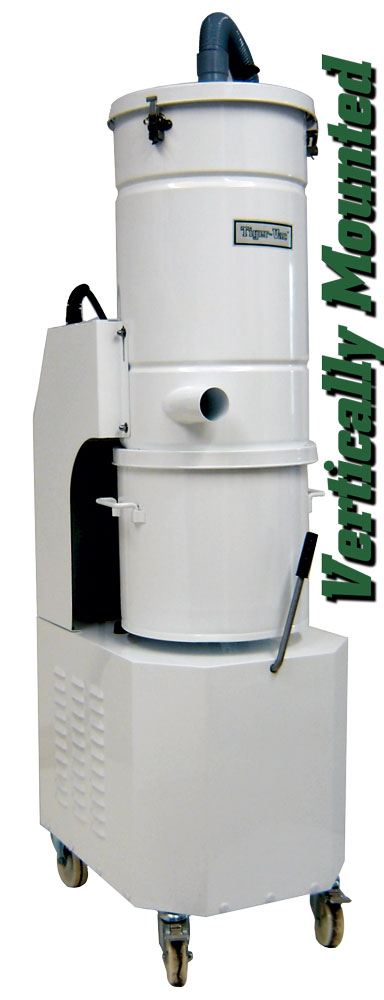
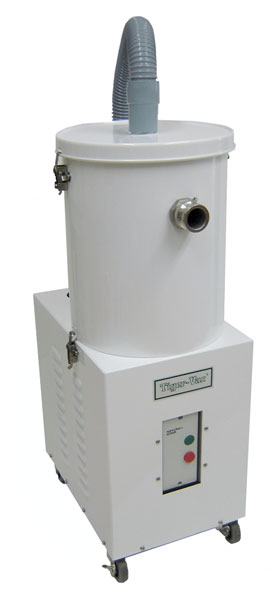
White Line • Clean Room • Process extraction

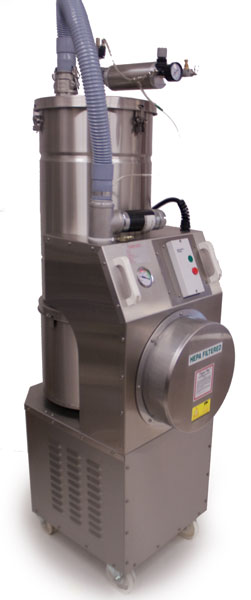
Tiger-Vac CD-2600 CR (MFS) WHITE LINE

Built for continuous source extraction on tablet presses and other process equipment in pharmaceutical production. Manual filter shaker, three-phase motor of 2.2 or 3.7 kW, and a 36 litre recovery tank you release with a single pull. Dry pick-up only.

  • One pull empties the tank. Pull the handle down and the 36 litres are released straight away. No tools, no hoses to disconnect, and the tank sits at a sensible working height, so your back is spared.
  • Designed to stay connected and run. Continuous source extraction directly on the tablet press, the granulator or the capsule filler, around the clock if that is what the process calls for.
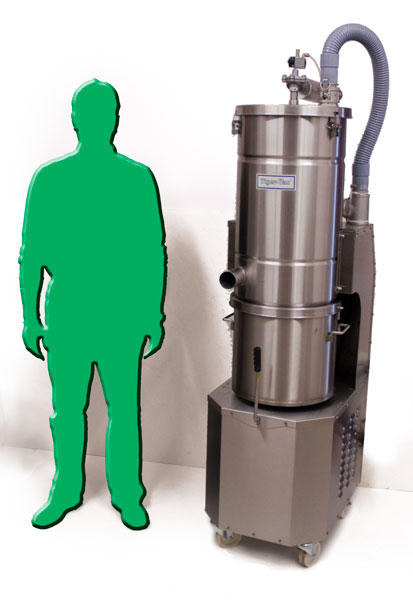
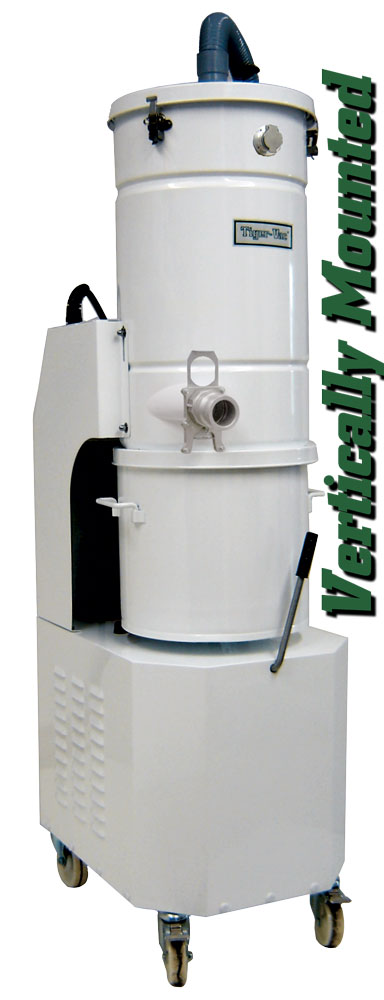
  • It takes up almost no floor space. The machine is built vertically and occupies only 51 × 66 cm, roughly a third of a Euro pallet. It can stand permanently beside the press without being in the way, and the four castors mean one person can move it.
  • The filter is cleaned mechanically. The manual filter shaker (MFS) does the job without compressed air and without electronics. Fewer parts to maintain and to qualify.
  • Cleanroom ready with HEPA or ULPA. With HEPA H14 or ULPA U15 fitted, the machine meets ISO Class 4.
  • 68 dB(A). Quiet enough to run all day in a room where people are working too.
Contact us Download data sheet (PDF)
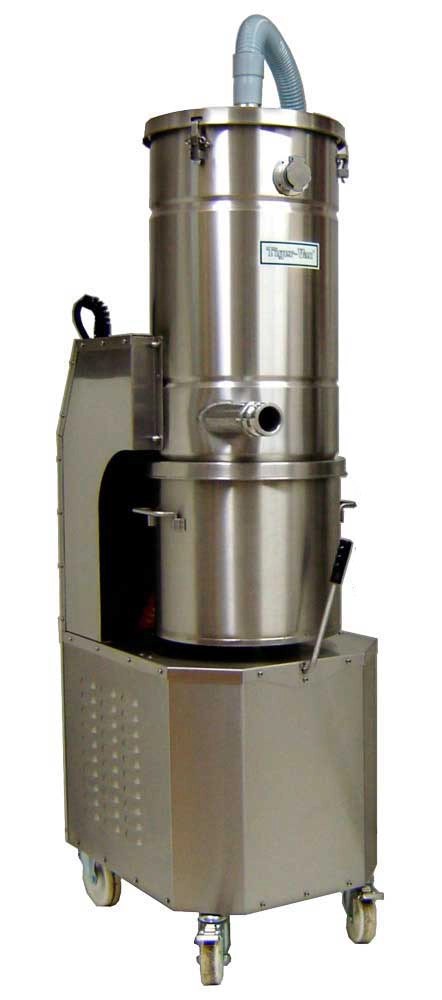
Tiger-Vac CD-2600 CR (MFS) stainless steel cleanroom vacuum with manual filter shaker
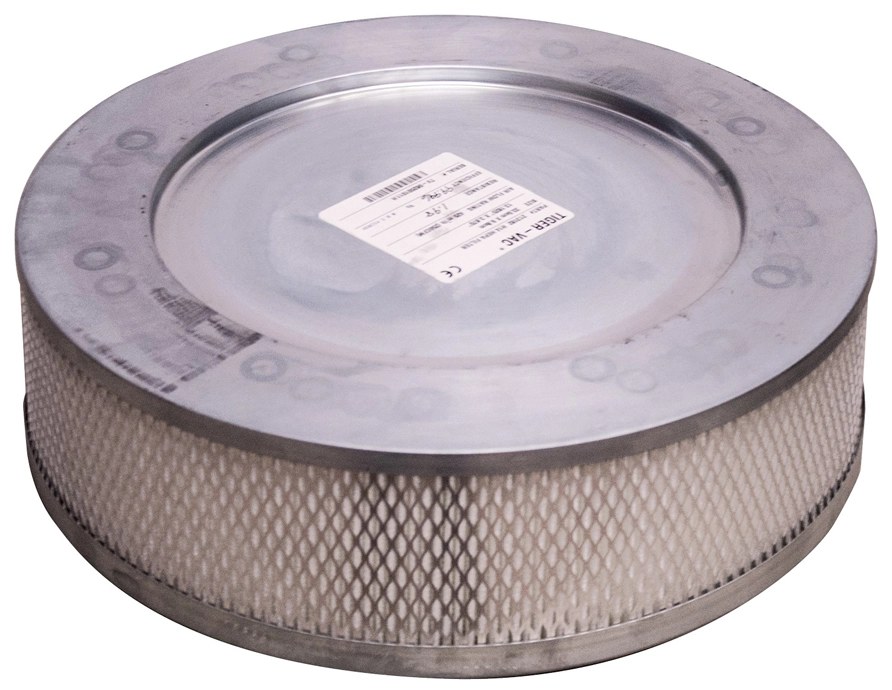
HEPA H14, 99.995 % at 0.3 µm (optional)
ULPA U15, 99.999 % at 0.12 µm (optional)
ISO Class 4 with HEPA or ULPA fitted
Every HEPA and ULPA system is aerosol tested at the factory

How it works

Watch the machine work

We have cut a window into the filter housing and the recovery tank so you can see what happens inside while the machine runs. Pick a tab and follow along: the dust at the press, the tablets that fall beside the track, the tank being taken out, and the whole path of the air through the machine.

01 Source extraction of dust at the press

It is the dust that has to go, not the product. The shroud sits over the tooling, where the dust is created, and from there one continuous duct runs down through the machine cabinet to a stub a good way below the discharge. The tablets have a clear path and carry on down the line. The duct is drawn on the outside of the cabinet so you can follow it.

Source extraction of dust at a tablet press with Tiger-Vac CD-2600 CR (MFS) On the left a tablet press about three metres tall. A shroud sits over the tooling inside the guarding, and from the shroud one continuous duct runs down through the machine cabinet to a stub on the side, a good way below the point where the tablets come out. From there a hose runs across to the tangential inlet on the CD-2600, which stands on the right and is 1.91 metres tall. Small grey specks show the dust being drawn from the shroud through the duct and the hose and into the machine, where it collects in the 36 litre recovery tank. The tablets themselves fall untouched out of the discharge chute and carry on in production; they never come near the duct. 3.0 m tablet press, about 3 metres tall shroud over the tooling one duct all the way clean air out 1.91 m Tiger-Vac CD-2600 CR (MFS) the tablets carry on in production 1 2 3 4 1 Extraction at the source A shroud over the tooling catches the dust the second it is created. 2 One duct all the way The shroud and the stub are the same duct. It runs down through the cabinet, clear of the chute. 3 The tablets carry on Production leaves the chute and continues down the line. Nothing is drawn in with it. 4 Only the dust goes along It ends up in the tank and in the filter sock inside the machine.
This is how it runs day to day. The machine holds the press under negative pressure and draws the dust away the second it appears, while the tablets go on untouched into production. Because the motor is built for continuous duty, it can stay connected around the clock.

02 Excess tablets are picked up inside the press

The second job is what falls beside the track. Under the table sits a fixed pick-up that catches the tablets which miss the track, and a duct carries them down to a fixed stub on the machine cabinet. The hose is permanently mounted, so nothing lies on the floor and the operator has nothing to do.

Excess tablets are picked up inside the press and collected in the recovery tank On the left a tablet press about three metres tall. Production falls out of the discharge chute into a bucket on the floor. Inside the machine, under the table, sits a fixed pick-up that catches the tablets which fall beside the track. From the pick-up a duct runs down through the machine cabinet to a fixed stub on the side, and from there a hose runs across to the tangential inlet on the CD-2600 on the right. The hose is permanently mounted; nothing lies on the floor. A window has been cut in the machine so you can see inside: the spin throws the tablets against the wall, they lose speed and drop whole into the 36 litre recovery tank, where they collect. They never reach the cone or the filter sock. 3.0 m tablet press, about 3 metres tall fixed pick-up under the table fixed connection clean air out 1.91 m Tiger-Vac CD-2600 CR (MFS) 1 2 3 4 1 Fixed pick-up in the press Tablets that fall beside the track inside the machine are picked up where they land. 2 The hose is fixed The connection is a fixed stub on the machine cabinet. No loose hoses on the floor. 3 Tangential inlet The air is set spinning and the heavy part is thrown against the wall straight away. 4 Down into the tank The tablets drop out and can be taken out again afterwards.
The tangential inlet sets the air spinning, and because the tablets are heavier than the air they are thrown against the wall, lose speed and drop whole into the 36 litres. They never reach the cone or the filter sock, and they can be taken out again when the tank is emptied.

03 How the tank comes out

This is where the difference shows in everyday use. The handle is pulled downwards, the catch releases, and the tank comes free and can be drawn straight out.

The recovery tank is released with one pull and drawn out of the CD-2600 The machine stands still while the lifting handle on the left is pulled downwards. The 36 litre recovery tank drops a couple of centimetres, the catch releases, and because the handle now points down, the tank clears it and can be drawn straight out to the left. Behind it you can see the open bottom of the filter housing. It is then pushed back into place and the sequence repeats. A dimension arrow shows that the top of the tank sits a good metre above the floor. On the rear of the machine you can see the light grey flexible hose running from the top down to the vacuum relief valve, the motor with the side channel blower beneath it, and the round canister holding the HEPA or ULPA filter. None of it has to be touched when the tank is emptied. 36 litres open bottom pull down pull out a good metre above the floor One pull, and the 36 litres are free 1 Pull the handle down The handle swings down, the catch releases, and the tank drops a couple of centimetres. No accessories are needed for it. 2 Pull the tank out It clears the handle, which now points down, and comes straight out. Hoses and filters stay in place, and one person can manage it. 3 Empty it and put it back The tank is pushed back into place, and the same handle locks it down. A good working height The top of the tank sits a good metre above the floor. You neither have to kneel nor lift above shoulder height, and that is what decides whether the emptying actually gets done on time.
The handle swings downwards so the tank can clear it. No accessories are needed, and neither hoses nor filters have to come off first. The flexible hose, the vacuum relief valve, the blower and the round filter canister on the rear of the machine all stay untouched. The top of the tank sits a good metre above the floor, so the emptying happens at a height your back can live with.

04 The path of the air through the machine

Here is the whole route, from the air coming in to it being released into the room again. The orange arrows show the direction.

The path of the air through the Tiger-Vac CD-2600 CR (MFS) The machine is drawn in section so you can see inside it, and orange arrows show where the air goes. The air enters through the tangential inlet on the left and is set spinning. The cyclone presses it down through the cone and into the 36 litre recovery tank, where the dust drops out and stays. The air turns and goes back up through the throat of the cone, out to the sides and into the filter sock through its bottom and sides. The outside of the sock is the dirty side and that is where the dust cake sits, while a cage inside holds the sock open. The clean air rises inside the sock, which seals against the lid with a gasket, and leaves the filter housing through a 90 degree elbow at the top. From there a light grey flexible hose runs down to the vacuum relief valve on the rear housing and on down to the side channel blower. The air passes the impeller, and from the blower outlet a hose runs to the round canister on the rear of the machine holding the HEPA or ULPA filter, if it is fitted. From there the air is released into the room. filter shaker 90 degree elbow gasket against the lid the dust settles on the outside tangential inlet 36 litre recovery tank vacuum relief valve mounted on the rear of the machine HEPA or ULPA, optional out to the room motor side channel blower with impeller Tiger-Vac CD-2600 CR (MFS), shown in section 1 2 3 4 5 6 7 8 The path of the air The orange arrows show where the air goes. 1 In through the inlet The air enters at an angle and is set spinning. 2 Pressed down by the cyclone The spin throws the heavy part against the wall and presses the air down through the cone. The dust drops out and stays in the recovery tank. 3 Back up through the throat Only air and the very finest dust make it back up. 4 Into the filter from outside The air passes in through the bottom and sides of the sock. The outside is the dirty side, and that is where the dust stays. The cage inside holds the sock open, and the shaker knocks the cake down. 5 Out at the top of the filter housing The sock seals against the lid with a gasket, so the clean air can only leave through the 90 degree elbow at the top. 6 Down to the vacuum relief valve The light grey flexible hose runs from the elbow at the top down to the valve on the rear housing. If the vacuum gets too high, it lets air in so the blower is not overloaded. 7 Through the impeller Below the valve a hose carries on down to the side channel blower. The impeller pulls the whole flow. 8 Last filter, then out From the blower outlet a hose runs to the round canister on the rear of the machine. If HEPA or ULPA is fitted, the air passes through it before it is released into the room.
The cyclone presses the air down so the heavy part drops out straight away. The air then goes back up and into the filter sock from outside: the bottom and the sides are the dirty side, and that is where the dust cake settles, while the cage inside holds the sock open. The clean air leaves the filter housing through a 90 degree elbow at the top, runs down to the vacuum relief valve on the rear of the machine and on down into the side channel blower. From the blower outlet a hose runs to the round canister holding the HEPA or ULPA filter, if it is fitted, and from there the air is released into the room.

Built to stay put on the process equipment

CD-2600 CR (MFS) was developed for continuous source extraction directly on process machines in pharmaceutical production. The typical job is a tablet press, where the machine draws dust and reject away from the press while it runs, but it is used just as often on granulators, capsule fillers, sieves and packaging lines. Because the motor is rated for continuous duty, the machine can stay connected around the clock without needing to cool down along the way.

The letters in the type designation tell you what it does. CR stands for Clean Room, the version intended for cleanrooms and pharmaceutical environments. MFS stands for Manual Filter Shaker, which cleans the main filter mechanically. Neither compressed air nor control electronics are involved, and that is an advantage when the installation has to be qualified and maintained.

The machine is also used to recover tablets. Tablets are drawn down into the tank without being crushed on the way, so they can be weighed or discarded according to your own procedure. If the machine is to form part of genuine containment at OEB 3 or above, this model will not do the job on its own. In that case we recommend a bag-in/bag-out or closed-canister solution, and we are happy to look at that together with you.

One pull releases the tank

It sounds like a small thing, but it is the detail operators notice every single day. You pull the handle on the side downwards and the 36 litre tank is released immediately. Then you roll it out, empty it and put it back. No tools are needed, no hoses or filters have to come off first, and you do not need a second pair of hands.

The tank also sits at a sensible working height. You neither have to kneel down nor lift above shoulder height, which makes a real difference when it has to be emptied several times a day. We often choose this particular model precisely because emptying is simple enough that it actually gets done on time.

This is how little room it takes: 51 × 66 cm on the floor is about a third of a square metre, or a good third of a Euro pallet. In return it is 191 cm tall, because the whole build stands vertically. In practice that means the machine can stay permanently beside a tablet press, even in a room where every square metre is spoken for.

MFS, MRP or ARP: which filter cleaning should you choose?

CD-2600 CR comes with three different ways of cleaning the main filter. The base machine is the same, and the difference lies in how and when the filter is cleaned.

SystemHow the filter is cleanedChoose it if
MFS, manual filter shaker
(this page)
The filter is shaken clean mechanically. No compressed air, no electronics. The filter needs cleaning at batch change or shift change, and you want as few components as possible.
MRP, manual reverse purge The airflow is reversed manually through the filter. You prefer cleaning without mechanical shaking, at planned stops. See the MRP model.
ARP, automatic reverse purge The airflow is reversed automatically while the machine runs. The dust load is so high that the filter has to be cleaned several times an hour mid production. See the ARP model.

Technical specifications

The machine comes with two motor sizes. The smaller one covers most jobs on a single tablet press, while the larger is used where hose runs are longer or where there is more than one extraction point.

Parameter2.2 kW motor3.7 kW motor
Voltage and frequency400 V, 50 Hz, three-phase. Not available single-phase.
Power2.2 kW (2200 W)3.7 kW (3700 W)
Current draw6 A7.4 A
Airflow330 m³/h340 m³/h
Max. vacuum3,300 mm H₂O3,560 mm H₂O
Vacuum relief valve (VRV)2,795 mm H₂O3,050 mm H₂O
Sound level (EN ISO 11203)68 dB(A)
MotorTotally enclosed fan cooled motor (TEFC), mounted vertically
DutyContinuous
Filter cleaningManual filter shaker (MFS)
Suction inletØ50 mm
Recovery tank36 litres, released with one pull
Pick-up typeDry pick-up only
Dimensions (H × W × L)191 × 51 × 66 cm
Footprint0.34 m², about a third of a Euro pallet
Weight (machine only)112 kg
Cable length10 m
BaseCarriage Base (CB) with four castors
PlugNot included
Cleanroom classISO Class 4 with HEPA or ULPA fitted

Versions and part numbers

The series comes in two versions. The difference lies in how much of the machine is stainless steel:

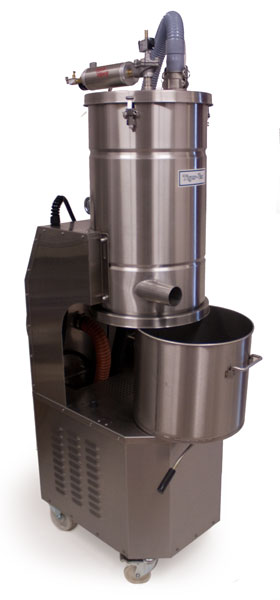
  • All stainless steel (111464B1 and 111468B1). Tank, filter chamber, motor housing and base are all stainless steel. This is the version we recommend for washdown rooms and for environments with cleaning agents or disinfectants.
  • Stainless steel and white powder coating (111308B1 and 111319B1). The product contact parts, meaning the tank and the filter chamber, are stainless steel, while the chassis and the motor housing are white powder coated. This is the classic WHITE LINE version, and it is less expensive where the machine will not be hosed down.

We always confirm the exact material breakdown on the order confirmation, so you have it in writing for your documentation.

Part no.VersionMotorAirflow and vacuum
111464B1All stainless steel2.2 kW330 m³/h at 3,300 mm H₂O
111468B1All stainless steel3.7 kW340 m³/h at 3,560 mm H₂O
111308B1Stainless steel and white powder coating2.2 kW330 m³/h at 3,300 mm H₂O
111319B1Stainless steel and white powder coating3.7 kW340 m³/h at 3,560 mm H₂O

Filtration and cleanroom suitability

The machine comes as standard with a PTFE laminated main filter with a clamping band, plus a filter cage that holds the filter in place when it is shaken. That is enough for ordinary process extraction, but if the machine is to stand in a classified room it needs an after-filter in a separate filter housing:

  • HEPA H14 with at least 99.995 % efficiency at 0.3 µm, tested to IEST-RP-CC001 and classified H14 by the MPPS method in EN 1822.
  • ULPA U15 with 99.999 % at 0.12 µm and 99.9995 % at 0.18 µm, tested to IEST-RP-CC001 and classified U15 by the MPPS method in EN 1822.

Please note that the base machine with the ordinary shaker filter is not in itself suitable for ISO Class 4. It is the HEPA or ULPA option that lifts the machine into cleanroom class, and we recommend ULPA when it is to stay permanently in a classified room. Every HEPA and ULPA system is aerosol tested for leaks before it leaves the factory.

Documentation: We supply a test certificate for the fitted filter and an EU declaration of conformity for the machine together with the delivery. If you need the paperwork earlier, for a supplier qualification or a URS for instance, we are happy to send it in advance. Call or write and we will work out what you need.

Filters, liners and spare parts

Supplied with the machine

Part no.Description
215025TAMain filter with clamping band, PTFE laminated. Support ring and cage sold separately.
214685AFilter cage, zinc plated

HEPA and ULPA filters with housing (optional)

Part no.Description
213182HEPA filter, Ø35.1 cm and 9.8 cm tall, at least 99.995 % at 0.3 µm, with gasket fitted
213181ULPA filter (U15), Ø35.1 cm and 9.8 cm tall, rated for 250 CFM
215014BFilter housing for CD-2600 STD and CRS, powder coated steel
215012Filter housing for CD-2600, stainless steel AISI 304

Collection liners (optional)

Part no.Description
214987Polyliner, clear with drawstring. Pack of 5.
213780Retaining plate for polyliner, for motors up to 5 HP

Hoses and accessories (optional)

Part no.Description
500390Clear polyurethane hose SD, Ø50 mm, light and hard wearing. Sold per metre.
635078Clear polyurethane hose SD, Ø64 mm, light and hard wearing. Sold per metre.
500159Clamping band, Tridon screw type size 32, stainless steel
635016Hose clamp, stainless screw type for Ø64 mm hose
500168Hose cuff Ø50 mm for Vacuflex hose Ø50 mm
635248Hose cuff for wire reinforced hose Ø64 mm
500198Cuff adapter from Ø50 mm to Ø63.5 mm (500168 and 635248)

Use recommended accessories only. See also our accessories range VACE and the hose programme FlexCore.

Photos
Related models

Questions and answers

Very easy, and that is one of the reasons the machine works well in daily operation. You pull the handle down and the tank is released straight away. Then you roll the 36 litre tank out and empty it. The tank sits at a good working height, so you neither have to bend down to the floor nor lift above shoulder height. No tools are needed, and you do not have to remove hoses or filters first.
MFS stands for Manual Filter Shaker. The filter is cleaned mechanically by operating the shaker function on the machine, after which the collected dust falls down into the tank. Neither compressed air nor electronics are involved. That means fewer components to maintain and a simpler qualification. The main filter is PTFE laminated and is supplied with a clamping band and a cage (part numbers 215025TA and 214685A).
All three are ways of cleaning the main filter, and the base machine is the same. MFS shakes the filter clean mechanically without compressed air. MRP (Manual Reverse Purge) reverses the airflow manually through the filter. ARP (Automatic Reverse Purge) does the same automatically during operation and is intended for a high and sustained dust load. Our rule of thumb: if the filter has to be cleaned several times an hour mid production, that points to ARP. If it happens at batch change or shift change, MFS is both cheaper to buy and simpler to keep running.
Yes, when it is fitted with HEPA or ULPA. The base machine with the ordinary shaker filter is not in itself suitable for ISO Class 4. If you choose HEPA H14 or ULPA U15 as an option, the machine meets ISO Class 4 (formerly Class 10). Tiger-Vac aerosol tests every HEPA and ULPA system for leaks before it leaves the factory, and the machine must either stand in the cleanroom or be connected to the room's exhaust.
HEPA H14 (part number 213182) with at least 99.995 % efficiency at 0.3 µm, or ULPA U15 (part number 213181) with 99.999 % at 0.12 µm. The filter sits in a separate housing, which we supply either powder coated (215014B) or in stainless steel AISI 304 (215012). We recommend ULPA when the machine is to stay permanently in a classified room.
No. CD-2600 CR (MFS) is a purely three-phase model and is supplied only with 400 V, 50 Hz. That applies to all four part numbers in the series. If you only have single-phase power available, we will find another model that suits the job.
Yes. Tablet recovery is one of the jobs the machine most often does at pharmaceutical manufacturers. Tablets are drawn down into the 36 litre tank without being crushed on the way, and because the tank is released with one pull, the product can quickly be weighed or discarded according to the applicable procedure.
Very little. The machine is built vertically and occupies 51 × 66 cm on the floor, about a third of a square metre. That is a good third of a Euro pallet, so it can stand permanently beside a tablet press without getting in the way. The four castors still allow one person to move it.
WHITE LINE is Tiger-Vac's designation for the version with white powder coating, intended for cleanrooms and pharmaceutical environments. We supply the series either entirely in stainless steel or as a combination where the product contact parts are stainless and the chassis is white powder coated. See the version table for the part numbers.

Shall we take a look at your tablet press?

Tell us what needs to be extracted and how far it is from the machine to the vacuum. Then we will recommend motor size, filter solution and version, and we will say so if another model suits you better. The advice is free and without obligation, and we are happy to send the documentation in advance.


Other Particulair universes