
Vacuum for 3D printing and metal powder
Polymer powder, reactive metal powder and powder recovery place three different demands on collection. These are the models we recommend for each — and why the choice is not interchangeable.
Three kinds of powder, three different requirements
Additive manufacturing covers processes that have little in common from a safety standpoint. A vacuum that suits an SLS line running polyamide can be actively dangerous on a DMLS printer running titanium. The dividing line is whether the powder is merely combustible, or also reactive.
1. Polymer powder — PA12, PEEK, PEKK and TPU
From SLS, MJF and BJT processes. The powder is combustible organic dust with a low minimum ignition energy, but it does not react with air or water. If the print room carries a zone classification, the machine must be ATEX certified for that zone. If it does not, the ACD requirement below applies instead.
2. Reactive metal powder — aluminium, titanium, magnesium and lithium
From DMLS, SLM and EBM processes. Here combustibility is not the only concern. The powder can ignite on contact with air or moisture, and a metal fire will not yield to water or foam. So the answer is not to fight the fire afterwards but to remove what it needs: the powder is drawn straight into a liquid bath at the moment of collection. As long as the particles stay covered by liquid they cannot form a dust cloud — and without a dust cloud there is no dust explosion. Tiger-Vac calls the principle inertisation in a liquid bath.
Which liquid belongs in the bath depends on the metal. Some powders tolerate water. Others react with it and release hydrogen, and there the bath must be run with oil instead. That is also the real difference between the two models below: one is intended for water, the other runs on either water or oil. What your particular powder tolerates depends on alloy, particle size and storage, and it should be confirmed with the powder supplier before commissioning. We are glad to help settle that.
3. Print rooms without zone classification
Many print rooms are not ATEX classified, and that is often the correct decision. But the dust inside the vacuum is combustible regardless of what the room is called. IEC 60335-2-69 Annex AA covers exactly this case: the machine must be built to Zone 20 internally even when the surroundings are not a zone. That is what an ACD machine is.
Recovery is not the same as cleaning
When emptying a build chamber or handling unused powder, the task is not to dispose of the material but to return it to the process. Tiger-Vac's PRS-HEC — Powder Recovery System with High Efficiency Cyclone — is built for that: a cyclone separates the powder from the airflow before it reaches the main filter, so the material is never mixed with filter dust.
Tiger-Vac states a separation rate of up to 98 %. How close you get in practice depends on the fineness and particle size distribution of your powder. A cyclone works on mass: the coarser and heavier the particles, the greater the fraction that drops out. Fine fractions follow the airflow through to the filter. A coarse metal powder therefore yields more than a fine polymer powder, and your own particle distribution decides the result. Tell us the material and grain size and we will give you a realistic estimate.
How to choose
Start with the powder, not the machine. If it is reactive metal, INERT is a requirement and not an option. If it is polymer, the zone classification of the room decides the rest. If the powder is to be reused, you need a cyclone ahead of the filter. If you are unsure how your area is classified, talk to us — it is faster than guessing.
Polymer powder and powder recovery
For SLS, MJF and BJT — and for build chamber emptying where the powder is to be reused.
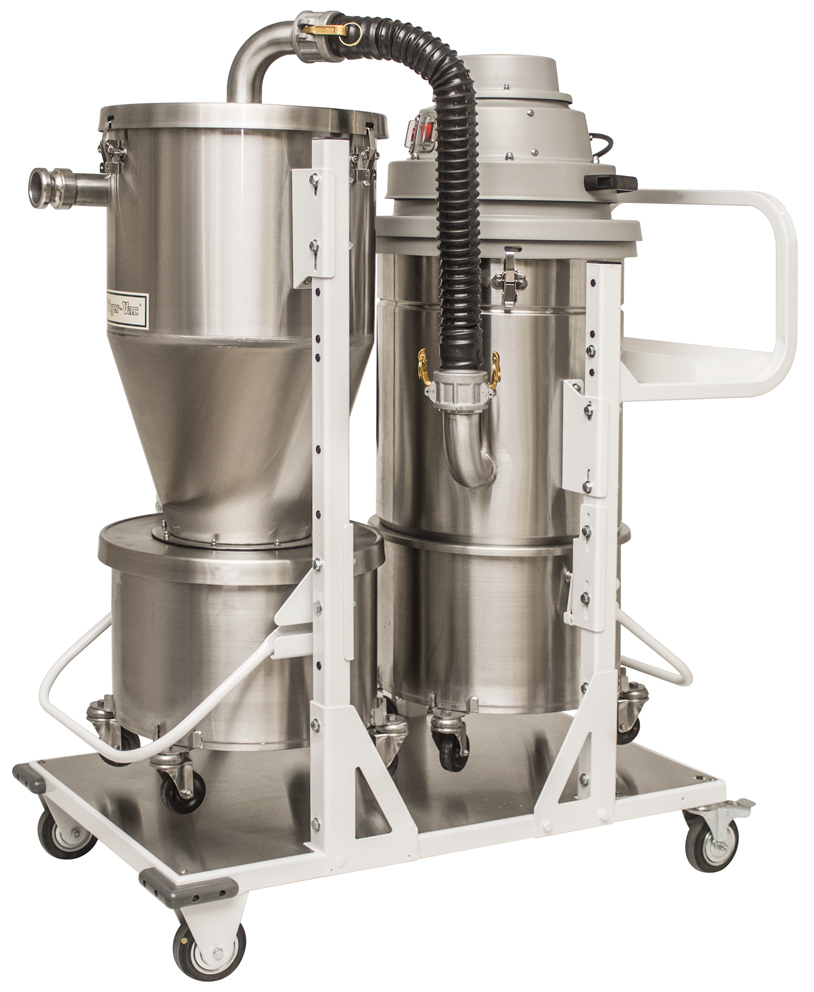
Tiger-Vac C-10 EX DT (PRS-HEC)
II 1/3D Ex h tc IIIC T200 C Dc IP6X (External) -- Ex h IIIC T200 C Da (Internal) -- -5 C <= Ta <= +37 C -- EN 17348 DT -- LCIE 15 ATEX 3061 -- IECEx LCIE 15.0048
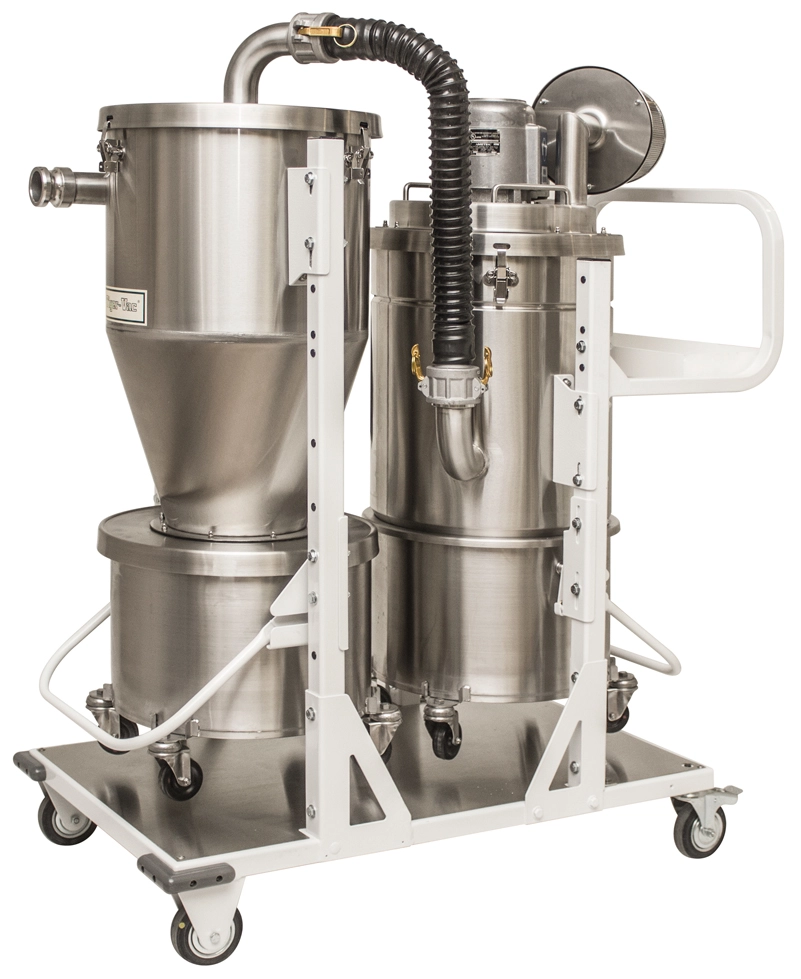
Tiger-Vac EXP1-20 DT (PRS-HEC) RE HEPA
II 2GD Ex d IIA T3 Gb / Ex t IIIC T200°C Db IP6X -- LCIE 03 ATEX 6297 -- EN 17348 DT
Reactive metal powder — wet collection in a liquid bath
For DMLS, SLM and EBM. The powder is drawn straight into a liquid bath, so it never sits dry in the container. Both models are marked II 2GD and classified WT to EN 17348, and both ship with a static-dissipative 3D tool kit.
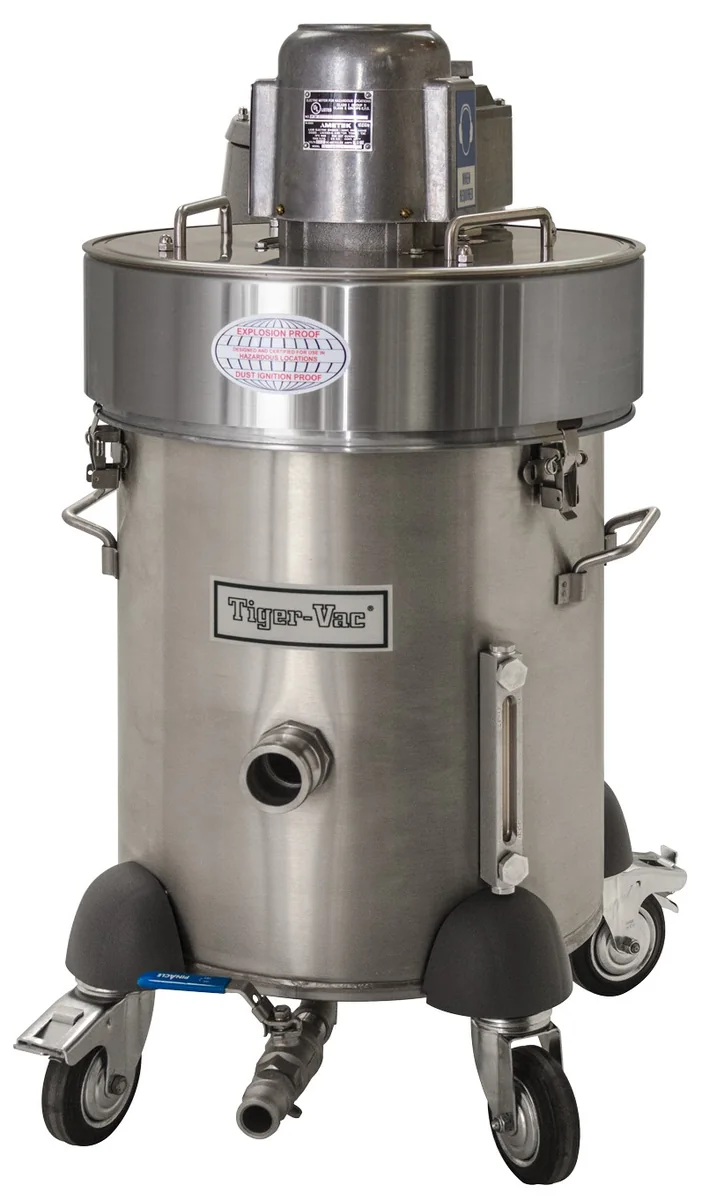
Tiger-Vac EXP1-10 (IT-40L) EX (CFE) HEPA W/3D TOOL KIT
II 2GD Ex d IIA T3 Gb -- Ex t IIIC T200°C Db IP6X -- 0 °C <= Ta <= +40 °C -- LCIE 03 ATEX 6297 -- EN 17348 WT
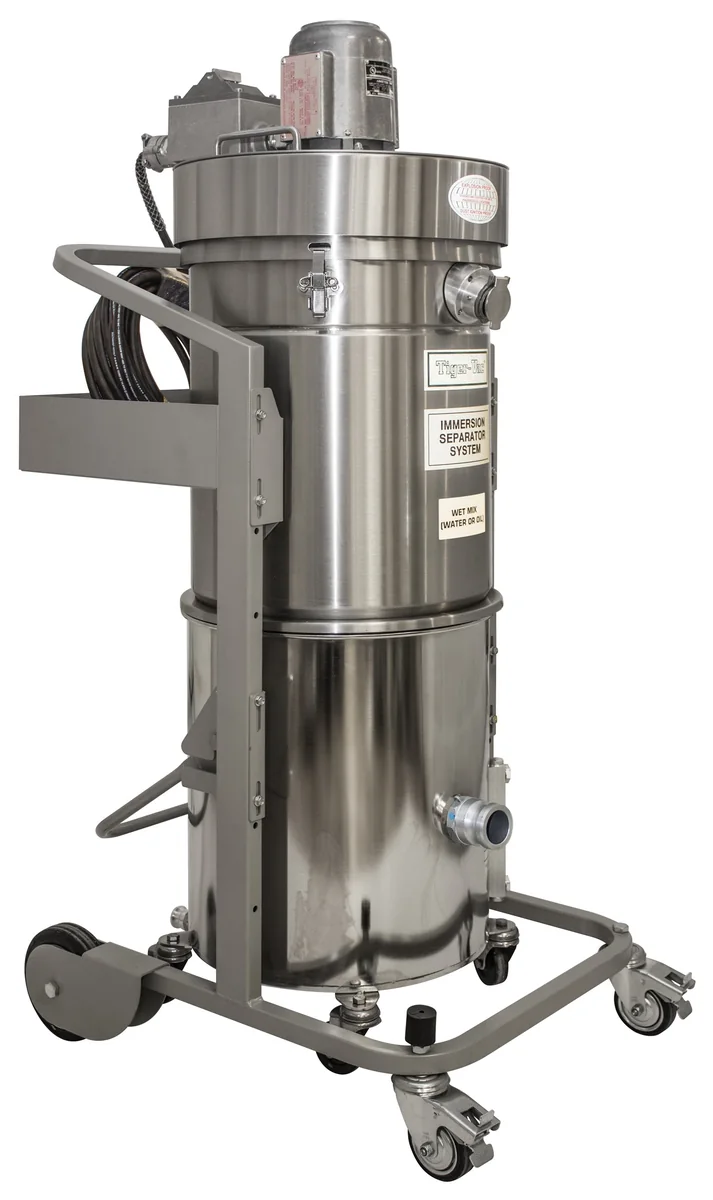
Tiger-Vac EXP1-10 (IT-40L) EX DT (CFE) HEPA W/3D TOOL KIT
II 2GD Ex d IIA T3 Gb -- Ex t IIIC T200°C Db IP6X -- 0 °C <= Ta <= +40 °C -- LCIE 03 ATEX 6297 -- EN 17348 WT
If the print room is not zone classified at all, and the powder is polymer rather than reactive metal, an ACD machine to IEC 60335-2-69 Annex AA is the way to go — see the range under ACD. If none of these fit, the rest is under ATEX Dust and ATEX Combi, or ask us.
Questions and answers
Can I use the same vacuum for both polymer and metal powder?
Not if the metal powder is reactive. Aluminium, titanium, magnesium and lithium require INERT collection with a neutralising liquid bath. A machine built for polymer powder does not have that protection, and mixed collection also raises the risk, because finely divided metal and organic dust together can form a more reactive mixture than either on its own.
Should the bath be water or oil?
It depends on the metal. Several powders used in additive manufacturing react with water and release hydrogen — magnesium is the clearest example, and fine-grained aluminium can do it under certain conditions. Hydrogen in a closed tank is exactly what you do not want, and there the bath must be run with oil. If the powder tolerates water, water is the simplest and cheapest choice. Tiger-Vac supplies both variants: the EXP1-10 (IT-40L) EX (CFE) runs on water, while the EX DT version runs on either water or oil. What your powder tolerates should be confirmed with the powder supplier before commissioning.
My print room is not ATEX classified. Do I still need a special vacuum?
Yes. The zone classification describes the room, not the inside of the machine. Inside the container and filter there is combustible dust suspended in air by definition, which corresponds to Zone 20 whatever the surroundings are called. IEC 60335-2-69 Annex AA covers precisely that situation, and machines built to it are called ACD.
Can the collected powder be reused?
Cyclone separation makes it possible, because the powder is not mixed with filter dust. Tiger-Vac states up to 98 % separation for PRS-HEC, but the actual yield depends on the fineness and particle size of the powder — coarse metal powders separate better than fine polymer powders. Whether the material may then go back into the printer is decided by your own material specification.
What does EN 17348 mean for 3D printing?
EN 17348:2022 is the product standard for vacuum cleaners in explosive atmospheres. It introduces the concept of an internal ATEX zone and sets requirements for the whole machine, including hoses, nozzles and filters. For 3D printing that means an ATEX mark on the machine alone is not enough — the accessories must be part of the certification. Read more in our article on EN 17348:2022.
What is the difference between ACD and ATEX?
ACD covers machines for combustible dust in areas that are not ATEX classified — the protection is internal. ATEX certified machines may also be used inside a classified zone. The difference is set out in detail in ACD vs ATEX.
Not sure which model fits your powder?
Tell us the process and the material you work with and we will give you a concrete recommendation — including when the answer is that you do not need an ATEX machine at all.