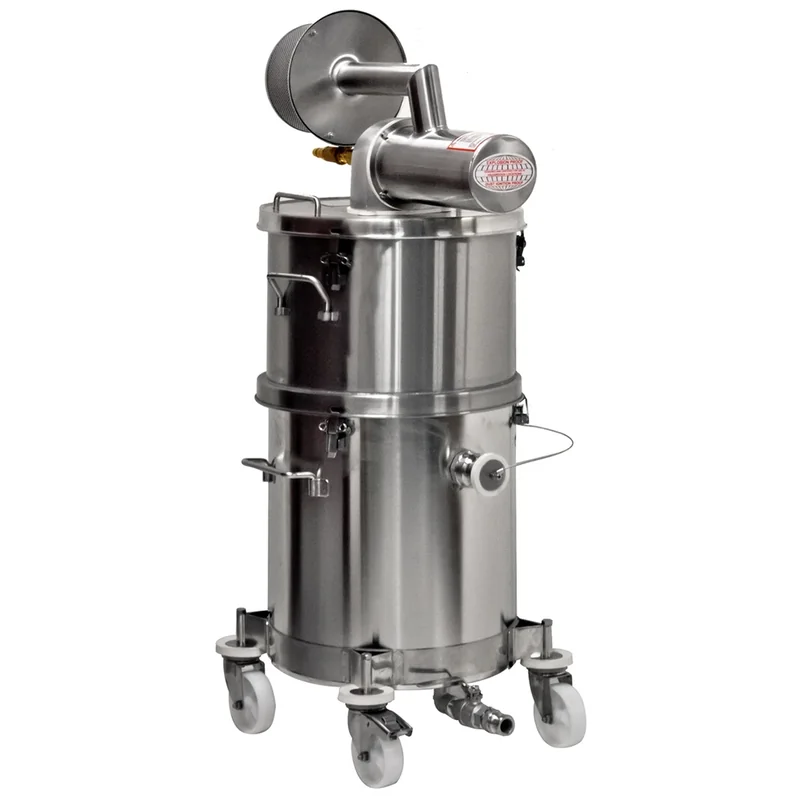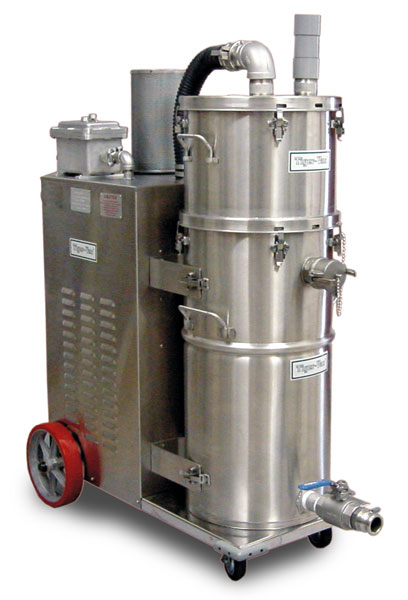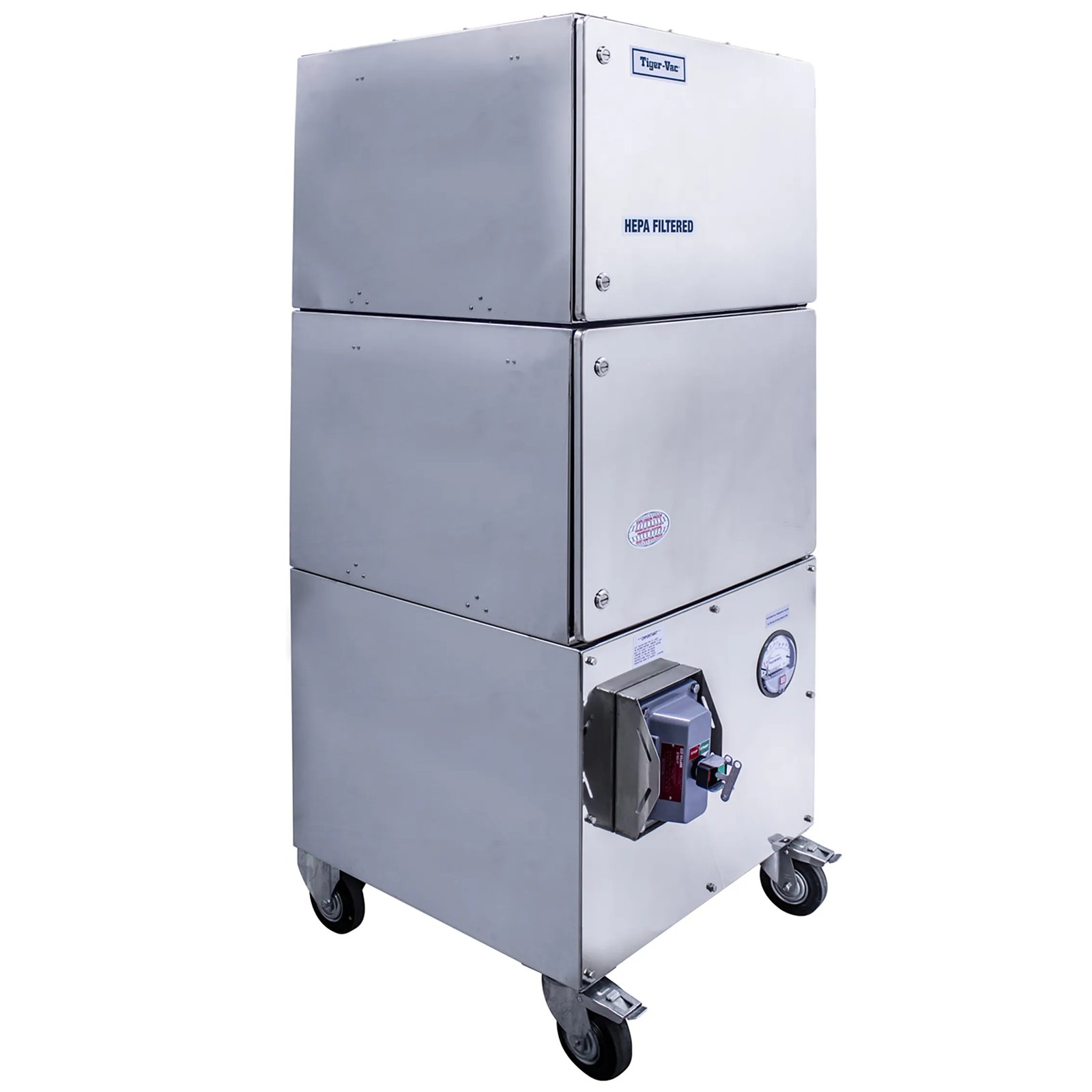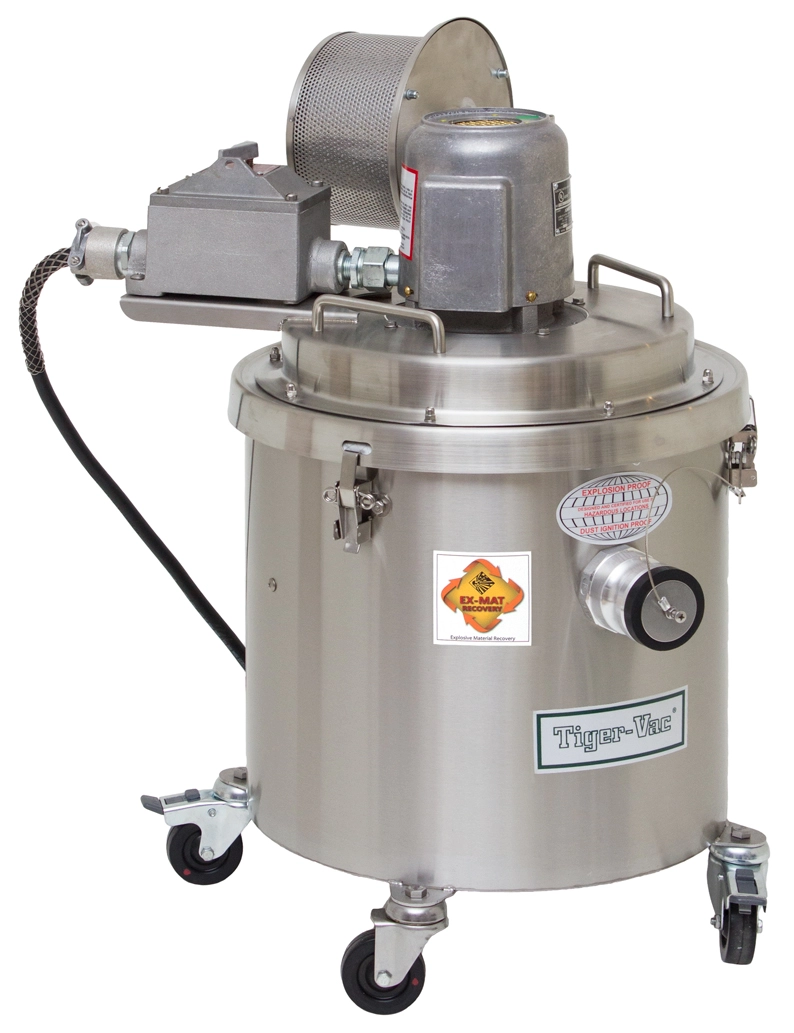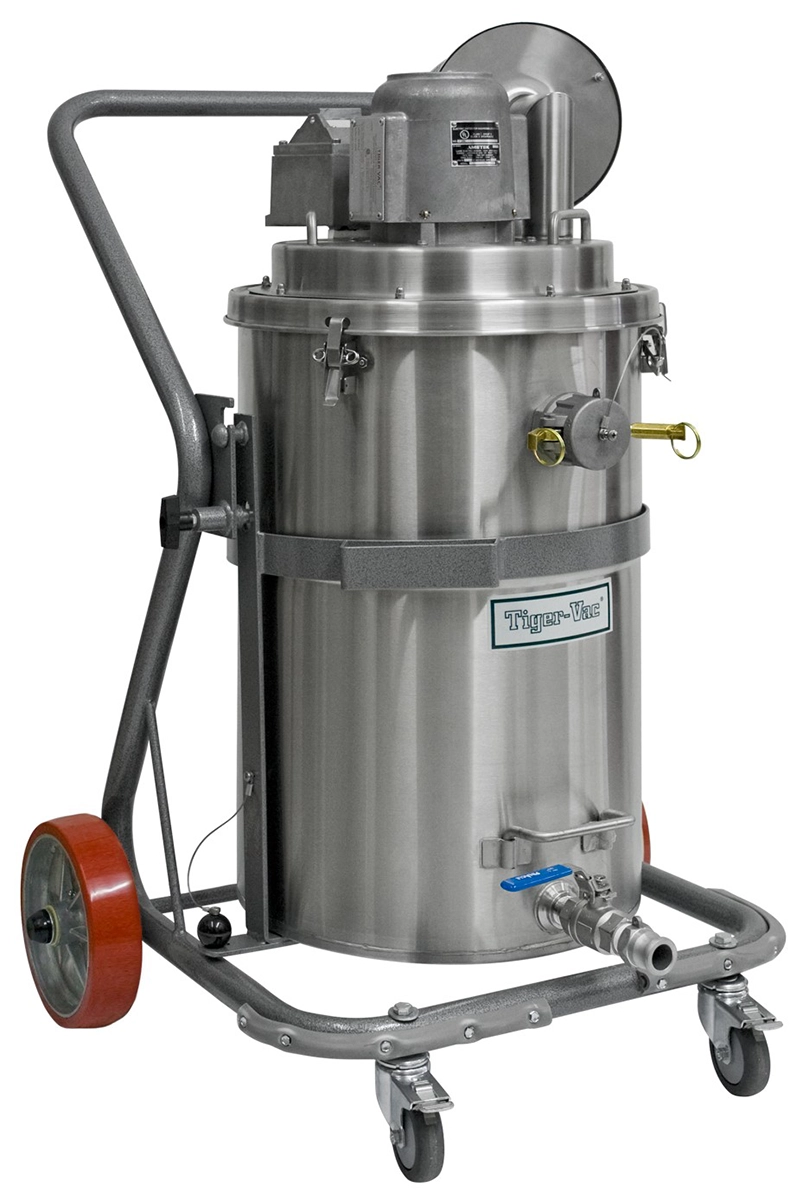
EXP1-10 (4W) RE HEPA (MRAC)
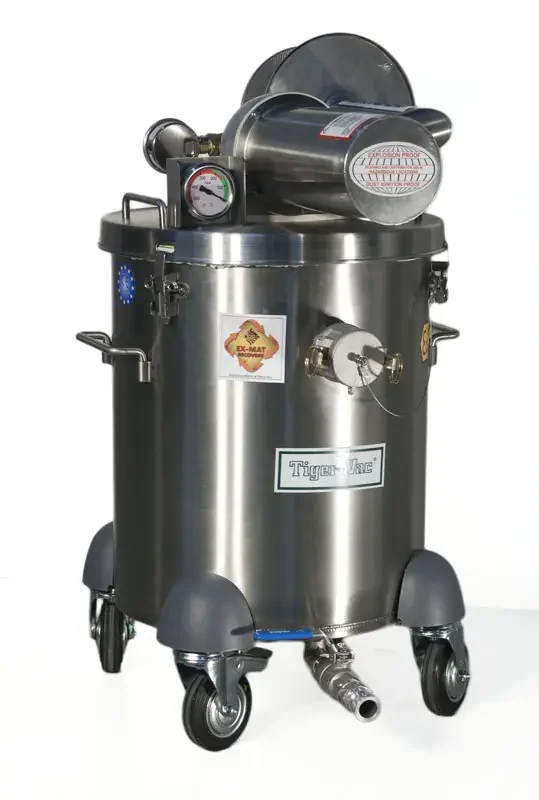
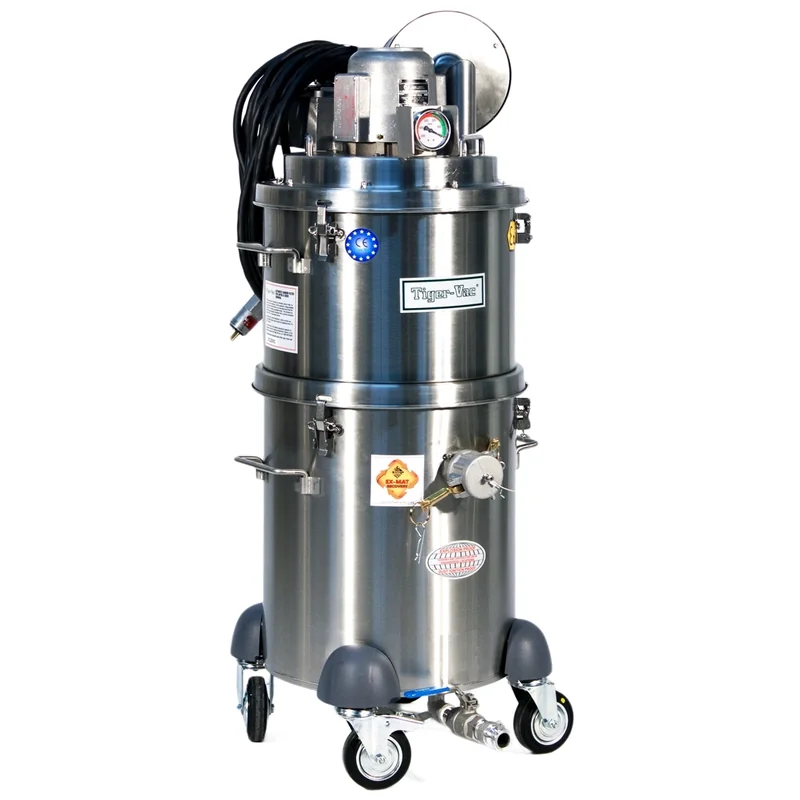
For sites with 230 V. Explosion-proof motor, the higher airflow of the two and the lighter machine.
An ordinary ATEX vacuum captures the dust, but the solvent vapours pass straight through the filter and are blown back into the room. Tiger-Vac EXP1-10 and SS-10 have activated carbon that binds the vapours before the air is exhausted through HEPA H14. They collect wet and dry, they are marked for Zone 1 and 21, they handle gases and dust particles, and you choose: power or compressed air.
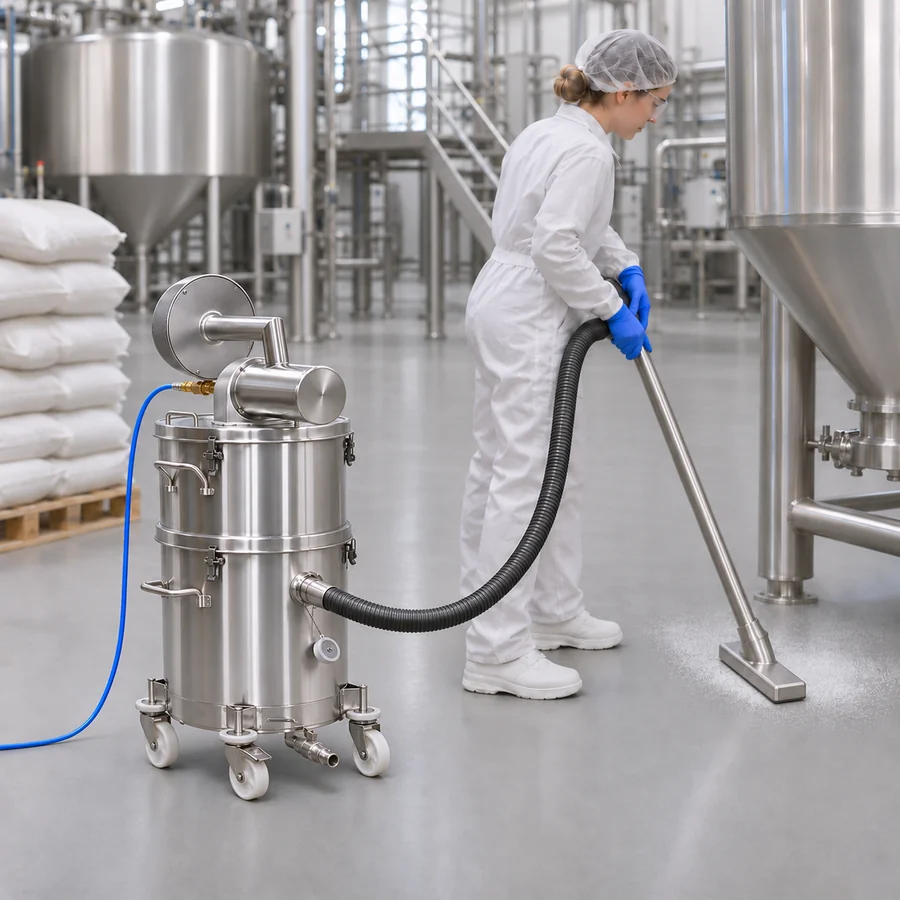
AI-generatedSugar and other fine powders settle in the filter, and soon the machine stops pulling. SS-10 has about three times the vacuum of the electric EXP1-10 and therefore far more reserve.
Without activated carbon the vacuum blows the solvent vapours straight back into the room. Here a ring of activated carbon binds them before the air leaves.
An electric machine in Zone 1 needs an approved connection. SS-10 runs on compressed air alone, without a single electrical part and with temperature class T6.
An international ingredients manufacturer in Denmark needed to clean an area classified as Zone 1 and 21. The dust was fine sugar, and methanol vapours could be present. The team had bad experiences with vacuums that quickly lost suction on the fine dust.
“Do we need activated carbon? And will the suction hold?”
Those were the customer's two questions. We took the vapours to the manufacturer's compliance department, which recommended activated carbon, because it is the carbon that holds the methanol vapours back. The customer measures the concentration and sets when the carbon is changed.
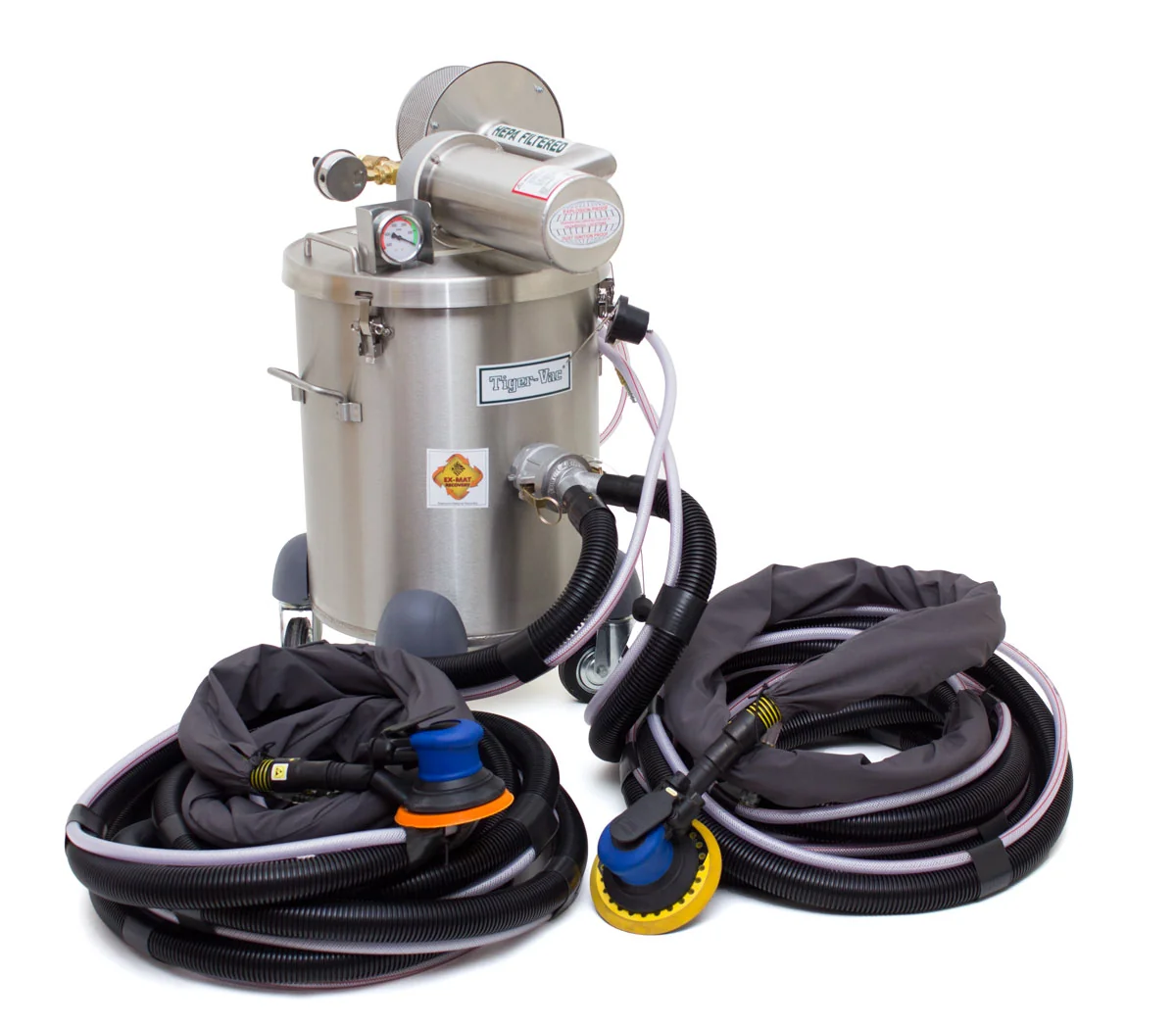
We offered both models side by side. After an internal meeting the customer chose SS-10 on compressed air with about three times the vacuum. The package is put together with a 7.5 m hose, static-conductive nozzles and a stainless steel wand, plus filters, carbon cartridges and conductive bags for the first six months.
At a pharmaceutical manufacturer the task was spills of 70 % ethanol, about 5 litres at a time. There was no specification, so we sized for Zone 1 and 21 and sent the manual, declaration of conformity and ATEX certificate in Danish with the quote, so the ATEX manager could approve the machine from the start. Here we offered EXP1-10 in the version without carbon.
AI-generatedActivated carbon sits between the container and the motor head and binds toxic and corrosive vapours before the air reaches HEPA H14.
SS-10 pulls 448 mbar. That gives reserve when fine powder starts to settle in the filter.
Built to EN 17348 DT/LC for combustible dust and flammable liquids: 22.7 L of dust or 28.5 L of liquid.
Same housing, container and filters. Choose EXP1-10 on 230 V or SS-10 on compressed air to suit what you have in the zone.
Stainless steel AISI 304 and conductive accessories. On SS-10 the resistance to earth is below 10 ohm through the whole chain, including wheels, hose and tools.
ATEX certificate from LCIE on both and IECEx on SS-10. We send the certificate before you order, so it can be approved internally.
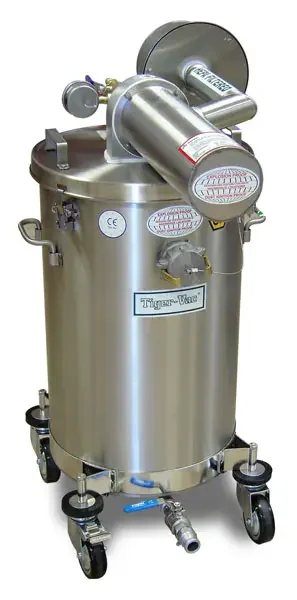
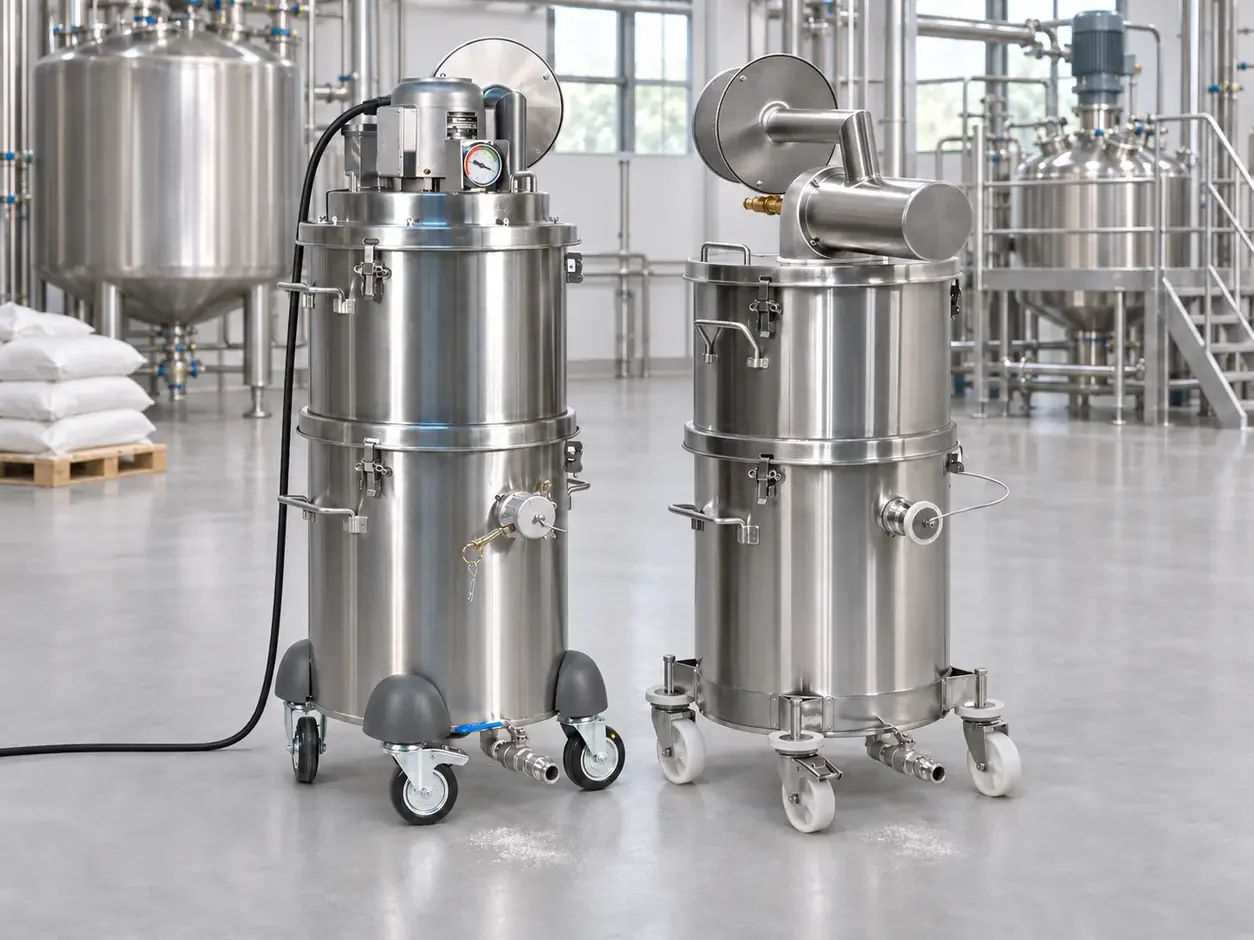
The two machines share the same container, the same activated carbon ring and the same HEPA H14, and both may be used in Zone 1 for gas and Zone 21 for dust. The difference is what drives the suction.

For sites with 230 V. Explosion-proof motor, the higher airflow of the two and the lighter machine.

For sites with compressed air, or where power in the zone is a problem. No electrical parts, temperature class T6 and about three times the vacuum.
Suction holds even on fine powder, and wet and dry go into the same machine. We are happy to propose a maintenance programme.
II 2GD, EN 17348 DT/LC and a certificate from LCIE. The vapours are bound in carbon instead of being blown back into the room.
Compact, easy to move and ready to use with 230 V or compressed air. One contact from the first question to delivery.
We answer all your questions, and where there is any doubt, we verify it with Tiger-Vac's compliance department.
Same housing, container and filters. They differ in drive, temperature class and performance.
| Specification | EXP1-10 (4W) RE HEPA (MRAC) | SS-10 (4W) RE HEPA (MRAC) |
|---|---|---|
| ATEX marking | II 2GD Ex d IIA T3 Gb / Ex t IIIC T200 °C Db IP6X | II 2GD Ex h IIC T6 Gb / Ex h IIIC T85 °C Db |
| Certificate | LCIE 03 ATEX 6297 | LCIE 03 ATEX 6310 X · IECEx LCIE 17.0076 X |
| Zone | Gas Zone 1 and dust Zone 21, external | Gas Zone 1 and dust Zone 21, external |
| Gas group | IIA | IIC (also covers IIA and IIB) |
| Ambient temperature | -5 °C to +37 °C | -4 °C to +37 °C |
| Standard | EN 17348 DT/LC | EN 17348 DT/LC |
| Drive | Explosion-proof single-phase motor, 1.0 kW, 4.5 A | Compressed air through one 6 mm venturi, no electrical parts |
| Supply | 230 V, 50 Hz, single-phase, 15 m cable without plug | 21.2 L/s at 5.5 bar, compressor of at least 15 HP, 1/2" connection |
| Temperature class | T3, max. 200 °C | T6, max. 85 °C |
| Airflow | 224 m³/h | 204 m³/h |
| Vacuum | 152 mbar (1,550 mmH₂O) | 448 mbar (4,570 mmH₂O) |
| Filtration | Cloth main filter, activated carbon (MRAC) and HEPA H14 | Cloth main filter, activated carbon (MRAC) and HEPA H14 |
| Container | 22.7 L dust / 28.5 L liquid | 22.7 L dust / 28.5 L liquid |
| Material | Stainless steel AISI 304 | Stainless steel AISI 304 |
| Inlet | Ø 38 mm | Ø 38 mm |
| Sound pressure | 79 dB(A) | 79 dB(A) |
| Dimensions and weight | 480 × 460 × 1190 mm, 37 kg | 460 × 460 × 1120 mm, 43 kg |
Tell us what needs to be collected, which vapours may be present, and whether you have power or compressed air in the zone.
Already know which model you want? Choose it in the form. If you are unsure, describe the dust, the liquid and the vapours, and we will help you clarify what you need.
Technical advice: We help you choose the right industrial vacuum cleaner based on dust type, vapours, application and ATEX requirements.
Fast answers: We usually answer e-mails within 30 minutes, and we are ready on the phone.
Price and delivery: You get the price and the current delivery time in our quote.
Specialists: We have worked with ATEX since 1991.
Thomas Lyngskjold
+45 20 22 82 72 · thl@particulair.com
Particulair · Højtoften 12 · DK-2690 Karlslunde · Denmark
ATEX suitability must always be assessed against the specific zone and the product documentation.
If both combustible dust and flammable vapours may be present, the vacuum must be marked for both. EXP1-10 and SS-10 are category 2GD and built to EN 17348 DT/LC, that is for combustible dust and flammable liquids.
The activated carbon binds the vapours, but how long a fill lasts depends on the substance and the concentration. You set the change interval from your own measurements, and we are happy to help you plan it.
Ask us about the documentation →II 2GD means category 2 for both gas and dust. The machine may be used in Zone 1 for gas and Zone 21 for dust.
The harmonised standard for vacuum cleaners in explosive atmospheres. DT is dry collection, LC is flammable liquids.
A ring of activated carbon (MRAC) sits between the container and the motor head and binds toxic and corrosive vapours before the air reaches the HEPA H14 filter.
SS-10 runs on compressed air alone and has temperature class T6, max. 85 °C. It is the answer when a T3-rated electric machine is not enough.
An explosion-proof industrial vacuum with activated carbon and a HEPA 14 filter is used wherever dust or liquid has to be picked up in ATEX zones and flammable or toxic vapours may be present in the air at the same time.
Powder that may give off solvent vapours, e.g. sugar with methanol, in GMP and food production.
Cleaning at solvent plants, filling stations and mixing tanks where VOC vapours are present in the air.
Clean-up after spills of flammable liquids and solvents with an ATEX certified wet/dry vacuum.
Emptying and bottom cleaning of IBC tanks, drums and process vessels with a pneumatic ATEX vacuum without electrical parts.
The carbon cartridge is chosen to suit the task. For solvents and VOCs the regular activated carbon cartridge is used. Reactive metal dust such as aluminium and titanium requires an inert solution, see Inert vs ATEX.
Then an ATEX vacuum for dust is often enough, for example Tiger-Vac C-10 EX (4W) for Zone 22 with Zone 20 inside the container.
These two are only a small part of our range. We work with more than 160 ATEX models for gas Zone 1 and 2 and dust Zone 21 and 22 and more than 20 ACD models, both mobile and stationary. Technical advice: we help you choose the right industrial vacuum based on dust type, application and ATEX requirements.
They share the same housing, container, carbon ring and HEPA H14. EXP1-10 has an explosion-proof 230 V electric motor and temperature class T3. SS-10 runs on compressed air, has no electrical parts and temperature class T6. SS-10 gives about three times the vacuum, while EXP1-10 moves slightly more air.
A ring of activated carbon (MRAC) sits between the container and the motor head. It binds toxic and corrosive vapours from the working air before the air reaches the HEPA filter and is exhausted.
It depends on the substance and on how high the concentration is. You therefore set the change interval yourself from your own measurements. We are happy to help you plan it, and we supply carbon cartridges for the changes.
Yes. Both are built to EN 17348 DT/LC for combustible dust and flammable liquids. The container holds 22.7 L of dust or 28.5 L of liquid. Dust and liquid are collected separately, not as a mixture.
Yes. A conductive plastic bag (poly liner) is placed in the container before use. When it is full, it is closed and disposed of without anyone coming into contact with the dust. The bag is static-conductive, so it does not build up charge while it is handled.
The machines have a Ø38 mm inlet. For them we supply static-conductive nozzles, brushes and floor tools in antistatic NBR and stainless steel wands. See the accessories at VACE, or ask us and we will put together a kit for your task.
SS-10 uses 21.2 L/s (1,272 Nl/min) at 5.5 bar and needs a compressor of at least 15 HP. The connection is 1/2".
No. We work with more than 160 ATEX vacuums for gas Zone 1 and 2 and dust Zone 21 and 22, both mobile and stationary. See all Ex-Vac products or ask us for advice.
II 2GD means category 2 for both gas and dust. The machine may be used where an explosive atmosphere can occasionally occur in normal operation, that is externally in Zone 1 for gas and Zone 21 for dust. Category 2 does not cover Zone 0 and 20 inside the machine.
The temperature class states how hot the surface of the machine can get at most. It must be below the ignition temperature of the gases and vapours that may be present in the zone. T3 is max. 200 °C, T6 max. 85 °C.
Yes. Besides the regular carbon cartridge there are cartridges for mercury vapour, for chloride vapours and for arsine and phosphine. They fit both machines, and the cartridge is chosen to suit the task. Ask us if your vapours need something special.
Yes. Both machines have HEPA H14 as standard: 99.995 % at 0.3 µm, H14 to EN 1822. Every machine is leak tested at the factory before it ships.
EN 17348:2022 is the harmonised standard for vacuum cleaners used in explosive atmospheres. DT means dry collection, LC means flammable liquids. EXP1-10 and SS-10 are built to EN 17348 DT/LC and can therefore handle both.
160+ ATEX vacuum cleaners for gas Zones 1 and 2 and dust Zones 21 and 22, mobile and stationary
See all models →
Tell us what needs to be collected and which vapours may be present. Then you get a quote for the model that fits. We have just helped an ingredients manufacturer with exactly that task.